People, Places, Things: The Year in Stories
Stop and tell me if this plot sounds familiar. You wake up to the alarm clock on New Year’s Day 2022 and think, “What a godawful year we just went through. Thank heaven it’s over — things can only get better!” And then you remember waking up to the alarm clock on New Year’s Day 2021 and thinking exactly the same thing.
Welcome to “Groundhog Day.” My mantra for the coming year is, “Don’t drive angry!”
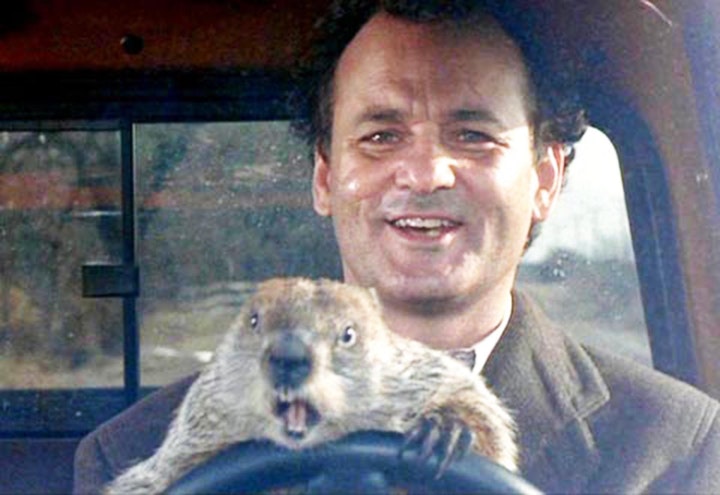
I never really appreciated Bill Murray’s character in “Groundhog Day” until 2021. He realizes he’s stuck in an existential hamster wheel, but in his escape he finds his way to becoming a better human being, as opposed to spending eternity driving recklessly in the company of a large rodent. Hidden there somewhere is a metaphor, I’m sure, but you’ll have to figure it out on your own. I’m just not that profound.
I won’t lie and say that the last couple of years haven’t taken their toll on my psyche. I’m an optimist by nature — it’s a part of my faith tradition — but in 2021 I was moving beyond “glass half full/glass half empty” and into the vicinity of, “Who the hell peed in my glass?”
What saved me from abject cynicism is that I write stories for Meyer Sign. It’s a wonderful arrangement, really. I write whatever I please and they pay me for it. True, I’m engaged in what is known in the trade as “content marketing,” but I have the freedom to choose that content — and thanks to my “patron,” Meyer Sign owner Ken Hitt, I have the privilege of hosting it on the company’s media platforms. If I haven’t mentioned this before, I’ve got the world’s best job.
While the vetting process for the stories we tell might seen arbitrarily self-indulgent, there is some thematic coherence to them: for the most part, they are the stories of people, places, and things associated with the Skagit Valley and its environs. Some of them are as immediate as last week. Many are inspired by the past, and the lessons they might teach us regarding the future. As often as not, however, they are simply bits of local whimsy that serve no other purpose than to put a smile on someone’s face — and perhaps a little more love in their heart for their neighbors.
In looking back at what the method to our madness produced by way of the stories we told in 2021, it seemed to me that “People, Places, Things” was a crackerjack of a theme. Although it might at first glance seem like a straightforward organizational approach, the reality is that those three categories are often very much intertwined. But fools rush in, as they say…so pour yourself another cup of joe, add the last of the egg nog to it, and take a little trip down memory lane with me.
People
We told some stories last year about Magic Skagit businesses that were actually stories about the people who created them. We learned about the Rozemas, a family of Dutch origin who are in their third generation of building custom boats for commercial and recreational purposes (in the interest of full disclosure, my daughter married into the family, and we’ve gotten two wonderful grandkids out of the deal as well as the best son-in-law you could ask for).
We met the 1987 Sedro-Woolley High School graduate whose father “gave him the car bug,” and who now owns a local automobile dealership with a sweet spot for gently owned rigs and a knack for finding them through the auction markets.
As was the case with the origin story of Rozema Boat Works, the majority of our “people stories” were immigrant narratives as well. There was the story of Viry Delgado, whose journey from “the heart of Mexico” to the Magic Skagit resulted, with the help of family, in a much loved restaurant known in Mount Vernon and La Conner as COA. Another immigrant story was that of German-born Henry Klein, who founded Mount Vernon’s first full-service architectural firm and whose projects have helped shape the design esthetics of our Pacific Northwest. We probed the mystery of another German immigrant whose secret garden survives in downtown Mount Vernon, and we met a Swedish immigrant whose gift to the Magic Skagit was to instill the love of music in generations of its inhabitants.
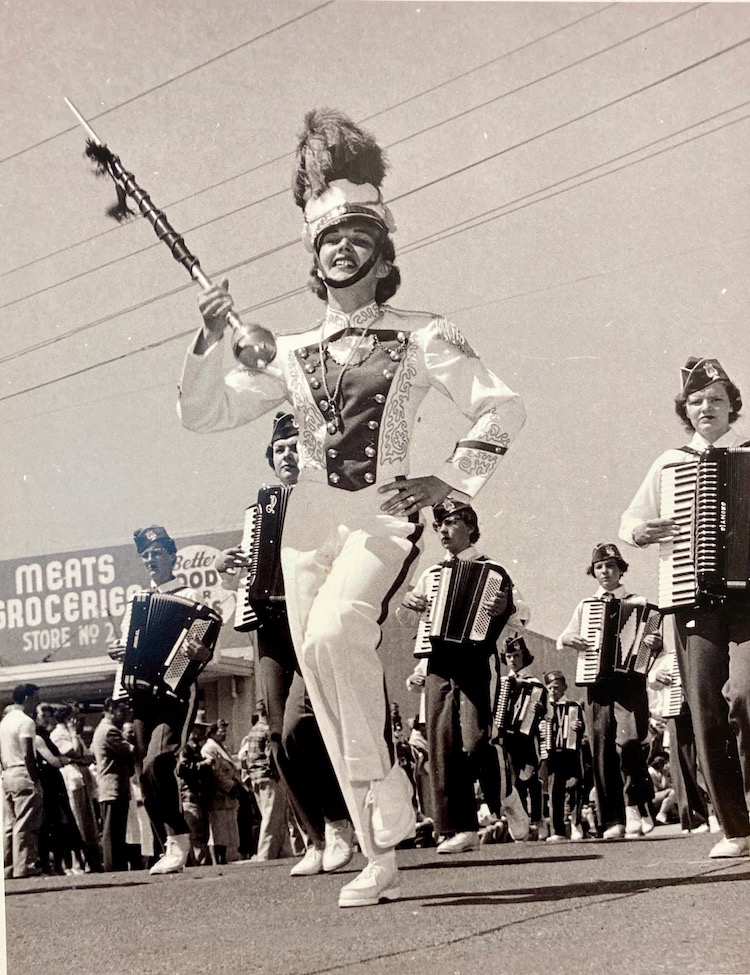
The latter story, that of Hugo Helmer, was inspired by a 2021 exhibit at the Skagit County Historical Museum — which was also the source of the story we published about Mary Stewart, a latter day pioneer who settled on Samish Island and who helped establish the Skagit Valley’s tulip industry. We thank the museum as well for hosting the exhibit on Henry Klein.
We met some folks in 2021 who were the embodiments of the exhortation, “do what you love and love what you do.” There were the small town Washington sister and brother entrepreneurs who transformed what had previously been a Seattle hobby shop into a manufacturer of leading edge carbon composites that found their way into the landing gear of the first unmanned helicopter to fly above the surface of Mars. Seriously, you can’t make this stuff up.

Speaking of family affairs, we also wrote about the husband and wife who dropped out of corporate America and turned their love of wine into a brand that claims the title of “official wine of the Skagit Valley Tulip Festival.” Another tale of personal-obsession-turned-business-model was that of Brandan Sawyer, whose culinary mission is to bring “competition style BBQ” to the Magic Skagit. Bless you, Brandan!
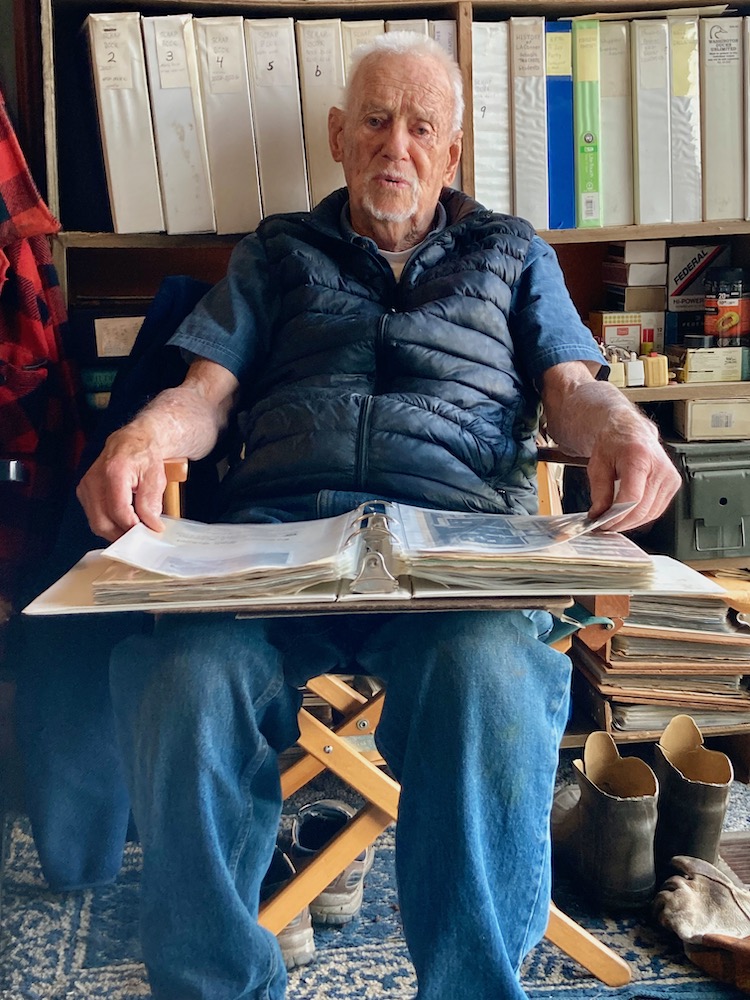
One of our most popular “people stories” was that of Bruce McCormick (aka, “Honker”) — a living link to the Skagit Valley’s pioneer past whose home on the farmlands of McClean Road is a repository of local history, waterfowl of all sorts, and collections of caps and shotgun shells that deserve entry into the Guinness Book of World Records.
Among those whose lives and gifts we celebrated were two to whom we bade farewell. At the beginning of the year we noted the passing of Neil Hall — a celebrated Skagit Valley bon vivant and one of the best friends a tree ever had. And on Labor Day of last year came one of the most profound losses that Meyer Sign has ever experienced — the passing of our revered co-worker and beloved friend, the inestimable Gregg Collins.
Places
Owing to a case of congenital wanderlust, some of my favorite stories have been about places — and once again, many of these stories are also of the people whose lives gave those places their significance to our shared history as Skagitonians. The very first of last year’s “Tales From the Magic Skagit” series was a walking tour and retrospective of Northern State Hospital. We also took some great little day trips that included Newhalem and the illuminated gardens of Seattle City Light; the crypt of its creators, superintendent J.D. Ross and his wife Alice; and a visit to a reptile zoo in nearby Monroe. Going a bit further afield, we brought you the stories of the lighthouse at Admiralty Head and a veritable Disneyland for coffee lovers in the heart of the Emerald City, where people know a thing or two about a good cup of java.

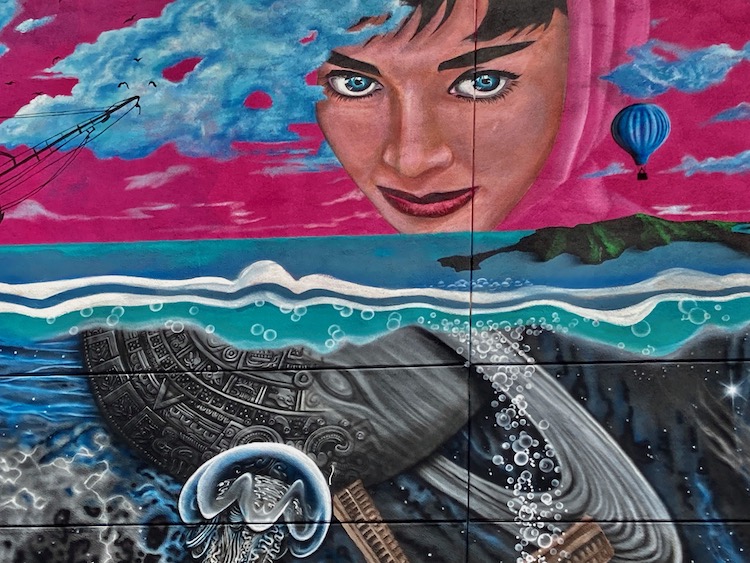
The places we visited also included those enchanted portals through time that we otherwise refer to as “museums.” We wrote about the history of the Skagit County Historical Museum, as seen through the eyes of its director, Jo Wolfe, and about the Skagit Valley’s newest museum and its connection with the Apollo 8 mission, the Heritage Flight Museum. We also shared historical tidbits connected with a Skagit River log jam of biblical proportion and the pioneers who cleared it; the historical link between a local food co-op and an enigmatic fraternal organization; the last vestiges of what were once known as “stump farms;” and a downtown mural that forms a collage of Magic Skagit themes.
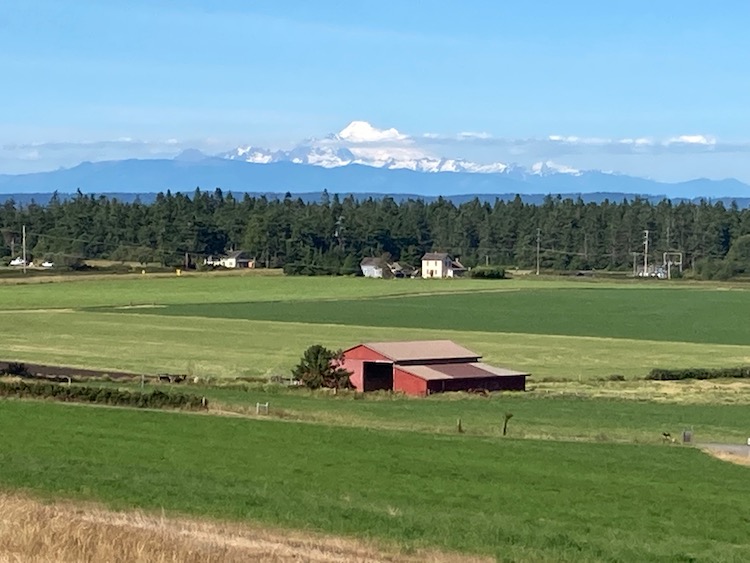
Of all of our place related stories, however, my favorite was a historical vignette set in a spot on Whidbey Island that I think of as one of my “spirit places”: Ebey’s Prairie. As much as its story is a geological one, inspired by the beauty of its landscape, it is equally imbued with the hauntingly tragic narrative of the Ebey Family. It warmed this writer’s heart that so many of our Meyer Sign readership enjoyed it as well. One of my new year’s resolutions, by the way, is to write more tales like this — and I’m pleased to say there are already a number of them on the editorial agenda in the weeks ahead. I’ll have more to say about this later, so don’t touch that dial.
Things
Along with raindrops on roses and whiskers on kittens, my favorite things include good food and communal celebrations. In thinking of celebratory events as “things,” there isn’t a “thing” more associated with the identity of the Magic Skagit than our annual Tulip Festival. While our iconic flowers were impervious to a novel virus, us humans sadly were not. As a result, the festival took a 2020 hiatus, but came roaring back in 2021. Out of sheer gratitude, we devoted several stories to the event, including a look at the artist who created the 2021 Tulip Festival poster, a tribute to Mount Vernon’s iconic Tulip Tower, and a couple of tulip histories on how the Skagit Valley’s beloved blooms brought about the demise of a Turkish sultan and the crash of the 17th century Dutch economy. Who knew, right? And while we’re on the subject of Magic Skagit flora, we also published a sequel to a very popular 2020 story about Mount Vernon’s majestic tulip poplar tree that is sure to give our local arborists something to brag about.
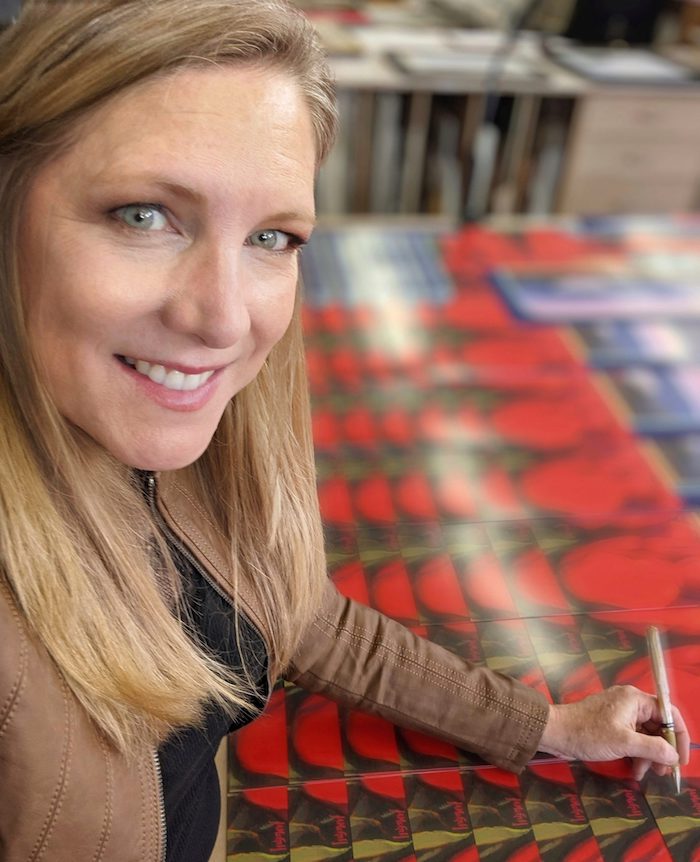
Even if you only know me through my stories, you know that I like food. I’m pretty sure I’m the guy the “see food diet” joke was based on — I see food…I eat it. All kinds. I love the adventure of it above the imperatives of sheer gluttony. I would also describe myself as a culinary hedonist, and I think that a good many of us enjoy living vicariously through a good food story. Along with our stories about Brandan Swayer of Brando’s BBQ fame, the wines of Pasek Cellars, and the origins of COA, we published a collection of favorite culinary tales, mourned the loss of a food favorite, pondered the complexity of coffee, and introduced you to a new place to get a sandwich.

As was the case in 2020, last year’s public health situation curtailed my wife’s and my dining options outside our home kitchen to primarily take out from a few tried and true favorites. Our hope this January 2022 is to experience more places to eat…which was our exact same hope back in January 2021. Again, welcome to “Groundhog Day.”
Meyer Sign follows the marketing maxim that the best way to promote your success is to promote the success of your customers. People will invariably connect the dots. That said, there were three stories that we published last year that illustrated one of my favorite sayings, “it ain’t braggin’ if you done it.” Or as my 9 year old grandson once put it, “You know you’re awesome when people think you’re bragging and you’re just telling them what you did.” Among our bragging rights from 2021, one had to do with a technical achievement, another concerned a good deed, and the third was an aspirational goal that will shape the stories we tell for years to come.
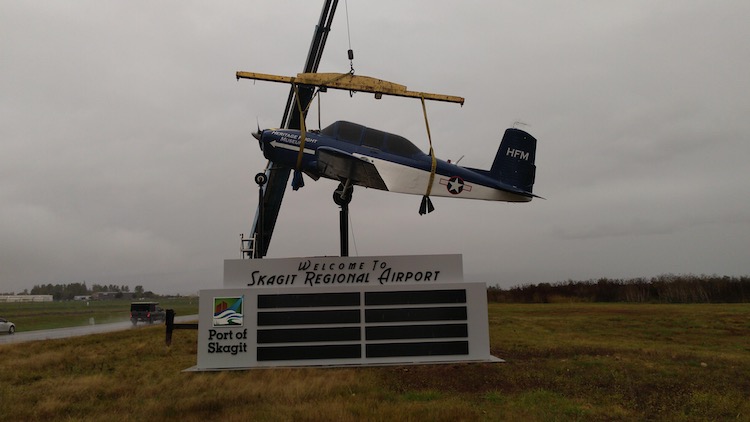
At the end of last September, in the midst of some mighty contrary weather, Meyer Sign installed a monument sign marking the entrance to Skagit Regional Airport and the location of Heritage Flight Museum. This was a project notable not only in terms of the engineering challenges it posed, but because of the collaboration between Skagit County, Port of Skagit, the airport, and Heritage Flight Museum that took it from concept to reality.
Right around Thanksgiving, Meyer Sign had a unique opportunity to express our gratitude for our Skagit Valley home through our participation in Skagit Publishing’s first time annual guide to local charities — a project that not only encouraged understanding and support of their various missions, but helped foster greater community engagement. We chose to support Underground Ministries, an innovative program that partners with faith groups throughout the Skagit Valley to “roll away the stone” for incarcerated individuals who are releasing back into the communities they offended. In the process, we were proud to have been able to introduce our readers to Chris Hoke, Underground Ministries’ founder.
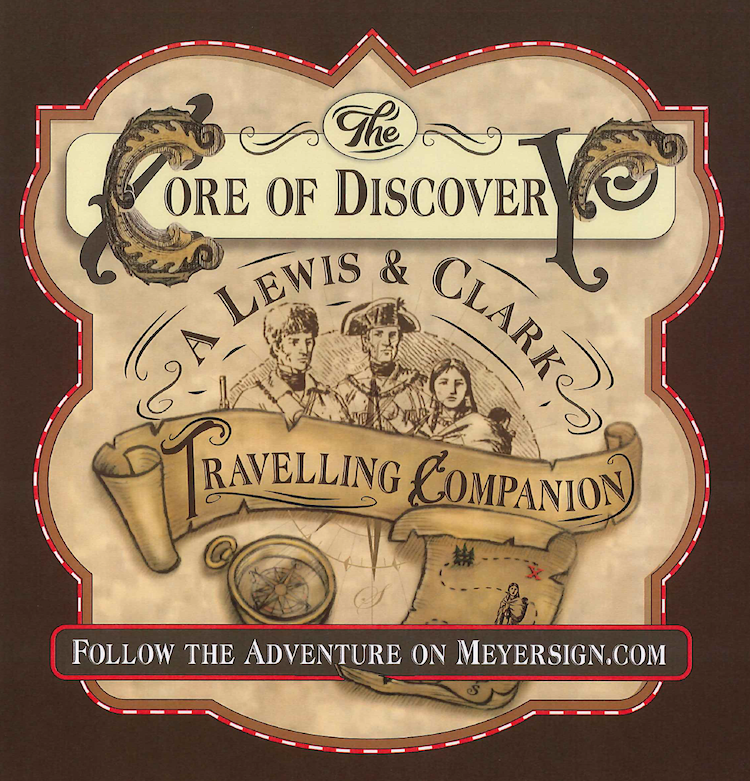
Finally, we told you about Meyer Sign’s decision to underwrite a new content series devoted to what is arguably the “origin story” of the West — or at least the West of our popular imagining. The series is called “The ‘Core’ of Discovery: A Lewis & Clark Traveling Companion.” If you’ve enjoyed our Tales From the Magic Skagit series, we think you’re going to appreciate this connection with places of the Pacific Northwest and across eleven states that figure in the saga of Lewis & Clark’s expedition in 1804-1806. We look forward to taking you along for the ride.
Looking beyond our new series, we have a backlog of tales we’ll be sharing as we go into this new year. We’ll explore more local history, with the help of our regional museums, and I want our historical lens to look back before the usual 19th century starting point of our historical narrative. This means including the perspectives of peoples that the United States of America encountered as our nation rapidly encompassed their communities. Their’s is a perspective that stretches deep into our past as people who have shaped and been shaped by our Skagit Valley landscapes.
That said, you’ll understand why I want to kick-off our 2022 Tales From the Magic Skagit series with a story about Jay Bowen, a much loved local artist and member of the Upper Skagit Tribe. I recorded an interview with Jay last fall when he graciously invited my wife and I to his home and studio in Shelter Bay, on the land of the Swinomish Nation. I had previously written a story about his role in the creation of what I like to call the Riverwalk Totem Pole, a soaring metal and mixed media sculpture known to Jay, as the person who designed it, as the Valley of Our Spirits.
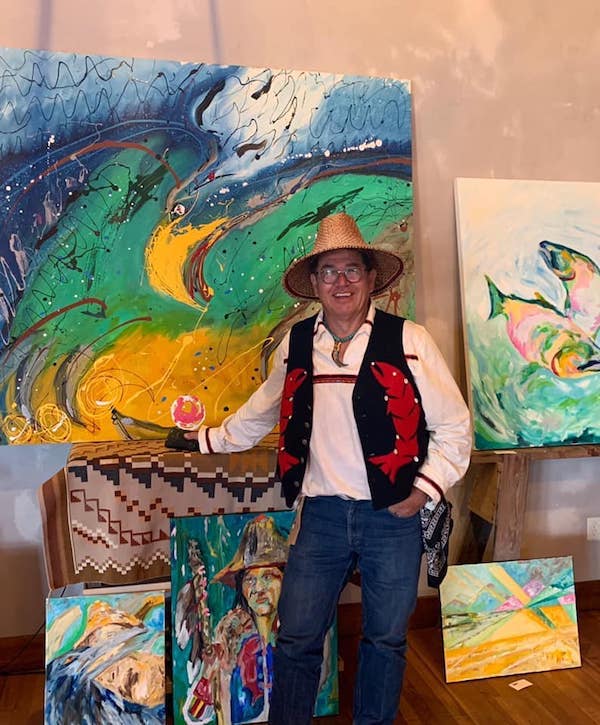
I’m looking forward to future conversations like this one, and to the opportunity to extend our notion of who we are as Skagitonians to a time prior to our last major immigrant wave by listening to the memories of the people who had already been here for millennia.
Thanks for wading through this lengthy retrospective. In return for your time, I hope you’ve come away with a few stories that will resonate with you throughout the coming year. I also want to thank you for being such a wonderful audience. You’ve made me smile, inspired me, piqued my curiosity, and you’ve been more than generous with your appreciation.
Best of all, you’ve shared stories of your own, and our collective stories are how we keep ourselves alive in memory — they are the glue of our continuity. So if you’ll pardon the dreadful pun, thanks for “sticking” with me through the many stories we’ve shared. We’re planning on many more to come, the Good Lord willin’ and the Revetment don’t flood! In the meantime, we at Meyer Sign wish you a very happy new year, and we offer this bit of advice for coping with 2022: Don’t drive angry.