Tales From the Magic Skagit: A Hard Day’s Knight
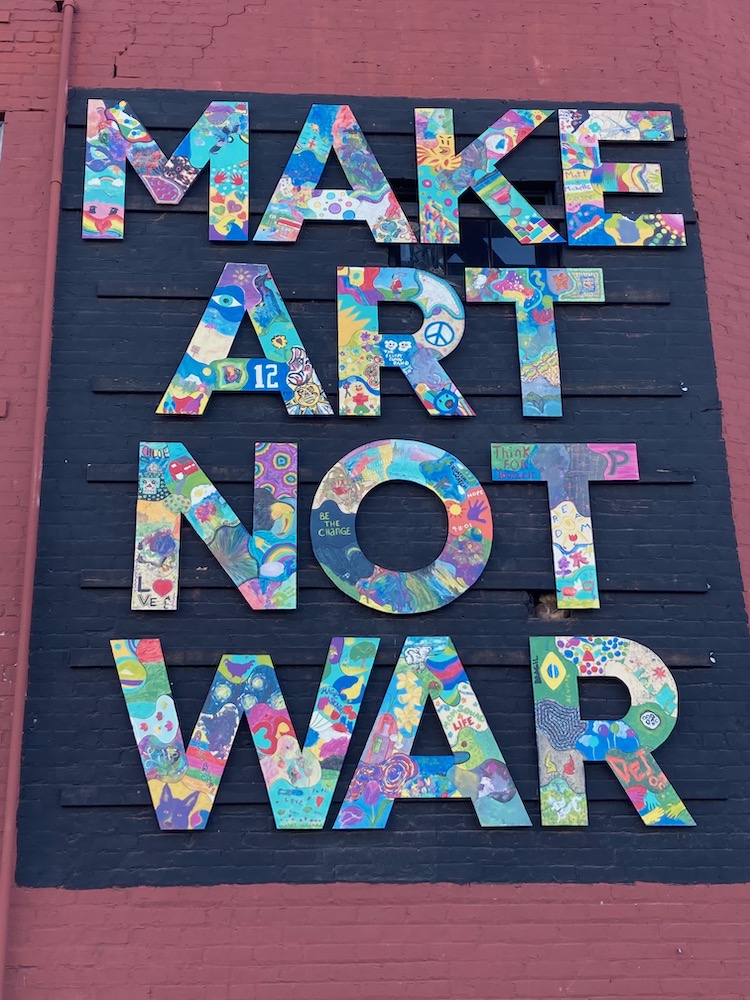
Across the mighty Skagit River on the Division Street Bridge, downtown Mount Vernon greets me eastside with a couple of visual landmarks. The splashier one is the “Make Art Not War” collage that lets you know without a doubt that behind the storefront it graces there are some very creative people with love in their hearts and smiles on their faces. It’s the sort of sign that a retired hippie such as yours truly can’t help but respond to. It just makes me want to commit random acts of kindness and engage in senseless beauty, and for that I thank Tri-Dee-Arts.
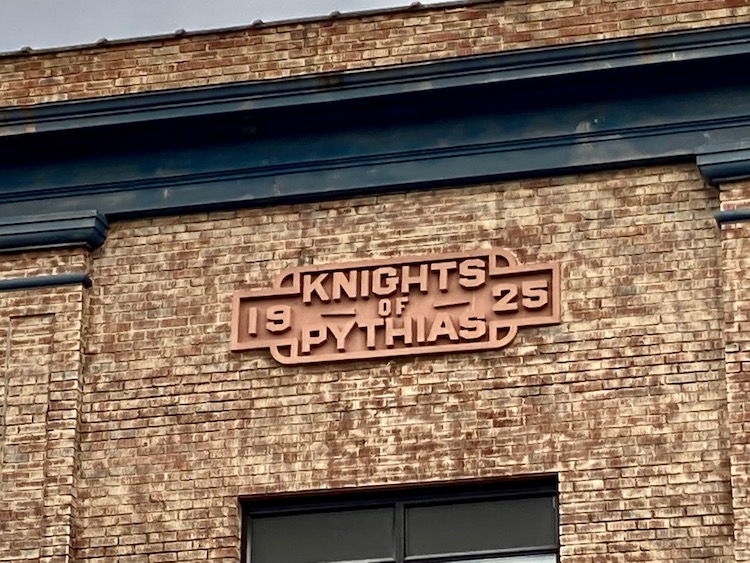
The other visual that catches not only my gaze but my fancy is the masonry tag on the building occupied by the Skagit Valley Food Co-op that identifies the structure as the home, half a century before the Co-op’s founding, of “Knights of Pythias.” For some demented reason, I always imagine Sylvester the Cat of Looney Tunes fame uttering the word “pythias” in the explosive manner of his famous exclamation, “suffering succotash.” And in that moment, as I’m turning right on 1st Street, my next thought is, “Who the hell are the Knights of Pythias…and what does it take to become one.”
To answer this question, which I know has been burning in the minds of our Meyer Sign readers, I turned to that unimpeachable source of all wisdom and knowledge in the known universe — and the research companion I could only have fantasized about as a college undergrad — Wikipedia. God bless crowd sourced history. And while any of you who are reading this (thanks, by the way) could just as easily consult the same source, I’m going to save you the effort through a bit of curation and some cheeky context…because that’s how I roll.
Submitted for your approval, here’s what I learned about the Knights of Pythias, courtesy of Mr. Google. And let me just say at the outset that if I could make this stuff up, I’d be getting some mad screen writing offers from Hollywood.
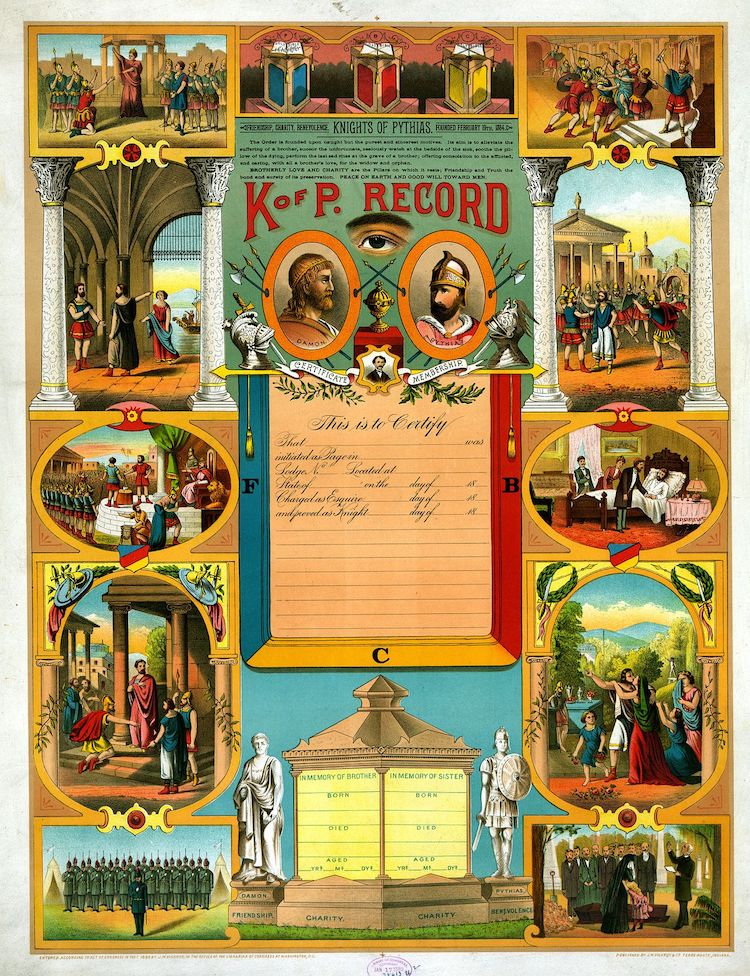
The Knights of Pythias, a “fraternal organization and secret society,” was inspired by the Pythagorean ideal of friendship, as expressed in the Greek legend of Damon and Pythias. As a morality tale, it’s one that bears repeating if you’re looking for something in the “I’d take a bullet for you” category, and it takes place around 400 BC. Damon and Pythias are followers of the Greek philosopher Pythagoras, and while traveling in Syracuse (Greece, not New York) Pythias is accused of plotting against the tyrant Dionysius I.
Tyrants back in the day tended to be a rather thin-skinned lot when it came to conspiratorial behavior (the more things change, right?), and Pythias is sentenced to die. He asks Dionysius to let him go home just long enough to settle his affairs and say his goodbyes — after which he promises to return for the carrying out of his sentence. Dionysius isn’t about to fall for such an obvious ploy, but Damon steps up and offers himself for execution should his friend not fulfill his pledge. If I ever open a bail bond service, I’m going to call it Damon’s.
I’ll let Wikipedia take it from here:
Dionysius was convinced that Pythias would never return, and as the day Pythias promised to return came and went, he called for Damon’s execution — but just as the executioner was about to kill Damon, Pythias returned.
Apologizing to his friend for the delay, Pythias explained that on the passage back to Syracuse, pirates had captured his ship and thrown him overboard, but that he swam to shore and made his way back to Syracuse as quickly as possible, arriving just in time to save his friend. So astonished by and pleased with their friendship, Dionysius pardoned both men. It was also said that the tyrant then sought to become their third friend, but was denied.
Wow. Talk about a cold shot. The secondary moral to this story is that just because you’re an all powerful despot doesn’t mean you automatically get to hang with the cool kids. But I digress.

Fast forward to Washington, D.C. in the year before the Civil War ended. One Justus H. Rathbone attends a play based on the legend of Damon and Pythias, written by the Irish poet John Banim. Overcome by ideals of loyalty, honor, and friendship at such a fraught period in American history, Mr. Rathbone founds a fraternal oder designed to instill these ideals in all who pledge their membership. And talk about a membership pledge…
I declare upon honor that I believe in a Supreme Being, that I am not a professional gambler, or unlawfully engaged in the wholesale or retail sale of intoxicating liquors or narcotics, and that I believe in the maintenance of the order and the upholding of constituted authority in the government in which I live. Moreover, I declare upon honor that I am not a Communist or Fascist; that I do not advocate nor am I a member of any organization that advocates the overthrow of the Government of the Country of which I am a Citizen, by force or violence or other unlawful means; and that I do not seek by force or violence to deny to other persons their rights under the laws of such country.
I’ve honestly never understood the antipathy toward professional gamblers, but it’s pretty clear that unless you could pass muster as an upstanding citizen, you wouldn’t be gracing the hallowed lodges of the Knights of Pythias. There are three ranks in Pythian Knighthood: Page (hopefully not requiring ones hair to be bobbed), Esquire, and Knight. I have to admit that I was lukewarm about joining the order until I learned that, at least in its earlier history, induction into the Knights of Pythias involved the receipt of a ceremonial sword. Like my nine year-old grandson, I believe that nothing says gravitas like a ceremonial sword.
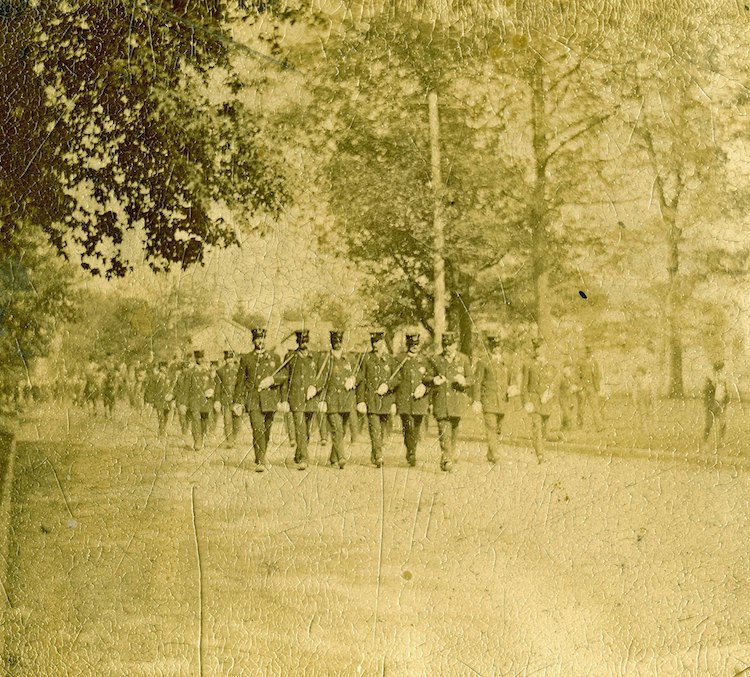
Despite its “fraternal” designation, the Knights created a female auxiliary, the Pythian Sisters, and two youth groups: the Pythian Sunshine Girls and the Junior Order of Princes of Syracuse (again, Greece, not New York — although “Princes of Syracuse” would make a killer title for a Sopranos sequel). At the close of the 19th Century, the Knights of Pythias offered a side degree (perhaps for its more ambitious adherents) called the Dramatic Order of the Knights of Khorassan, along with its associated female auxiliary, the Nomads of Avrudaka.
I feel compelled to interrupt this narrative to point out that Khorassan is a province in Iran. I should know, having lived in Iran for a few years. As they say in Syracuse (New York, not Greece), “go figure.”
In 1877, Knights of Pythias offered an optional rank that included insurance benefits, which probably came in handy with all the marching around with swords that the Knights were prone to engage in along with their philanthropic endeavors. In 1930, the fraternal insurance operation of the Knights spun off into its own mutual life insurance business, American United Insurance Company.
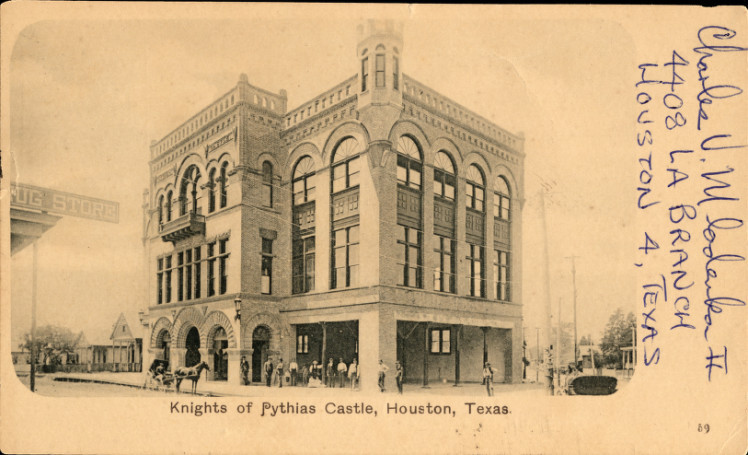
By the early 1920s — a time that Wikipedia refers to as “the end of the so-called Golden Age of Fraternalism,” the order had nearly a million members. By 1979, however, this number had declined to fewer than 200,000. In 2003, there were over 2,000 lodges in the United States and around the world, with a total membership of over 50,000. Although it was founded in Washington, D.C., the order is headquartered in Stoughton, Massachusetts.
Looking at a list of notable Pythian Knights, I have to say I was impressed. The roster includes Supreme Court Justice Hugo Black, William Jennings Bryan, Warren G. Harding, Franklin Roosevelt, Hubert Humphrey, William McKinley, and Nelson Rockefeller. I should also add that Louie Armstrong, Old Satchmo himself, was a Pythian Knight.
There is also a Wikipedia list of “notable Pythian buildings.” In addition to Mount Vernon’s lodge (aka, Skagit Valley Food Co-op), Washington’s entries include a Knights of Pythia building in Bellingham (in Fairhaven, wouldn’t you just know it), and a Pythian Temple in Tacoma, which is on the National Registry of Historic Buildings (NRHP).
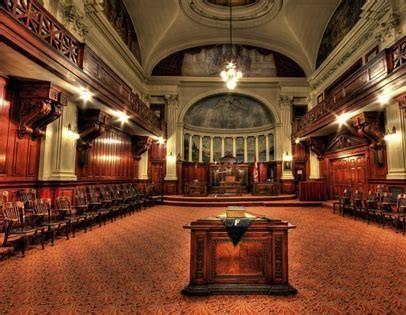
Although I tend to follow Groucho Marx’s philosophy of avoiding any organization that would have me as a member (I do have my standards), there are some very compelling reasons that I would make an exception to this rule with regards to the Knights of Pythias. Again, there are ceremonial swords. And as you might expect with ceremonial swords, there are parades. I’m not talking about carnival bacchanalia here — maybe something more along the lines of a Lutheran version of mardi gras. But along with the philanthropic pursuits that we’ve come to associate with better known fraternal organizations such as Kiwanis and Lions Club, what I find most alluring about Knights of Pythias is the possibility of connecting the dots between an ancient Greek philosopher, a legendary bromance, Syracuse (Greece or New Jersey), the nation’s capital during the Civil War, and Persia. Throw in a secret handshake and you can call me “Page.”