Day Tripping: Exploring the Urban Trails of Vancouver, BC with Craig Romano
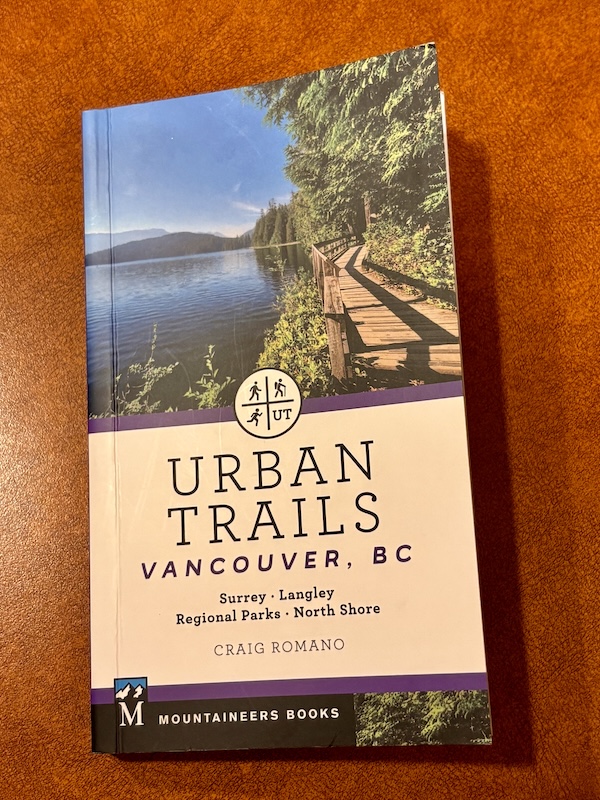
If you’ve lived very long in the Pacific Northwest, and especially if you are fond of hiking the great outdoors, the name Craig Romano may be familiar to you. Romano is the award-winning author of more than 25 books dedicated to running/walking/hiking/biking the Pacific Northwest, including Columbia Highlands: Exploring Washington’s Last Frontier, which was recognized in 2010 by Washington Secretary of State Sam Reed and State Librarian Jan Walsh as a “Washington Reads” book for its contributions to our state’s cultural heritage.
Romano grew up in rural New Hampshire, where he fell in love with the natural world. He moved to Washington in 1989 and has since hiked more than 35,000 miles in Washington and British Columbia. That’s a lot of worn out sneakers. As an avid runner, he has competed in more than 100 half-marathons as well as 40 marathons and ultra runs, including the Boston Marathon and the Cuyamaca 100K Endurance Run. Having run some marathons and half-marathons myself, I appreciate the dedication, not to mention perspiration, that goes into these accomplishments.
A visit to the website craigromano.com will connect you with Romano’s series of day hiking and backpacking guides, including Hiking Washington’s History, which he co-authored with Judy Bentley in the Cascadia Daily News. Romano has also authored a series of “urban trail” guides, the latest of which represents his first written foray outside the PNW: Urban Trails Vancouver, BC. My wife and I recently attended a talk he gave at the Burlington Library (kudos to Vince Richardson at the Skagit Valley Herald for the tip off), during which he gave a slideshow overview of all 55 destinations covered in his book. I should note that Romano was fresh off his completion of the Red Rock Canyon Marathon outside Las Vegas — his 12th marathon in a quest to run a marathon or ultra marathon in all 50 states. The man is a beast.
Having grown up in an urban setting with notable green spaces (San Francisco), I share Romano’s fascination with the juxtaposition of manmade and natural wonders — tall trees within sight of tall buildings. And it was clear from Romano’s presentation in Burlington, as well as from his book (I now have a signed copy), how much he loves Vancouver, BC.
And what’s not to love? Assuming you have either a passport or an enhanced driver’s license, Vancouver is arguably more accessible to Skagit Valley residents than is our metropolis to the south — and I’d much rather drive north on I-5 than in the opposite direction, if you know what I mean. Another thing Vancouver has going for it is its mass transit system, which means you can actually leave your car at home and still take advantage of the day hikes that Romano details in his handy pocket guide (which includes not only maps but transit links). And if you’re planning to spend more than a day exploring the guidebook’s destinations, Romano highly recommends finding more economical lodging outside the Metro Vancouver Regional District (MVRD), and where many of the trails in his book are situated — all of which can be reached via public transportation.
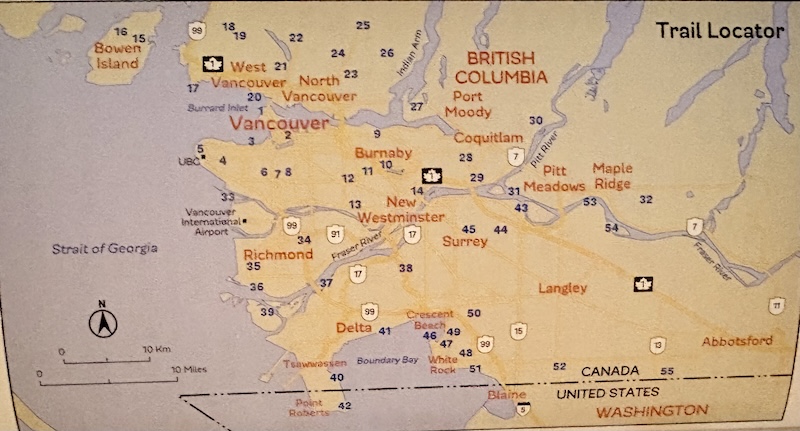
Urban Trails Vancouver BC focuses on the myriad of trails, parks, preserves, and greenbelts within the urban and suburban fringe areas of the Metro Vancouver Regional District and the exclave of point Roberts, Washington. The MVRD contains 21 municipalities, including the thriving cities of Surrey, Burnaby, Richmond, Coquitlam, and New Westminster — all equally as diverse and packed with parks and trails as Vancouver. In Romano’s book you’ll find trails to old growth forest, lakeshores, coastal beaches, riverfront, wildlife-rich wetlands, waterfalls, mountaintops, scenic vistas, meadows, historical sites, and vibrant neighborhoods and communities. As Romanon points out, “While we often equate trails with wildernesses and forest areas, plenty of accessible trails and natural beauty are tucked away in population centers as well.” The routes included in his guidebook are designed to show you where you can go for a good run, a long walk, or an invigorating hike right in the heart of Canada’s third largest metropolitan area!
Besides being a handy and comprehensive guide to all things urban trail in Vancouver, Romano’s book is an unabashed love letter to our “neighbors to the north,” as I like to refer to our friends from Beautiful British Columbia. His affection especially shines through in his guidebook intro, which I quote below.
Vancouver, British Columbia is one of the most beautiful vibrant and livable cities not only in North America, but in the world. Situated at the mouth of the Fraser River on the Strait of Georgia and set against a backdrop of steep, craggy mountains, its location alone makes this an exceptional city. With nearly half of its residents born outside of Canada, Vancouver is one of the most culturally and ethnically diverse cities in Canada. With a population exceeding 3 million, the Metropolitan Vancouver area is home to some of the largest Chinese and Indian (particularly Sikh) populations in North America. The area is also home to communities of Japanese, Korean, Southeast Asians, Filipino, Pacific Islanders, Middle Eastern, Persians, First Nations, Latin Americans, Africans, and Europeans of British, Irish, Italian, German, Portuguese, Ukrainian, Romanian, and other ethnicities.
The Vancouver area lies within the traditional lands of ten local First Nations: Katzie, Kwantien, Kwikwetlem, Matsqui, Musqueam, Qayqayt, Semiahmoo, Squamish,Tsawwassen, and Tsleil-Waututh. In 2015, the Metro Vancouver government committed to fostering respect, reconciliation, and mutual understanding with all Indigenous Peoples and communities. Through reconciliation, Metro Vancouver is building and strengthening, respectful and reciprocal relationship relationships with local First Nations, engaging with them meaningfully on plans, programs, and projects. Metro Vancouver is committed to building trust through genuine collaboration, creating a mutually respectful place for meaningful dialogue and outcomes, and creating opportunities for Board-to-Nation relationships to thrive.
Founded on the ancestral lands of the Musqueam, Squamish and Tsleil-Waututh peoples, Vancouver began as a small community called Gastown, established shortly after the Confederation of Canada in 1867, that was centered around a mill and a saloon. It has since grown into one of the world’s great cities. With a population nearing 750,000, Vancouver is Canada‘s eighth largest city, and it’s metropolitan area is the third largest in the country.
Vancouver also has the highest population density in the country (the fourth highest in North America) and is one of the most expensive cities in the world to live in, yet it consistently ranks as one of the most livable cities in the world. It is ethnically and culturally diverse, has an excellent public transportation system, and is teeming with cultural attractions, parks, greenbelts, and an extensive urban trail system. The city’s urban planning places a strong emphasis on aesthetics and view corridors. It is bike-friendly and has one of the largest public waterfronts of any major metropolis. Much of Vancouver’s industrial past has been and continues to be transformed into livable neighborhoods complete with greenbelts and trails.
Owing to its excellent public, transportation system and network of trails, Vancouver is easy to explore on foot. Its beautiful parks, breathtaking natural surroundings, and culturally dynamic neighborhoods make Vancouver one of the finest destinations in the world when it comes to urban hiking, walking and running.
If the above tribute doesn’t make you want to grab your enhanced ID and set your automobile’s compass to Due North, I’m not sure that anything else I could add will be any more persuasive…although I could certainly mention one more lure: the food. There are some amazing restaurants in Vancouver, particularly if you love Asian cuisine. I suspect Vancouver, BC could give Singapore a run for its money when it comes to culinary diversity.
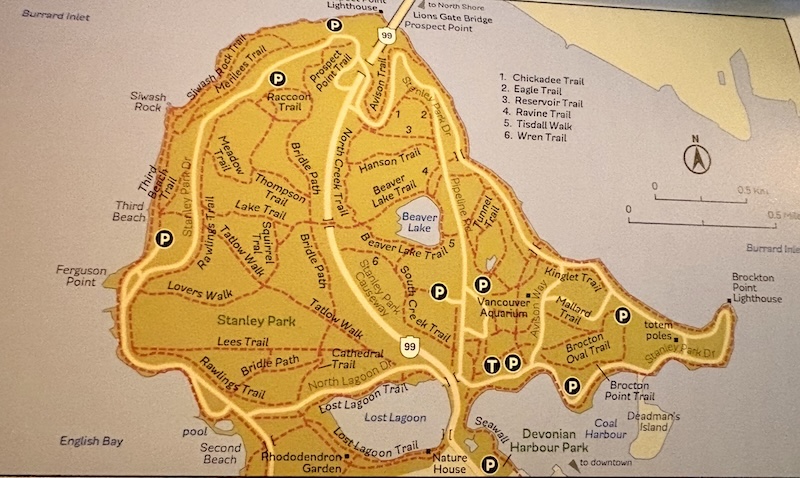
One of my resolutions for 2026 was to spend more time exploring the San Juan Islands. Since I started reading Urban Trails Vancouver, BC, however, I’ve added another: take more day trips to Vancouver with Craig Romano’s book in my rucksack. My wife’s and my first destination will be Stanley Park, with its network of more than 17 miles of trails detailed by Mr. Romano. I’ll let you know what I find, so stay tuned for future “Day Tripping” episodes in Beautiful British Columbia. By the way, Craig’s guide also has some tips on fitting in with the locals, including some Canadian and BC terms and jargon. I’m sure this will come in handy when I’m shelling out loonies at Timmy’s, eh?