Tales From the Magic Skagit: Goodwinds Composites and the Pursuit of Excellence
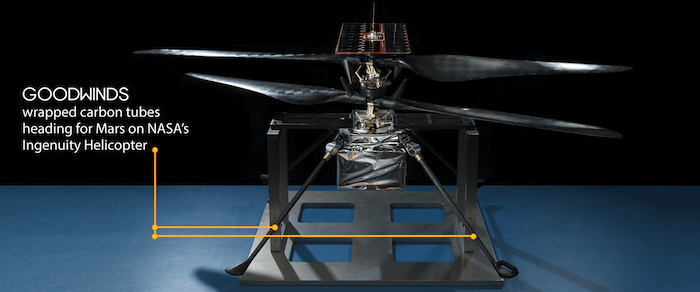
I first heard of the Mount Vernon company known as Goodwinds Composites the same way most other residents of the Magic Skagit did: from a recent article in the Skagit Valley Herald about a local company that was helping NASA with the first unmanned helicopter exploration of Mars. It was a fantastic account of engineering marvels and high tech materials; but if truth is stranger than fiction (and it is), the story of how Goodwinds Composites came into being is even more interesting than its contribution to our knowledge of the red planet.
The story opens on the mouth of the Columbia River, in Ilwaco, Washington. That’s where the owners of Goodwinds Composites — Amelia Cook and her brother Leland Holeman — grew up, in what Amelia described as a place of “rainy Washington winters and a lot of coastal beauty, in a tourist town far from anything.”
Small Town Virtues
In retrospect, Ilwaco seems an unlikely point of origin in the journey to the 2008 founding of a company that occupies a highly specialized niche in the production and machining of carbon composite rods and tubes. But once you know the whole story, it all makes perfect sense. It’s one that is less about the arcane world of composites technology than it is about the “can do” values of small town life and family entrepreneurship. And as hokey as it may sound, it’s also an object lesson in the empowering commitment to excellence as a business model.
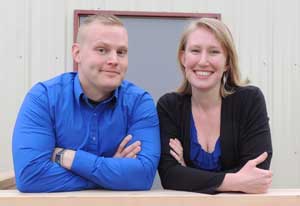
“My brother and I grew up in a small business,” Amelia explained to me in a recent interview. “Our parents owned a 50-room motel, and we grew up working there — from the laundry room to the front desk — as well as volunteering for the various organizations our mom was involved in.”
If you happened to grow up in a small town, you can appreciate that success is a lot about showing up. As Amelia explained, “In a really small town you have the opportunity to do everything…if you want to. We both played sports, we both were in drama, we were in bands, we worked on the newspaper. You get to do everything!”
Amelia and her younger brother shared some similar interests and friends, even as in true sibling fashion, she noted, “we fought like cats and dogs.” But although they pursued different paths in college, “we always hung out with each other and loved each other.” These filial bonds would serve them well when they took the big step to business ownership.
Entrepreneurial DNA
It should probably come as no surprise at this point in my narrative that neither Amelia nor her younger brother had ambitions in carbon composites manufacturing and supply. “For a long time I wanted to be a doctor, and then I thought maybe I’d do international business,” said Amelia. “I speak French and Leland speaks German, so we’ve got some experience in languages, and I’d always wanted to travel.”
But it turned out that both Amelia and Leland had acquired the “small business ownership gene” from their parents. “We used to talk around the dinner table about the business our parents owned and operated for 18 years, and whenever my dad went into another business he would always analyze how it worked — so maybe having a small business was just in our blood. But I don’t think I could have imagined this.”
What Amelia could not imagine began as a hobby shop in Seattle called Goodwinds. “Our parents have a friend who is a business consultant. He used to vacation on the Long Beach Peninsula every summer, so he got to know my parents and was a good business advisor to them. He was consulting with a woman in Seattle who was planning to retire and wanted to sell her hobby store — a part of which included online supplies.”
“Being small town folks we didn’t want to have a hobby store in Seattle, but the supply side had potential. We thought we could turn it into an industrial supply business and make the case to industries to transition from metals to composite materials. Our parents invested some money and we moved the business up here (to Mount Vernon).” Amelia was not quite 27 years old, fresh out of the MBA program at Western Washington University and thinking about starting a family. Leland was not quite 24.
Although their company’s original clientele were primarily hobbyists, Amelia’s and Leland’s first item of business following their 2008 purchase of Goodwinds was, according to Amelia, to “make ourselves found” by anyone who was searching online for a carbon composite rod or tube. To understand just who that might be, you have to understand the intrinsic properties of carbon composites in the trade-off between structural integrity and weight. Maximizing the first while minimizing the second is at the heart of Goodwinds Composites’ value proposition.
Carbon Composites 101
When asked to recite the “elevator pitch” regarding her company, Amelia has a simple explanation that belies the complexities of its business model. “Goodwinds Composites is a manufacturer of carbon and fiberglas composite rods and tubes for use in a variety of industries as mostly structural support. Aerospace, musical instruments, OEM applications — anything you can imagine that has a plastic or metal rod or tube could probably realize gains in strength and structural integrity while reducing weight, just by replacing that metal rod or tube with a composite one.”
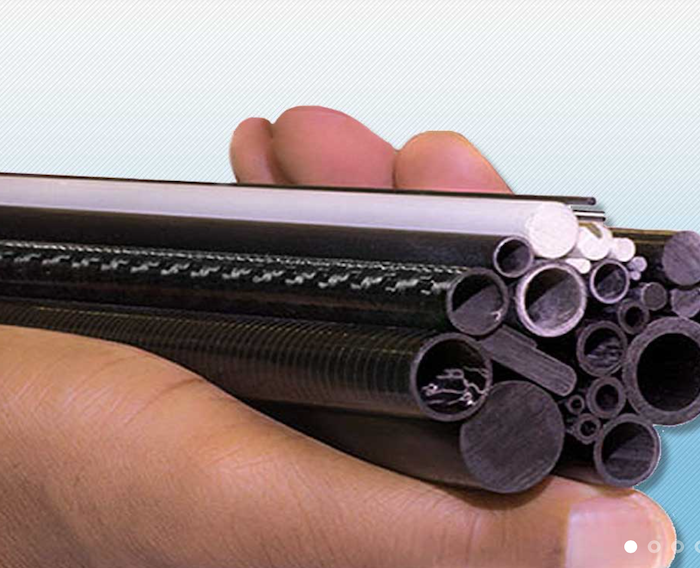
Think of something as prosaic as a kite frame, a tent pole, or the push rod for an RC aircraft and you’ll appreciate the advantages that carbon composites deliver to the hobbyist/consumer market. But the applications extend to virtually anything where the greatest amount of strength for the least amount of weight might apply. The musical instrument market might be less obvious, but makes just as much sense, as Amelia explained to me.
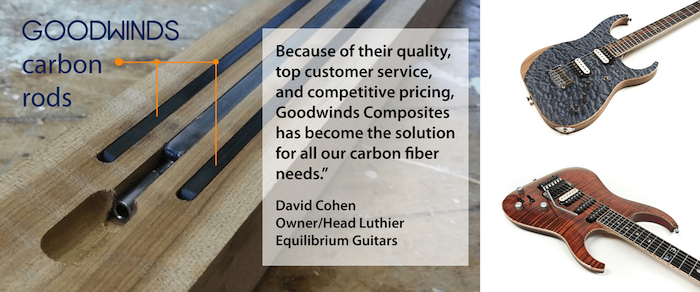
“The instrument market is truss rods or truss rod stabilizers for stringed instruments like guitars, violins, cellos, bass guitars, etc. A truss rod goes into the neck of a stringed instrument to keep it from deforming. Instruments are wood, which is highly affected by humidity and temperature. The earliest guitars would deform even in a day. To combat this, truss rods go into the neck of the guitar to keep it stabilized, and carbon rods are used either as the truss rod or as stabilizers to keep the truss rod from deforming. Composites are unaffected by heat and humidity.”
Up the Value-Added Curve
Composite rods and tubes have been around for several decades, but they are still a relatively new technology — and like any new technology they were more expensive when they were first introduced. “In the ‘90s, hobby enthusiasts would buy small carbon and fiberglass rods and tubes and cut them off for use in anything that had to be really light but really strong. Today there are five to seven big companies that make carbon composite rods on a large scale, by which I mean not necessarily volume but size,” said Amelia.
Initially, Goodwinds Composites provided not only a retail source for the inventory purchased from large suppliers, but would also cut rods and tubes according to their customers’ specifications. Over time, however, the company added specialized manufacturing equipment that allowed them to provide even more customization through a process called “pultruding.”
“To ‘extrude’ something means to push it through a die,” Amelia explained. “The pultruding process involves pulling carbon or fiberglass fibers through a resin and a series of dies, and then cure it in an oven. This has the advantage of all the fibers being oriented in the same direction, which gives the resulting rods and tubes incredible strength. Imagine it as though you were pulling thread from a spool — but through a resin bath and then through dies and ovens to create the final shape. The resulting rods and tubes still have a bend radius, and you can break them if you bend them past this, but pulling them end-to-end makes them incredibly strong.”
Amelia estimates that there are five to seven large companies in the U.S. who manufacture pultruded carbon composite rods and tubes, for whom her company is a customer rather than a direct competitor.
“The big pultruding companies have huge factories with many different machines running many lines at once in order to keep the costs low,” said Amelia. “We are a much smaller scale operation. We purchase thousands of feet of pultruded rods and tubes from those big factories and then cut them to spec with specialized saw equipment. We pultrude stuff that is smaller — from .125” down to .020” in diameter — in house. We use the same continuous process but we are the only ones doing stuff this small, as well as providing secondary process manufacturing on what the big pultruding companies make. So if you need five thousand pieces of quarter-inch carbon rod at precisely 2.5 inches long, we are the only company in America that can do this — and we do these kinds of orders all the time.” As any savvy marketeer will tell you, you narrow your focus to broaden your appeal.
Carbon Wrapping
As viable as Goodwinds Composites’ carbon composites pultruding and machining niche may be, it’s not the capability that took their brand into outer space. For that, we turn to the company’s other process specialty: carbon wrapped tubes. Amelia explained the “recipe” for carbon wrapped tubes to me with a zeal that would have delighted Julia Child.
“This process takes sheets of carbon material with fibers that are either unidirectional or woven in a twill weave and pre-impregnated with resin. We keep it frozen in big rolls and then we thaw it and cut patterns out of these big sheets and wrap those patterns around a steel mandrel. At that point we can wrap multiple layers, oriented in different directions, to create whatever profile our customer wants. We then wrap it in cellophane and cook it in the oven, which makes all of that resin in the fabric liquify and then solidify at a certain temperature for an even distribution of resin throughout the layers of carbon fabric.”
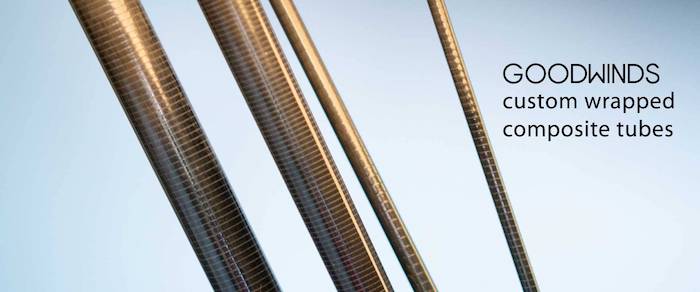
“At the end you take the wrapping off and the steel mandrel out and you have a tube with a very specific inner diameter and an outer diameter that is determined by the number of wraps, with walls of varying thickness per specification. What you get is infinite customizability.”
NASA
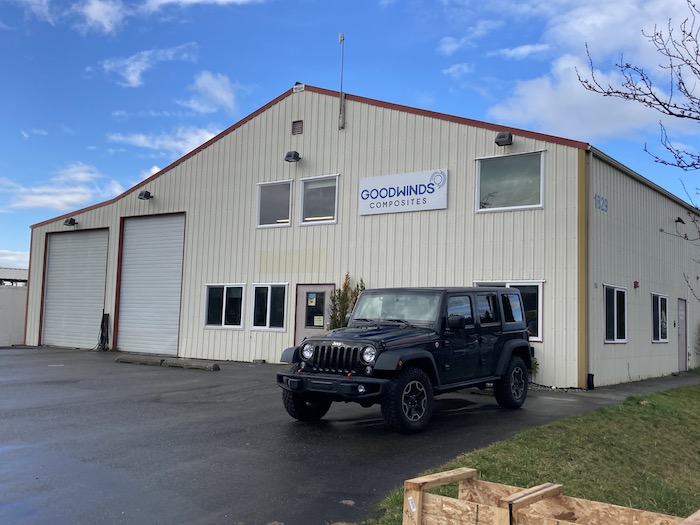
As Goodwinds Composites’ capabilities expanded, it moved further from its hobbyist roots. “In the last few years we’ve abandoned all pretense of being a hobby store in any way, shape, or form,” said Amelia. In 2010 the company hired a composites engineer as well as additional staff to assist with cutting and shipping, and in late 2014 it purchased its current facility on Railroad Avenue, just off Blackburn Road, and hired a production manager and an inventory manager. Thanks to its additional space, it also added two full manufacturing operations and a big machine shop to offer an expanded set of secondary processes for its custom rods and tubes.
Even with these new capabilities the company maintained its online retail presence. “You don’t have to call us to try something out and there’s no minimum order,” Amelia said. “You can be an engineer at NASA and order online, not tell us who you are and just play around with our stuff before finally calling and talking to our composites engineer and giving us more detail on what you want to do. That is something that none of our competitors among the big supply houses can do.”
Which is, of course, exactly how NASA discovered Goodwinds Composites.
“They ordered some of our standard tubes online and had them shipped to a person in California,” Amelia recounted. “They did this a couple of times before calling us and telling us who they were and what they were looking for. Our composites engineer worked with them on their specific needs.”

Chief among those needs were the inherent advantages of carbon composites: a material strength greater than metal but 70 percent lighter than steel, 40 percent lighter than aluminum, and three times stiffer. And while the basic properties of metals can’t be changed, the same is not true for composites — especially given the advantages of carbon wrapping.
“Wrapped composites are application specific,” said Amelia. “You can customize them for impact resistance and crush strength, and for a specific amount of bend that an engineer might want.”
There were other advantages as well. Carbon doesn’t corrode, so it can be used in an acidic or chemically challenging environment, and its properties don’t change depending on temperature (thermal expansion), which is critical considering the extremely low temperatures experienced during a Martian night.
NASA was also looking for something that would not deteriorate with exposure to ultraviolet radiation. In short, Goodwinds Composites was able to supply the perfect set of legs for its Ingenuity helicopter — the first human made device to fly above the surface of Mars and offer a glimpse of the red planet from an entirely new perspective. In the process, it carries a piece of the Skagit Valley to our planetary neighbor.
Overcoming the Pandemic
There is, of course, no way one can discuss anything taking place in 2020 without taking into account the impact of a once-in-a-century pandemic, and like everyone else in the world, Goodwinds Composites had to make some adjustments. Early in the pandemic it went through a temporary closure, and along with following basic health department guidelines the company adapted to working remotely when feasible.
The biggest impact, however, has been on the retail side of the business. “We’ve stopped getting phone calls from people with innovative ideas, and we hope that will come back as the pandemic recedes,” said Amelia. “In the past, someone might have a great idea and order some materials, and maybe a year later we would receive a production order with something they had dreamed up in the sports, leisure or hobby sector. It would be nice to get that back.”
Looking past the pandemic, Amelia sees the future of her company as continuing its culture of innovation. “In our business, innovation is a necessity,” she told me. “Nobody likes machining composites. It’s really dirty and it gums up the machines. Methods of manufacturing are relatively new and changing all the time. Some of this is just about doing things better…but how do we make new products using composites that haven’t been done before?”
Sustaining a culture of innovation is more than just an aspiration. As Meyer Sign knows from its own experience, it requires the right people — and finding those people is at the core of Goodwinds Composites’ goals. “In the future we plan to expand our product offering, and this makes a great opportunity for people who are self-taught,” said Amelia. “We hired our composites technician straight out of high school. He had gone through the Northwest Career & Technical Academy’s program and learned a little about the use of composites in boat building, which is a field here in Skagit County. We helped him get his composites certificate through Skagit Valley College. It is so much more about attitude and fit than about ability at the beginning of the job.”
The Pursuit of Excellence
“We strive for excellence, and that includes in our own conduct,” Amelia elaborated. “I hope we can expand in such a way that we can hire more people out of high school or college. We are in a growing and developing field, and we want people to stay and have a wonderful job here. But we also like to give opportunities for people to acquire skills and move on to something that maybe fits better. Seeing people move on and live their dreams has its own rewards.” That sentiment resonates strongly for us at Meyer Sign as well.
The concept of “excellence” is one that you frequently encounter in corporate mission statements, to the point that it often seems more platitudinal rather than aspirational. But to understand it in the context of a sister and brother from “a tourist town far from anything” and the company they’ve created over the past thirteen years, I can’t think of a better summary than the one you’ll find on the “About” section of the Goodwinds Composites website:
Excellence. It’s what drives us. It’s what keeps us pushing toward the next innovation, the tighter tolerance, the increased levels of production. We love working here. We love providing a great working environment for our employees. We love engaging with our customers to help them find the perfect composite product for their application. And we love, more than anything, hearing about our customers’ successes using Goodwinds Composites’ rods and tubes.
Thanks to one of their customer success stories, NASA’s Perseverance rover, we have all heard more about Goodwinds Composites this year. I expect we’ll be hearing more in the years to come.