Tales From the Magic Skagit: From These Waters
If you’ve ever driven north on S. 1st Street, Mount Vernon, it’s highly likely that the mural at the intersection with Gates Street caught your eye. It’s big, it’s bold, it’s colorful — and last but not least — it is a swirling tapestry comprised of vignettes about the immigrant experience, particularly as it applies to the Skagit Valley.
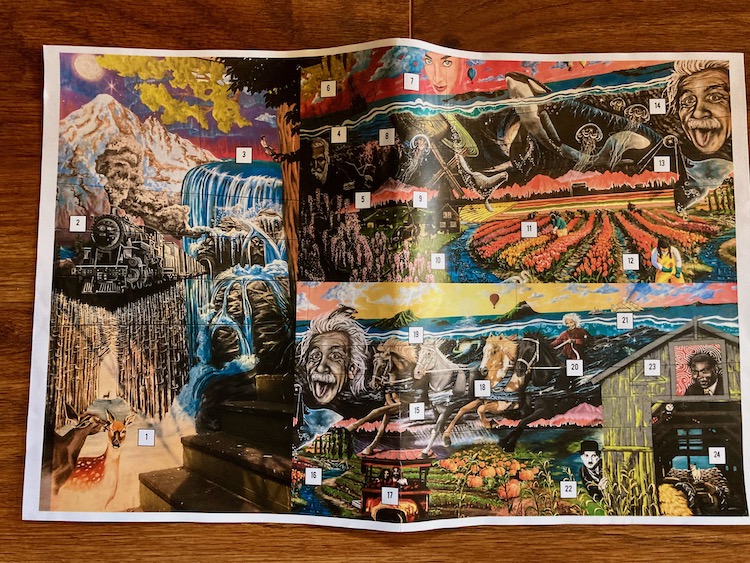
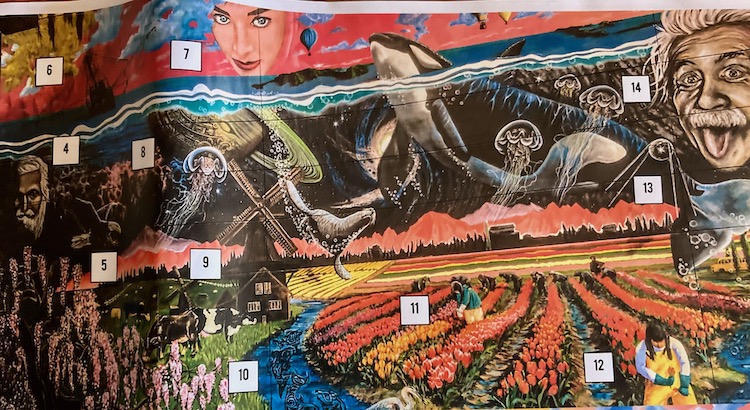
Taking up the entire south-facing wall of Ristretto Coffee Lounge & Wine Bar, the mural incorporates no fewer than twenty-four artistic references. With time enough to take it all in, close inspection of the mural would no doubt reveal a good many of these references to the average observer familiar with the Magic Skagit. Thanks to the Mount Vernon Chamber of Commerce, you’ll find a free poster-sized, full-color explanation of the mural, entitled “From These Waters — A Celebration of the Contributions of Immigrants to Our Native Lands,” located just below the sign identifying the work and those who made it possible.
The mural project, featuring lead artist Benjamin Swatez, was the inspiration of a Mount Vernon-based organization known as Voices of the Children. The organization describes its purpose as pairing “…youth around the world in collaborative arts projects to shine a spotlight on humanitarian crises, (and) encourage community engagement and personal growth.” Downtown Mount Vernon shoppers will more likely be familiar with Voices of the Children’s 407 S. 1st St. address as the location of Habibi, a boutique gallery featuring “artwork and artisanal items from Northwest Washington and around the world” (with 60 percent of the price for each item sold going back to the artist or artisan who created it).
Following the mantra, “Many voices. One cause,” Voices of the Children makes possible a variety of programs aimed at youth development. One of these is Rachel’s heART, which operates out of the YMCA OASIS Daylight Center and is dedicated to the memory of Rachel Damski, who escaped the holocaust as a teenager and emigrated to the United States to start a new life.
At the age of 80, Rachel began to paint for the first time, and as the guide explains, “her art benefited her life in indescribable ways and released trauma that she had been carrying in her psyche for decades. She recently passed away, leaving a legacy and a dream that everyone, especially youth, would have a similar opportunity to benefit from the gifts of painting and creative expression — which is why the art camp in her honor is called Rachel’s heART.”
The hard copy guides available at the mural site describe the public artwork as “…a starting point for discovery and conversation within and about the mural.” In order to render them in a poster format, the mural sections are arranged in three distinct panels, unlike how you would view the work in person. The following is an explanation of each panel’s elements.
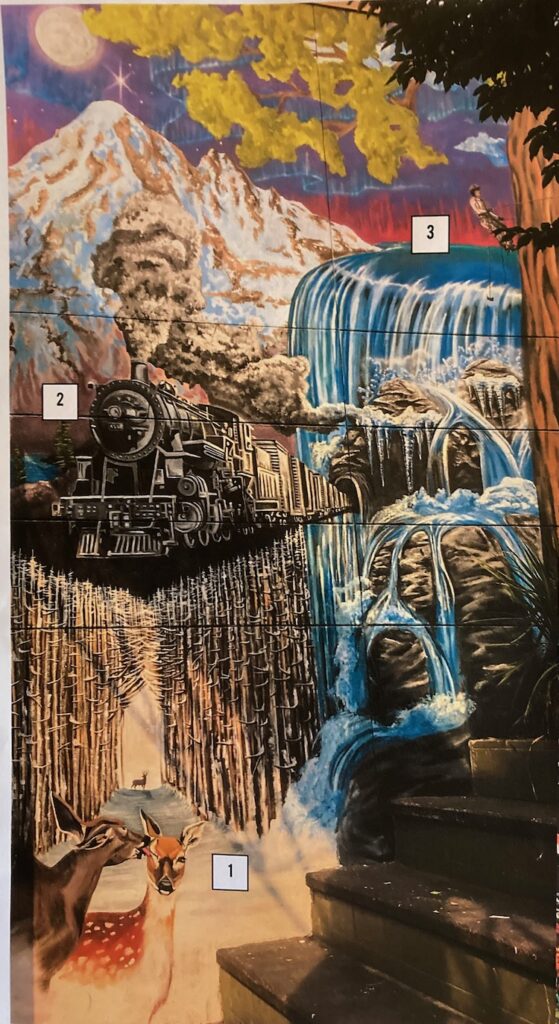
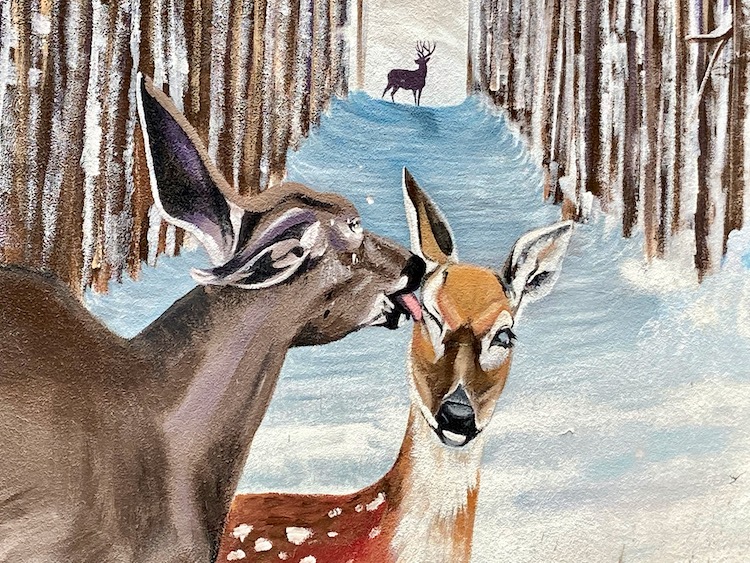
1) Rachel Damski was born in Germany and took up painting at the age of 80. The mural itself is inspired by her love for her children, the beauty of her adopted home, and the power of art to heal.
2) A steam train refers to the more than 40,000 Chinese immigrants who laid the tracks for the Transcontinental Railroad.
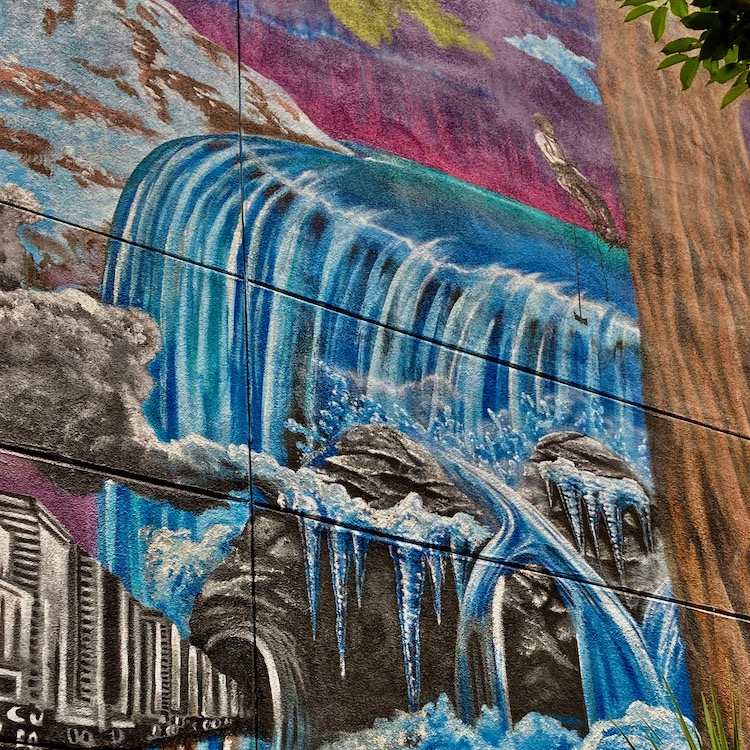
3) Although the guide appears to call our attention to a waterfall (a not infrequent frequent sight for those of us in the Pacific Northwest), the actual subject is a logger scaling a tall tree in the upper righthand corner of the panel. With seemingly endless stands of old growth timber, Mount Vernon’s founders prospered by selling logs to the Bellingham Mill Company, which provided steady work for new settlers.
4) The bearded visage peering at us from out of the cosmos and just behind both real and depicted trees is none other than one of America’s most famous Scottish immigrants, John Muir. As a naturalist, author, environmental philosopher, glaciologist, and pioneering advocate for the preservation of wilderness in America, he was a confidant of the U.S. president who established our national park system, Teddy Roosevelt.
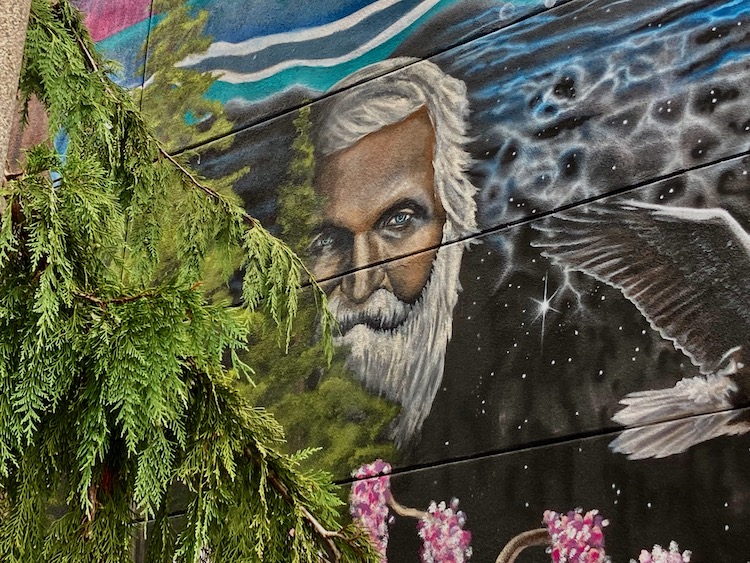
5) The bald eagle is not only the national symbol representing courage, strength and freedom, it is the only eagle breed that is indigenous to North America. It is also a frequent visitor to our Skagit Valley, and the celebrated object of our annual Skagit River Bald Eagle Festival.
6) The fishing boat is a reference to Norwegian settlers to the Skagit Valley, many of whom were fishermen.
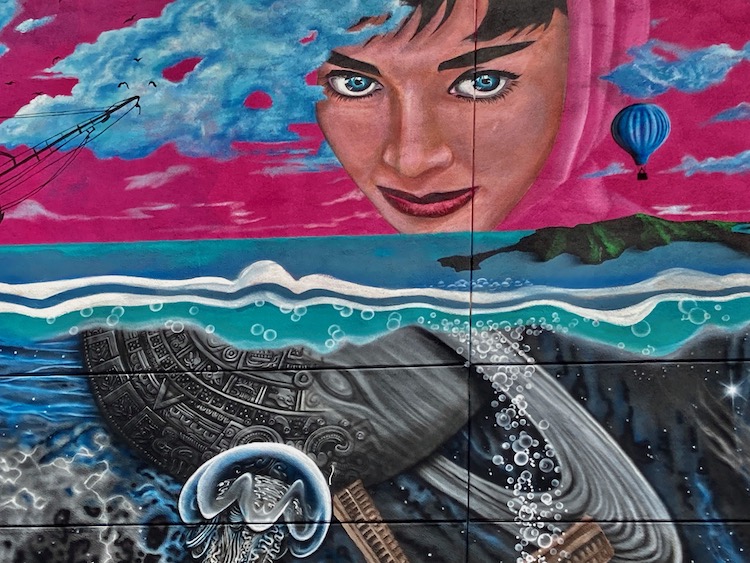
7) The enchanting visage of a woman’s face belongs to an immigrant from Belgium who we remember today as the actress Audrey Hepburn. In addition to her acting career, Ms. Hepburn devoted much of her later life to UNICEF and received a prestigious Presidential Medal of Freedom for her work as that organization’s Goodwill Ambassador.
8) Close scrutiny of this object, which appears to morph into a ringed planet, is in fact a segment of the Mayan calendar — a testimony to the astronomical genius of indigenous populations from Mexico and Central America.
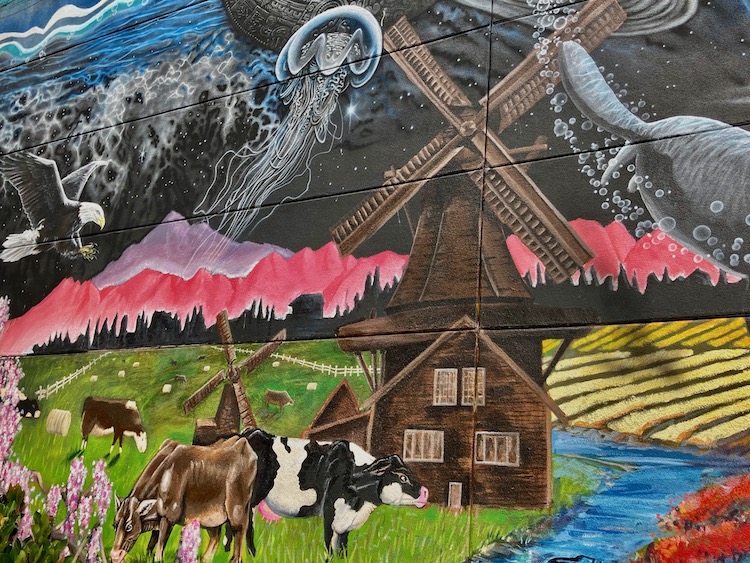
9) Closer to home you see a windmill — an obvious reference not only to the Dutch settlers to the Skagit Valley (of whom Meyer Sign’s founder, John Meyer, figured prominently), but also to the fact that Skagit Valley farmland was once dotted with these structures.
10) The land that those of us who live in the Skagit Valley call our home is part of traditional Skagit tribal fishing grounds. Hence the reason the mural is titled, “From These Waters.”
11) Where would our local economy be, particularly our agricultural industries, without the contributions of Latino immigrants? As business owners, they also employ more than 94,000 people statewide!
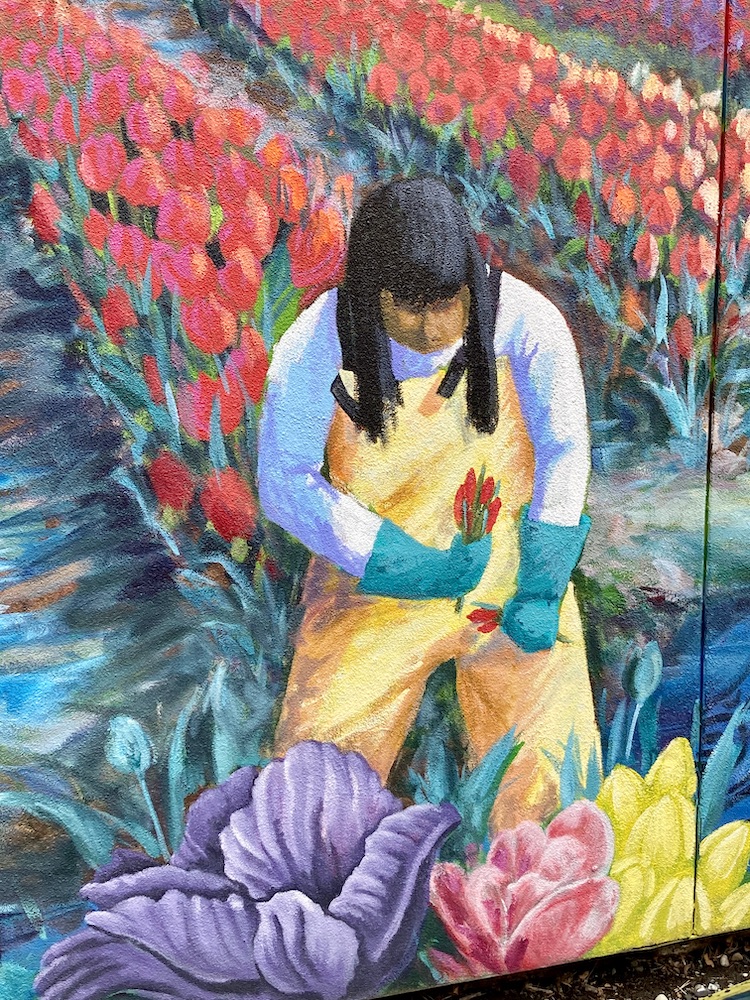
12) The farmworker who appears in the foreground of Skagit Valley tulip fields depicts a native of Oaxaca, Mexico named Maria — the subject for more than 20 years of local artist Alfred Currier.
13) Juxtaposed with orcas and jellyfish is an object of human ingenuity: Sputnik, the first artificial satellite launched in space by the country of origin for another immigrant group in the Skagit Valley — Russia.
14) Along with Rachel Damski, this whimsical portrait is of another famous German immigrant: Albert Einstein, the Nobel Prize winning physicist and mathematician best known for his Theory of Relativity along with advances in quantum theory.
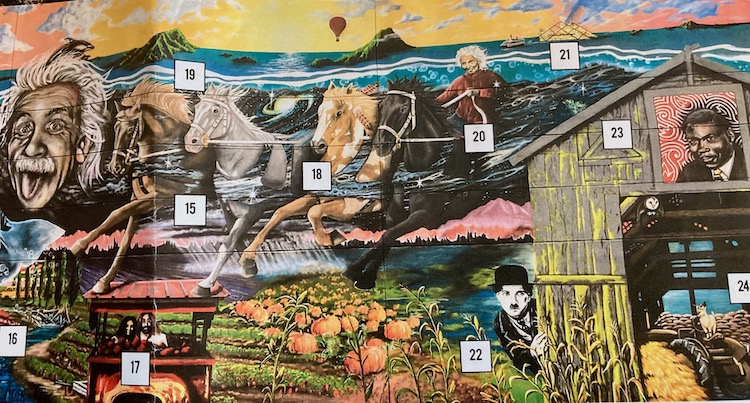
15) The reference made by this team of charging horses is a bit of a stretch…but if you think “chariot” you’ll at least be on the right track, so to speak. In this case the track would be the Roman Coliseum, and the reference would be to the Hollywood epic, Ben Hur — produced by Metro Goldwyn Mayer (MGM), a film industry titan founded by (you guessed it) an immigrant.
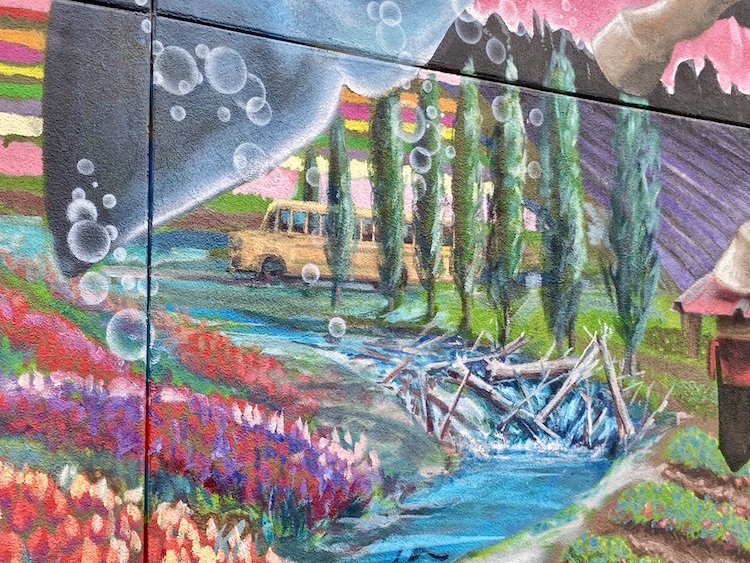
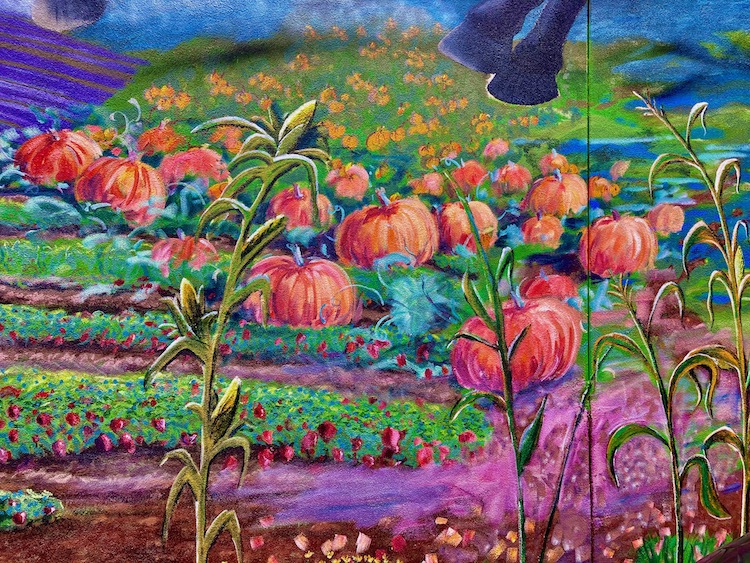
16) Look closely at this bucolic Skagit River scene, complete with blossoming fields and a shelter belt of poplars, and you’ll notice a logjam up around the bend. The earliest recorded “new people” to settle in Mount Vernon, Jasper Gates and Joseph Dwelley, could not have gone very far upriver in those days due to large sections of the Skagit that were blocked by centuries-old logjams. It wasn’t until the concerted efforts of the pioneers to clear those obstacles that commercial life could really take hold in the communities along the Skagit River.
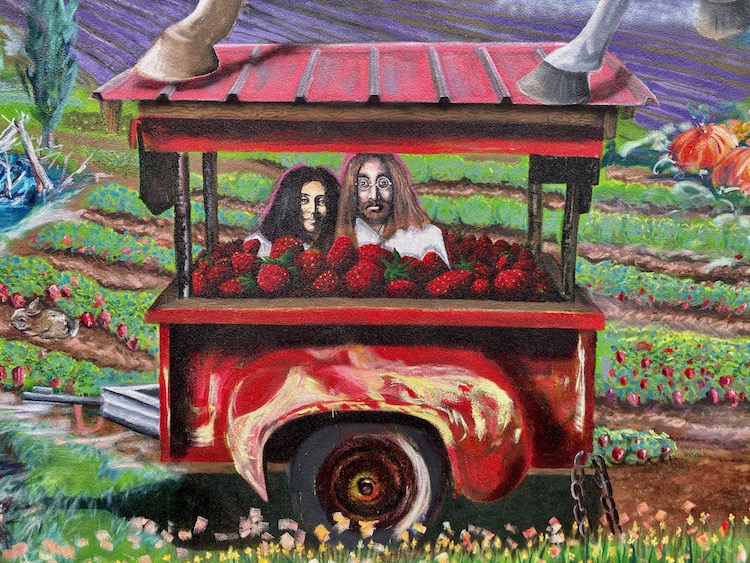
17) “Let me take you down, cuz I’m going to…”. That’s right, Strawberry Fields. So why wouldn’t John and Yoko be here? After all, they’re immigrants…and we have lots of strawberries. By the way…the walrus was Paul. Koo-koo-ka-choo.
18) Look closely at Ben Hur’s galloping stallions and you may wonder, “Which of these things is not like the other?” The answer is: the middle horse. He’s a native horse, not Arabian, and was perhaps bred by the Nez Perce. Unlike his fellow horses he is unbridled. The significance of this, according to the mural guide, is that he represents “the freedom that native peoples should possess in the land they initially inhabited.”
19) There’s a very good reason that this mural is called, “From These Waters.” In addition to the way the Skagit River has defined our valley, we also have the San Juan Islands at our doorstep. These islands, noted worldwide for the beauty of their landscapes, were originally inhabited by the peoples of the Coast Salish ethnolinguistic group.
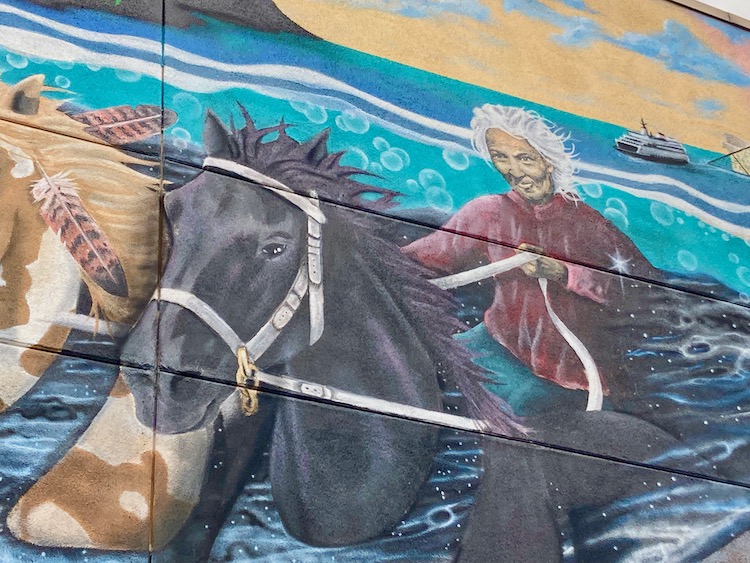
20) Meanwhile back at the chariot races, the intrepid driver you see isn’t Charlton Heston. It’s Nawal el Saadawi, an Egyptian writer, feminist, physician, psychiatrist, and last but not least, the founder of the Arab Association for Human Rights. It probably comes as no surprise then that she was imprisoned in Egypt. What is probably more surprising is that she taught at University of Washington. Go Huskies!
21) And what’s this strange pyramid of light in the wake of a Washington State Ferry? Why, it’s the Rock & Roll Hall of Fame (into which more than a few Washington rockers have been inducted), designed by the the world famous architect I.M. Pei. Originally from China, Pei also designed the inverted pyramids at the Louvre in Paris and other internationally acclaimed buildings.
22) Speaking of halls of fame and entertainment, here’s the legendary comedic star of silent film, Charlie Chaplin — an immigrant to America from the same source as our Founders: England. A quote in the mural guide from Congressperson John Rankin seems strangely ironic: “Chaplin’s very life in Hollywood is detrimental to the moral fabric of America.” Are you talking about “the little tramp”? Say it ain’t so, John!
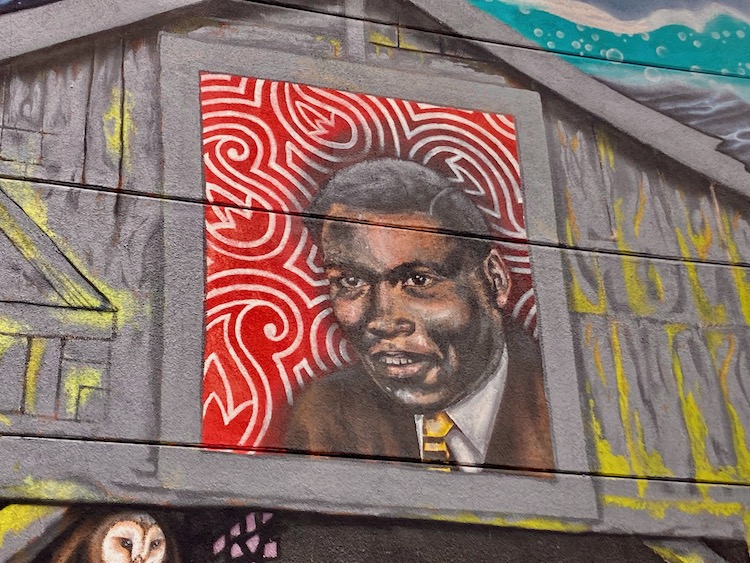
23) The distinguished looking gent peering out at us from the barn is Legson Kayira, who came to the Skagit Valley from the African country of Malawi. Kayira walked barefoot across Africa in his attempt to reach America and continue his education, which he did at Skagit Valley College and University of Washington. He went on to become a writer whose best known work is I Will Try.
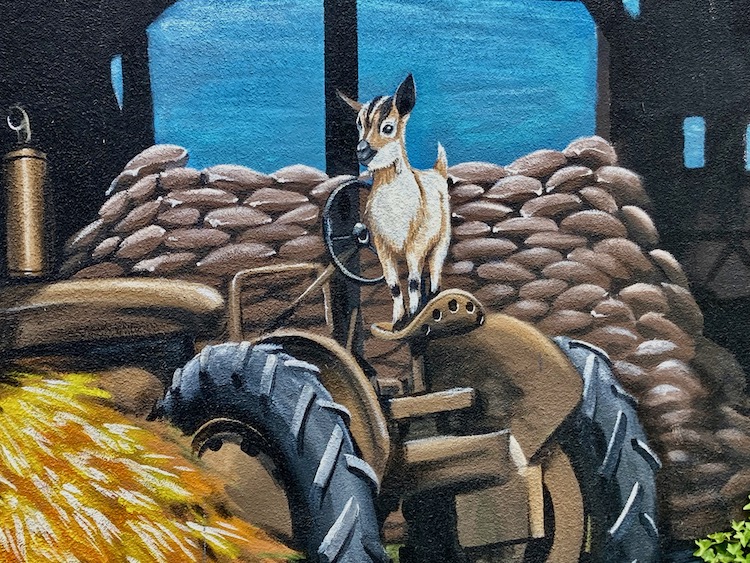
24) We’re on our last mural element, so I believe a drumroll is in order. Thanks for hanging in with me! Here we see a common enough sight in our rural Skagit Valley: a barn. Behind a tractor, the fruits of the harvest, and an uber cute little goat, are stacks of what you might think is grain. They are, in fact, something we used to see more of along the Skagit River (at least prior to flood control projects such as downtown Mount Vernon’s Revetment): sandbags. Oh…and don’t miss the barn owl in the rafters.
Needless to say, there is a lot going on in Mount Vernon’s most prominent mural, although I still haven’t spotted Elvis. But who needs The King when we live in a place of such beauty, and one whose co-mingled stories flow like a river of time through fields, forests, mountains and shores, and that bind us together in all our colorful diversity?
We love you, Magic Skagit!