Tales From the Magic Skagit: Our Lady of the Tulips
People have planted flowers in the Skagit Valley since the first immigrants arrived here from all points of the compass. I can’t help but wonder if that statement doesn’t come off as a bit ethnocentric, but my guess is (based on what I’ve been learning about the original people of the Magic Skagit) that depending on their seasonal mobility, indigenous communities may not have seen much of a point to planting anything other than an essential food source — especially when Mother Nature offered such wonderful displays of wild blooms each Spring.
For the pioneers to the Skagit Valley, however, flowers were more than just eye-pleasing testaments to “settling” the lands they occupied. Their very reappearance every spring, in the case of perennials, spoke to the sense of permanence that 19th Century settlers brought to a place they came to love as profoundly as the native peoples they encountered and lived among.
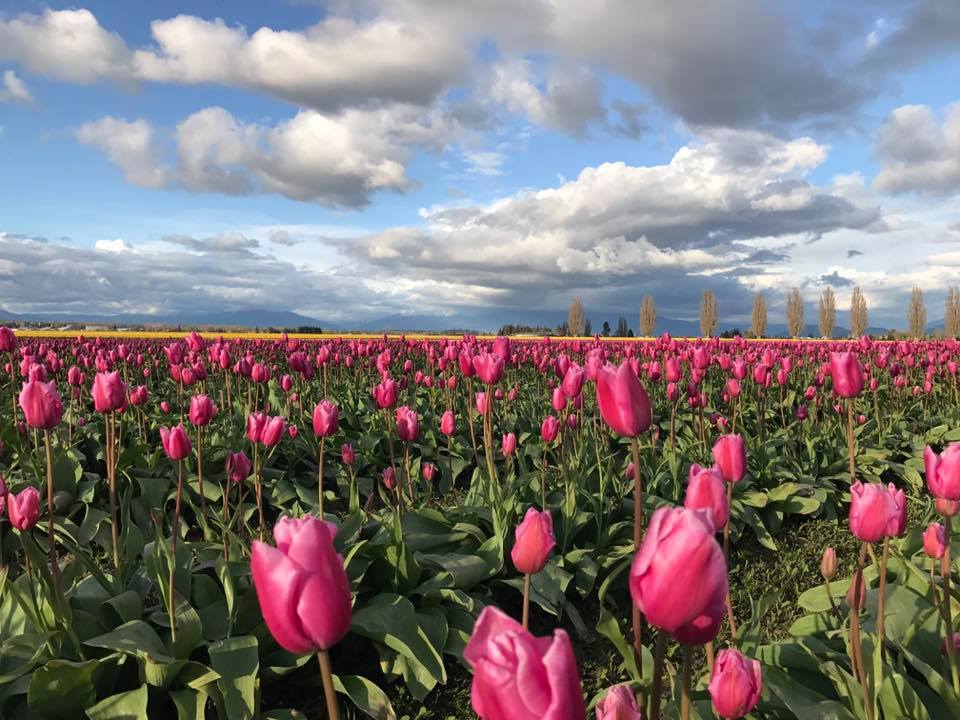
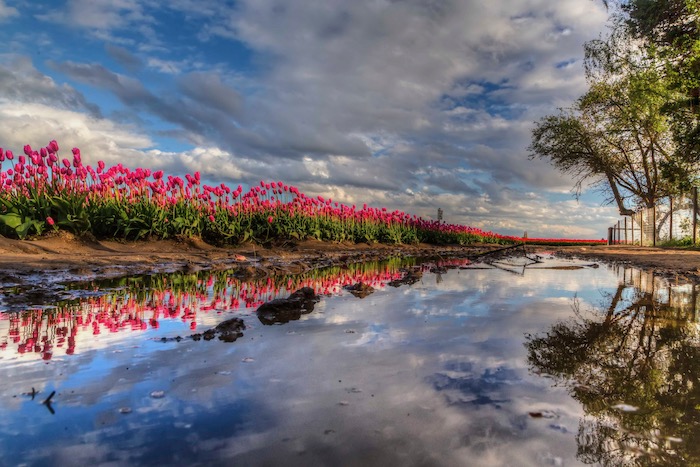
Every spring in the Magic Skagit, when we gaze rapturously across a blooming acreage of daffodils or tulips (with the occasional swaths of hyacinths), we rarely wonder how it came to be that — according to recent data from Washington State University’s Skagit County Extension — 75 percent of tulips grown commercially in the U.S. came from the Skagit Valley. Today, some 20 million bulbs are harvested from approximately 1,000 acres of tulips and daffodils each summer in Skagit County, while 75 million cut flowers are grown in fields and greenhouses. And of course, Skagit County is now known worldwide for the annual bacchanalia of bulbs we lovingly call the Tulip Festival. How do you like us now, Holland?
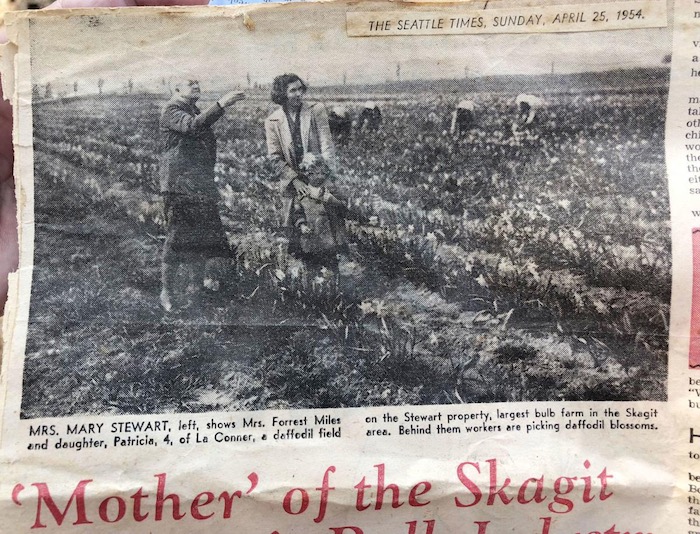
You may therefore be amazed to learn, as I recently did (thanks to the Skagit County Historical Museum), that the person who is generally credited with being the first to establish our local tulip industry was not a Dutch transplant, but a hearty local varietal who is fondly remembered as Mrs. Mary Stewart of Samish Island.
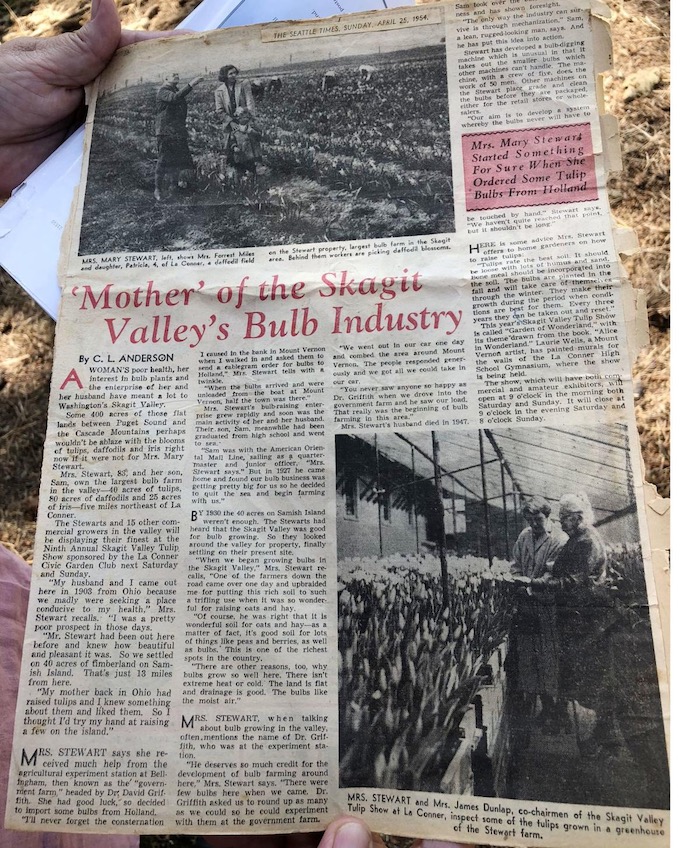
Mary Stewart and her husband William came to the Skagit Valley in 1903 from Ohio, which prior to Lewis & Clark had itself been considered the Western Frontier. According to the Historical Museum, the Stewarts migrated West in search of “a more healthful climate,” and forty acres of timberland on Samish Island became their home. Fondly recalling her mother’s tulip garden back east, Mary Stewart became the first person in the Skagit Valley to order tulip bulbs from Holland. She planted the first one in her yard in 1906 — which also happened to be the year of an “earth shaking” event a few hundred miles down the Pacific Coast, as you may recall.
What started as a floral tribute to her mother’s memory grew into a more serious enterprise, and with assistance from the agricultural experimentation station in Bellingham Mary began growing in earnest. According to the Skagit County Historical Museum she soon had a small mail-order bulb business, which is credited with starting the county’s bulb industry. Mary shared a story now retold by the Museum that “when her first shipment of bulbs arrived from Holland and were unloaded from the boat, half the town turned out to see it.” I suspect a few wondered how she could devote so much time and energy into growing something that couldn’t be eaten. In this respect they may have shared the perspective of the native population.
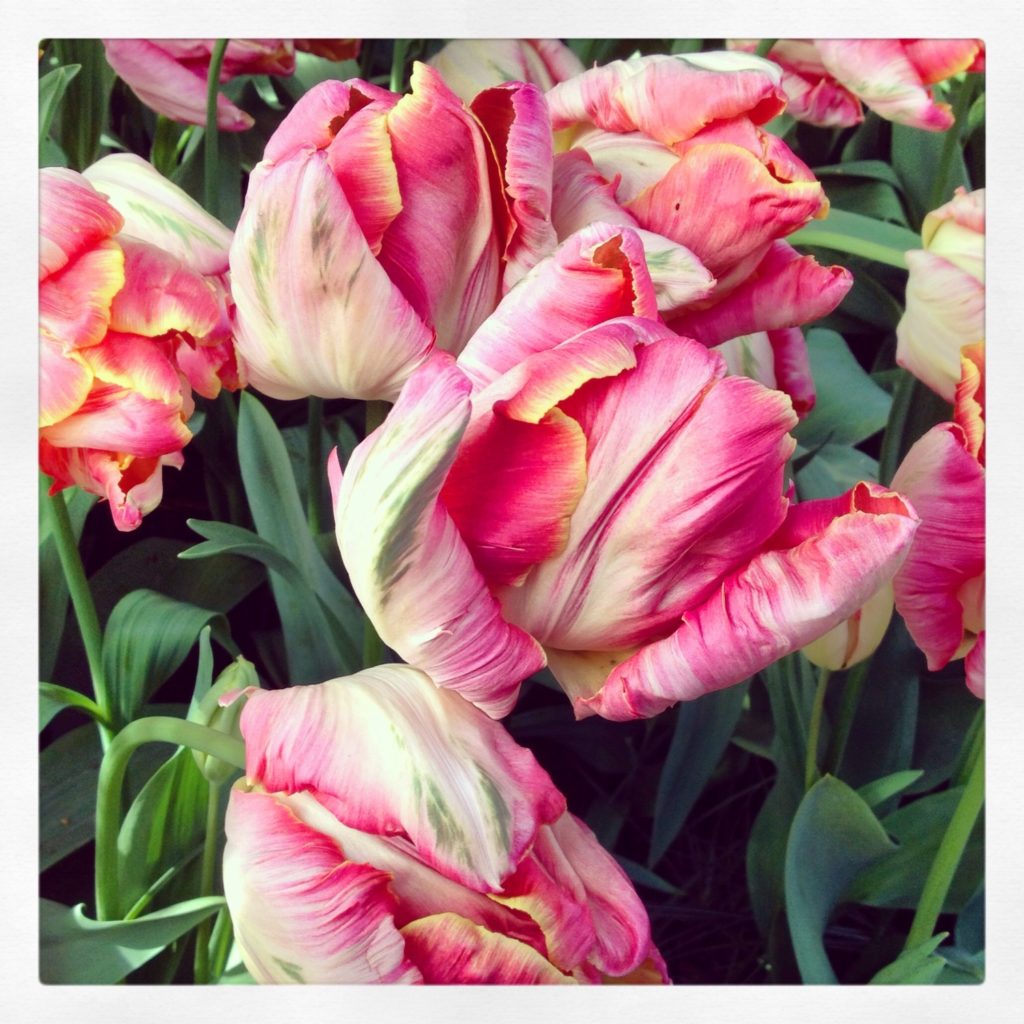
Over the ensuing decades Mary’s floral enterprise would grow to become a 250-acre operation in Mount Vernon under the direction of her son, Sam Stewart, and his wife Sarah Stewart. Appropriately enough, Sarah and Sam met at a flower show in Tacoma in 1928, and nine months later they were married. They settled down in Mount Vernon 1931. The Depression years were challenging ones for the Stewart family, just as they were for so many Americans across the nation. In a recorded interview at the Museum, Sarah Stewart recalled that, “We had no money in ‘29, ‘30 and ’3,” adding that customers had to save up to purchase even a single tulip bulb.
By 1930 the Stewarts had outgrown their original 40 acres needed to expand, and despite the shortage of funds they acquired more land just 5 miles northeast of La Conner and opened Skagit County’s first tulip farm, Tulip Grange Bulb Farm. By 1940 they boasted the largest bulb farm in the Valley, with included 40 acres of tulips, 80 acres of daffodils, and 24 acres of irises.
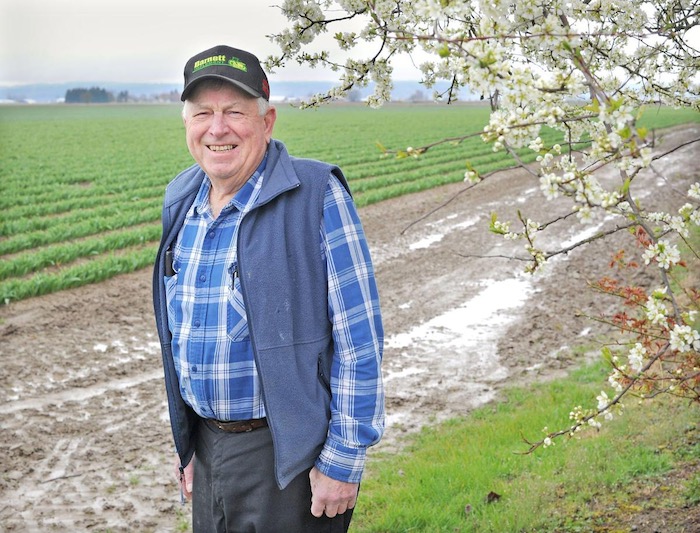
Mary’s grandson, David Stewart, who is now in his 80s, recalls life on his grandparents tulip farm where he began working at age 10, picking flowers, drying bulbs, and making crates. In an interview for a 2018 story in the Skagit Valley Herald, Stewart spoke of driving the bulbs and flowers to the train station in Mount Vernon and later to the airport in Seattle, where they made their way cross-country to places such as New York City, Chicago and Minneapolis — carrying the Skagit Valley brand back to many of the places its immigrant settlers had come from. In 1947, the Stewarts were able to ship their flowers directly from Skagit County by plane, cutting travel time by 10 hours.
The Skagit Valley Herald story recounted the summers of the 1930s and 40s, when the Stewarts employed about 100 local women and high school students in the flower fields for $1 a day, according to the Museum. David said the youths would collect the bulbs after his father dug them up with his horse-drawn plow, after which they were dried and sorted. The family had a grading machine from Holland that would sort the dried bulbs by size, David said.
In 1972, Sam Stewart died of a heart attack at the age of 69 and the farm was later sold to the American Bulb Company. Today, the Skagit Valley is home to about 350 acres of tulips, according to the Mount Vernon Chamber of Commerce. Just 12 years after Sam’s passing, Mount Vernon would establish its annual Tulip Festival — a month-long celebration of flowers, agriculture, and farming in the Magic Skagit that in 2016 drew visitors from all 50 states and from 93 foreign countries, according to the Skagit County Tulip Festival. Thanks to Mary Stewart and her homage to her mother, tulips became a centerpiece and an inescapable icon of Magic Skagit agriculture, industry, and tourism.