“Tulipomania” and a Nation of Greater Fools
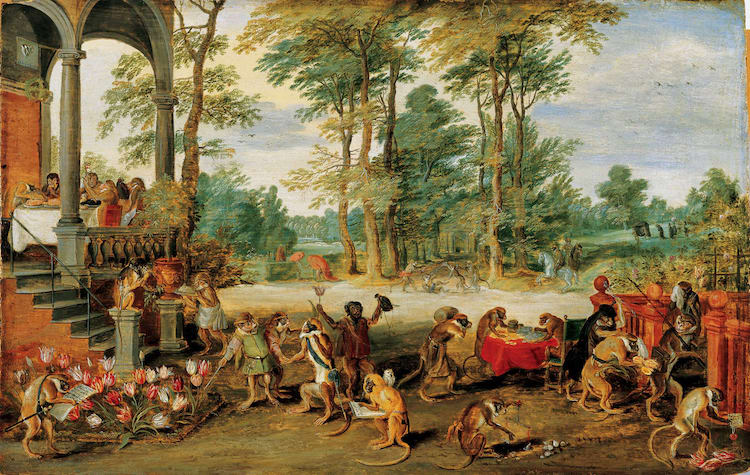
By now, most of us who have reached adulthood and paid any attention to current events along the way have at least some understanding of the cyclical nature of financial markets and the risks and rewards of speculation. We saw this in spades at the close of the first decade of the 21st Century with the collapse of a housing market fueled by easy credit.
While speculation may have driven the real estate gold rush, the housing bubble was at least based on tangible assets that the average person could relate to: brick and mortar dwellings constructed on parcels of land and the promise of equity that they implied. And while at some point logic dictated that housing prices had become unsustainable, the justification for buying in a hyper-inflated real estate market was that you could always sell at a profit, so long as someone else was willing to buy.
In its most unflattering characterization, this aspect of rampant speculation, whether it relates to stocks or homes, is known as “the greater fool theory.” You might be crazy to purchase an asset at many times its assessed value, but if someone is willing to pay more for it than you did, perhaps you’d be crazier not to. And lest you think this mindset is a modern phenomenon of free market economics, it just so happens to explain what took place in the Dutch economy nearly four centuries ago.
Blame it on Semper Augustus and “tulipomania.”
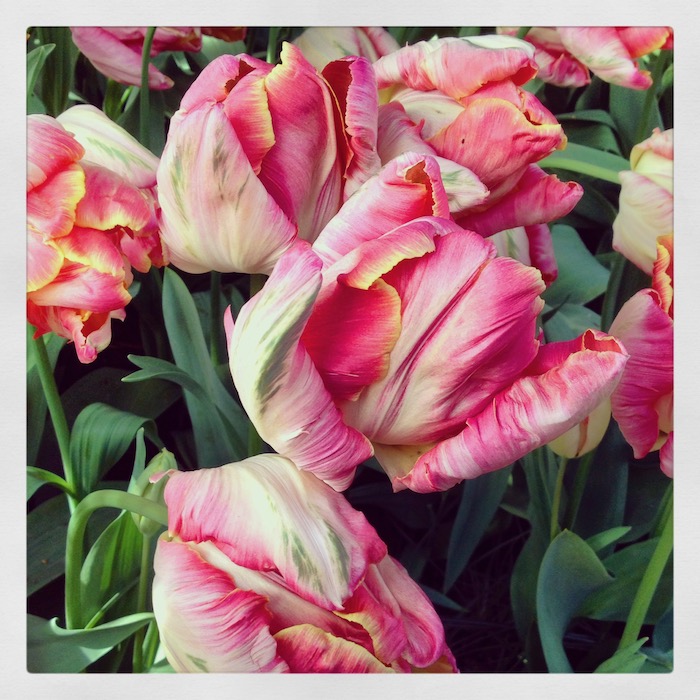
If you think we’re obsessed with tulips here in the Magic Skagit, a place where one month of every year is dedicated to a carnival of blooms, we’ve got nothing on Holland in the years between 1634 and 1637, when “tulipomania” reigned. It seems odd to think of the straitlaced Calvinists of Holland as being so completely besotted by a flower that they tanked their economy, but like a game of musical chairs when the music stops, Holland became a nation of greater fools with no place to sit down and recover their wits…or their investments. For a long time thereafter, the flower that we associate with the Dutch was the most reviled plant in the Low Countries

To understand how it all came about, we need to go back nearly a century earlier, to when an Austrian ambassador to the Turkish court of Suleiman the Magnificent, one Ogier Ghislain de Busbecq, was credited with sending a consignment of tulip bulbs to Europe after his arrival in Constantinople in 1554. Tulips made a big impression on the Europeans, and their exotic origins were no small part of their appeal — the “intoxicating aura of the infidels,” as one historian described it. How strong was that appeal? In France in 1608, a miller exchanged his mill for a bulb of Mère Brune. Around the same time a bridegroom accepted a single tulip as the whole of his dowry.
By the 17th Century, Holland had become sufficiently wealthy from global trade to indulge in the conspicuous display of blooms as a status symbol. There was no practical value to the tulip. It was a thing of beauty…no more, no less. The speculative bubble surrounding tulips in Holland formed in 1635, when the trade in actual bulbs gave way to trade in promissory notes that would list details of flowers, when they would be delivered, and their prices. Prior to this, the tulip market followed the rhythm of the season: bulbs could change hands only between the months of June, when they were lifted from the ground, and October, when they had to be planted again. Prior to 1635, the market was at least grounded in reality: cash money for real things.
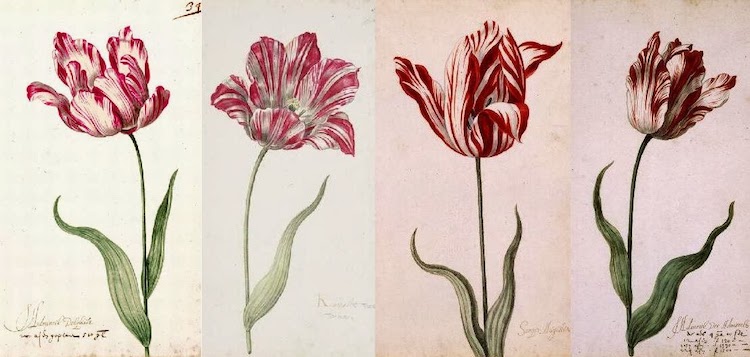
But now, trade in tulips became a year-round affair, which led to speculation by anyone wanting to make a quick buck based on the “greater fool” theory of bubbles. In his book, The Botany of Desire, author Michael Pollan describes the seeming insanity of the Dutch while in the grip of tulipomania.
“Rushing to get in on the sure thing, these people sold their businesses, mortgaged their homes, and invested their life savings in slips of paper representing future flowers. Predictably, the flood of fresh capital into the market drove prices to bracing new heights. In the space of a month the price of a red-and-yellow-striped Gheel ende Root van Leyden leapt from 46 guilders to 515. A bulb of Switzers, a yellow tulip feathered with red, shot from 60 to 1,800 guilders.”
The Dutch tulip trade was conducted by florists in “colleges” — back rooms of taverns dedicated to the new business two or three days a week. Sellers and buyers who wanted to trade were handed slates on which they wrote an opening price for the tulip in question. The slates were then passed to a pair of designated arbitrators who would settle the price somewhere between the two opening bids, and then hand the slates back to the principles with this price scribbled on them. The traders could either let this number stand, signifying an agreement, or rub it out — ending the deal. If only one party declined, the florist had to pay a fine to the college (an incentive to close the deal). When the deal closed, the buyer paid a small commission that was used to buy wine for everyone in the college — creating yet another incentive, and a lot of drunken speculators and spectators.
By 1636, Dutch taverns were crowded with an expanding population of greater fools seeking instant riches. On February 2, 1637, the florists of Haarlem, an epicenter of the Dutch tulip trade, gathered as usual to auction bulbs in one of the tavern colleges. A florist sought an opening bid of 1,250 guilders for a quantity of tulips. Finding no takers, he tried again at 1,100, then 1,000 — and all at once everyone in the room understood that the worm had turned.
News got out as to what had gone down in Haarlem, and within days tulip bulbs were unsellable at any price. There were no longer any greater fools to be found in Holland, the Dutch economy crashed, and the culprit was a flower. A best selling pamphlet published at the time pretty much summed up the catastrophe in its title: Flora’s Fool’s Cap, or Scenes from the Remarkable Year 1637 when one Fool hatched another, the Idle Rich lost their wealth and the Wise lost their sense.
Lest you dismiss the 17th Century Dutch as a pack of idiots, substitute “stock market” or “housing” for tulips in this story and you have the Big Crash of the 1930s or the implosion of the real estate market in 2008. The same dynamic applies.
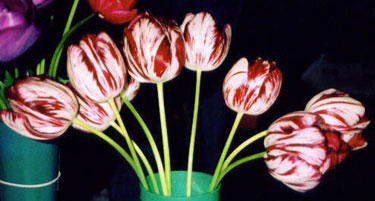
Which brings us to the poster child of tulipomania, the Semper Augustus, which has been described as an “intricately feathered red-and-white tulip,” one bulb of which changed hands for the exorbitant price of ten thousand guilders just before the crash — a sum that at the time would have bought one of the grandest canal houses in Amsterdam.
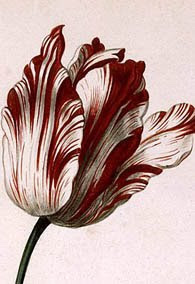
But there is another layer to the Semper Augustus story beyond that of a cautionary tale of speculative fever. The Semper Augustus no longer exists. The fact that we know what it looks like is due to the proclivity of the Dutch to commission portraits of tulips they couldn’t afford to buy — not unlike the guy with the Honda Civic who plasters his man cave with posters of Maseratis and Ferraris (no offense to Honda Civic owners, by the way).
Ironically, the extraordinary beauty of Semper Augustus is the result of a viral infection that ‘breaks’ the single block of color normally displayed on tulips. In doing so it added a stunning striation of white or yellow colored stripes. As beautiful as this effect may be, there is a terrible downside due to the harmful effects of the virus. In many cases, the virus is severely detrimental to the health of the bulb, reducing its vigor, and making it difficult to propagate. Eventually the bulb would lose its strength and wither to nothing, effectively ending the genetic line — which is why commercial tulip propagators rotate their fields with other crops to lower the risk of just such viral infections.
I can’t help but feel there is a metaphor lurking within the story of Semper Augustus besides being the tulipomania poster child — one of fatal attraction and the sometimes deadly consequences of beauty. I’ll leave it to our Meyer Sign audience to come up with their own interpretations rather than risk my banal attempts to puzzle it out. Suffice it to say that while we in the Magic Skagit of the 21st Century experience our own annual outbreak of tulipomania, unlike the 17th Century Dutch we’ve found a way to profit from our hedonistic pleasure with only the downside of traffic jams on I-5 and McClean Road as the cost of our indulgence. Fools rush in where flowers fear to tread.