Tales of the Magic Skagit: A New Spirit of Hope
Part 4 of Swedebs Park Tells the Swinomish Journey
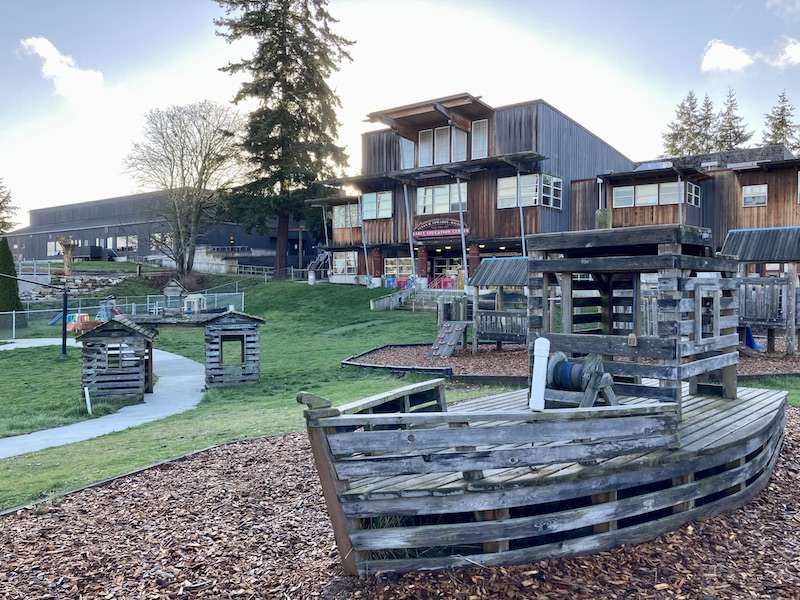
This is the final installment of our four-part series, Swedebs Park Tells the Swinomish Journey. As the descendent of European immigrants who first ventured west of the Rockies in the mid-twentieth century, I have approached this series not so much with trepidation as with a deep respect for the people whose story has always been theirs to share, and who have been gracious enough to do so through venues such as Swedebs Park and the Hibulb Cultural Center. Blessed are the bridge builders.
My role in this exchange has simply been as a humble conduit, and as a local historian who believes that if the history we tell of this place we call the Magic Skagit only begins in the mid-nineteenth century, than we are telling only a small part of its history. What the Swinomish Tribal Community has done through the creation of Swedebs Park not only keeps us honest about our collective past as Skagitonians, but deepens our appreciation of it, regardless of where our ancestors came from.
The Swinomish Indian Tribal Community
We proceeded to the lodge of Squi-qui, one of the Skagit Chiefs…the lodge is a large wooden building, 100’ long by 20’ wide. At the sides are upright planks, placed at intervals of 20’ apart to support the roof beams. These planks were painted with various hieroglyphics, indicative of the Tomanwas, or secret guardian spirit of the occupants of the lodge. The whole building was occupied by five or six different families, all relatives of Squi-qui, the chief.
— James Swan, Penn Cove (1859)

In the years following the 1855 Treaty of Port Elliott, James Swan would likely not have recognized the Swinomish community that he had witnessed shortly after the treaty’s signing. In the 1930s, however, after decades of oversight by the Tulalip Indian Agency based in Marysville, Washington, the Swinomish Reservation restructured itself under the Indian Reorganization Act and officially became the Swinomish Indian Tribal Community. It then held its first election to establish a governing body. The Swinomish Tribal Senate has overseen the reservation ever since.
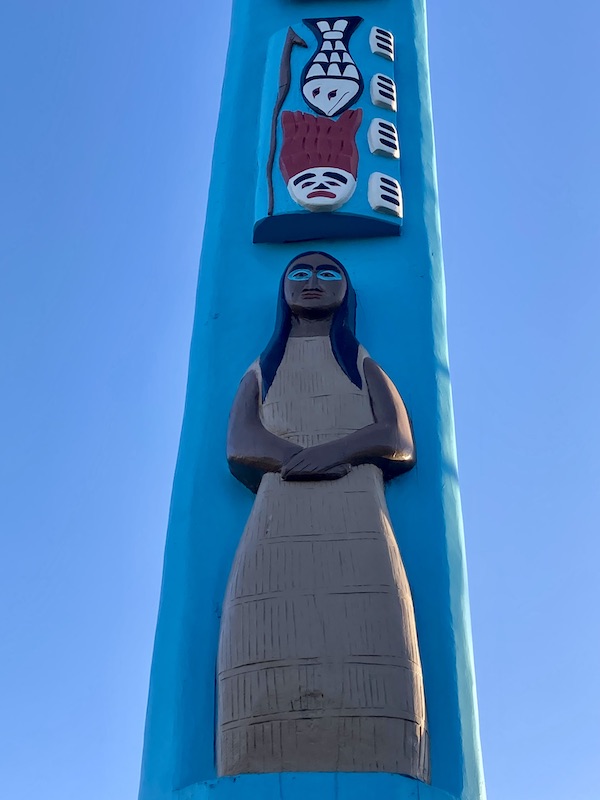
It was also in the 1930s that tribal leaders obtained federal funds for desperately needed housing on the reservation — but the resulting “Model Village” provided only eighteen families a home with indoor plumbing and electricity, and the tribe’s critical housing shortage continued for decades. In 1938, Works Progress Administration (WPA) funds did help erect two important landmarks that remain a visible part of the reservation. One is the Swinomish Totem Pole, which visibly expresses the teachings and guiding spirits that led the tribe’s ancestors. The other is the community ball field, which was renamed in 1946 for John K. Bob, an Army medic from Swinomish who died in World War II while courageously trying to save the life of a fellow soldier. He was one of many Swinomish veterans to serve the United States, despite the fact that their treaty rights often were ignored.
Not surprisingly for a people whose lives depended on hunting, fishing, and gathering for survival, the loss of territory in the aftermath of Treaty Time meant scarce economic opportunities for the Swinomish. The Tribal Senate struggled to create new opportunities for its members, including a fish trap, oyster business, sawmill, land leasing, and a restaurant. In 1964, to fund construction of a community center, the Swinomish issued the first tribally sponsored bond in the United States.
In 1966, the tribe began monthly publication of Kee Yoks (The Seagull), a newsletter to keep the community informed and connected. In the 1970s, the tribe erected the first buildings to house its government, and the Tribal Senate opened a new fish plant to can and smoke salmon, just as fishing in the region went into a sharp decline. Efforts to develop an industrial park and marina at the reservation’s north end, however, were stymied for a decade.
The advent of Indian gaming in 1983 opened a new economic avenue for the Swinomish Community. The Tribe erected the Swinomish Bingo Hall on its industrial park site in 1985, and expanded it into a casino nine years later. The revenue from tribal gaming brings critically needed employment to Swinomish along with opportunities to provide essential governmental services for the community in areas of social services, education, and health care. Gaming also brings the necessary resources to safeguard its traditional food ways — by protecting and restoring the habitat which sustains them.

In the 1990s, the tribe built the reservation’s first medical facilities. And in 2006, it realized a cherished dream with the remodel of its community center, adding classrooms, a new preschool daycare, and an up-to-date computer lab for its youth. As then Tribal Chairman Brian Cladoosby observed years later, “For the first time we are able to provide many of the services our parents and grandparents only dreamt about. Self-government, and self-sufficiency, are powerful medicine for our people.”
Regaining a Way of Life
My grandmother made mesh baskets with spaces for the liquid to come out. That was used for when they’d go clamming. My grandpa used to dig maybe three-quarters of a sack of clams, and then he tied a long piece of cloth onto the basket and then drop it out in the bay, and they would stay fresh. They didn’t have any refrigerators then. But they knew the way to preserve their food. I always say that shows how brilliant their minds were.
— Bertha (George) Dan (2003)
I remember going to gatherings in the Smokehouse when I was a kid. They were big events and would last for days. The school bus would let us off with our books and sleeping roll, and we’d walk down Wilbur Road to the Smokehouse. The mothers had these mats made of cattails that they would put the kids down to sleep on, underneath a blanket. That was our ‘feather mattress.’ There was a side room in the Smokehouse with a platform. That’s where all us kids would be put down to sleep.
— Phil Dan (2002)
Dad’s uncle, Charlie Snakelum, lived on Whidbey Island in a house made of cedar planks. We’d go down to visit him and stay three or four nights. Charlie had a small seine for throwing into the bay to catch fish and he’d let the kids throw it in and whatever we caught, that was our thank-you gift. I remember once he came up to the reservation with a whole canoe full of mussels, maybe a hundred pounds. They cooked a big pile of them on the beach near the Morris Street Bridge. All the elders ate what they wanted and what they didn’t want, that was left for the kids. We were able to go there and eat all the mussels we wanted. It was nice.
— Bertha [George] Dan, 2002
My grandfather had a great big canoe.I remember going to Victoria for a big Indian gathering. Three families went in his canoe with all our clothing and bedding. I remember when we crossed the Strait the sea lions started following us. And then my aunt said: ‘You kids get down on the bottom of the canoe! And we’ll cover you-up with blankets, and you go to sleep. Those animals know you’re helpless! You’d be the first ones that they’d come after! Oh, that made us lay down and be still! We stayed covered!
— Bertha (George) Dan, 1910-2004
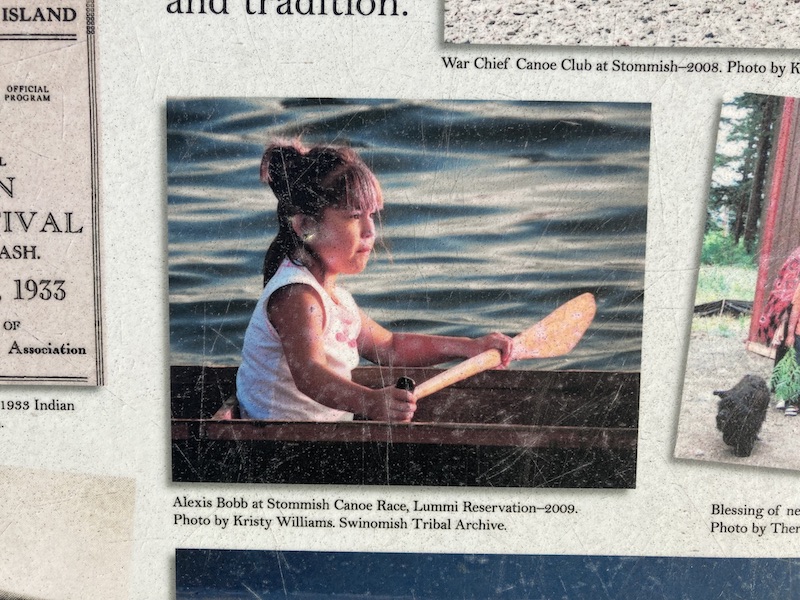
While many areas of society within the dominant culture of the New People remained closed to the First People, one significant point of intersection between cultures was canoes. As an informational panel describes it, “…the non-natives invited us to race canoes at their annual summer celebrations. Our carvers stopped creating traditional canoes in favor of sleek racing vessels like the Telegraph, Question Mark, and Lone Eagle — canoes that gained renown for their strength on the water. Large crowds from Seattle to Victoria cheered us on as we raced against fellow tribes from Western Washington and British Columbia. Movie companies filmed these races for theater newsreels shown across the United States. These rare events, where non-natives celebrated our culture, enabled us to retain our ties to traditional canoe travel and keep our past alive.”
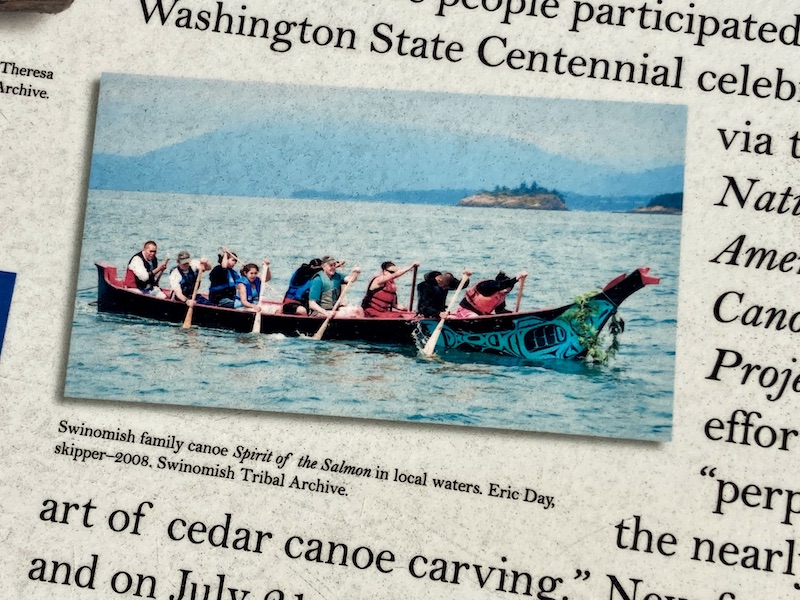
In 1989, Native people participated in the Washington State Centennial celebration via the Native American Canoe Project, an effort to “perpetuate the nearly lost art of cedar canoe carving.” New family canoes were carved and on July 21, 1989, sixteen tribes, including Swinomish, took to the water and made the memorable “Paddle to Seattle.” That was the start of “Canoe Journey,” a critical revival of a cultural tradition that has grown each summer since the Centennial. In 2011, the tribe proudly hosted the “Paddle to Swinomish,” warmly welcoming relations, friends, and newcomers to its shores for this historic occasion.
A New Sense of Place
My spirit guide will lead me to a good tree. And I will talk with the tree and the tree will tell me how to fall it, and how to carve it.
— Charlie Edwards (1938)
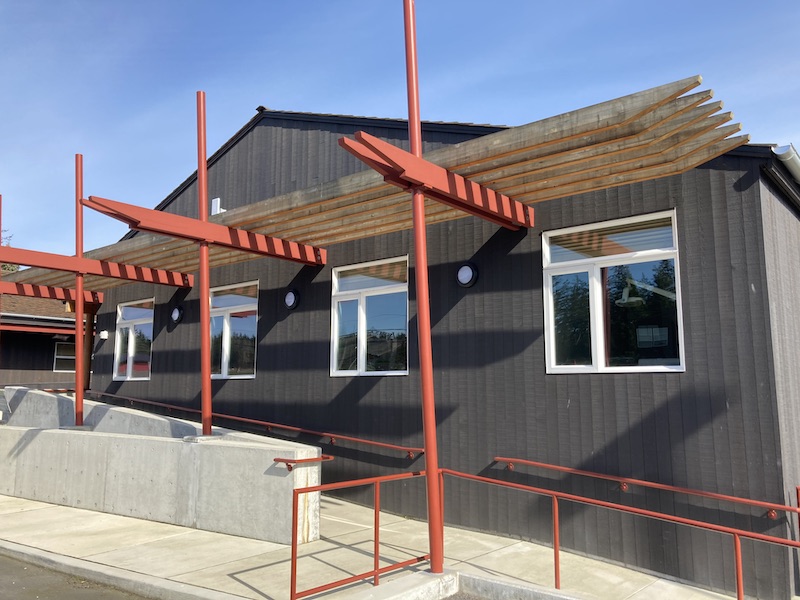
Today, the site of the Swinomish Tribal Community celebrated by Swedebs Park is not a testimony to diminishment, but to the promise of new meaning for its people. In 2008, the tribe began restoring marsh habitat along the channel to create vital rearing habitat for young salmon. In 2010, that project was expanded to restore the beach that you see here today. With the removal of a century’s worth of dredge spoils that had been deposited along with half of the old Morris Street Bridge’s western footing, new pocket estuaries were created for juvenile fish. As one of the Swedebs Park information panels proudly proclaims, “We are the People of the Salmon. This restoration of our Tribe’s historic beachfront supports this crucial resource, and allowed us to create an important gathering place for our people. Here, as our ancestors did before us, we will practice our cultural traditions and welcome visitors to this place that we proudly call home.”
Creating a viable infrastructure for the Swinomish community has taken many decades that are marked by countless celebrations and cultural events. These celebrations and events demonstrate the strength and perseverance of a people, and as one of the Swedebs Park’s panels relates, “Each year as we host Slohal “bone game” tournaments, gather in the longhouse for winter spiritual ceremonies, or commemorate Treaty Day or the Blessing of the Fleet, we honor our ancestors. They passed their wisdom on to us. We have much to be thankful for and great things to aspire to as we move forward in this 21st century.”
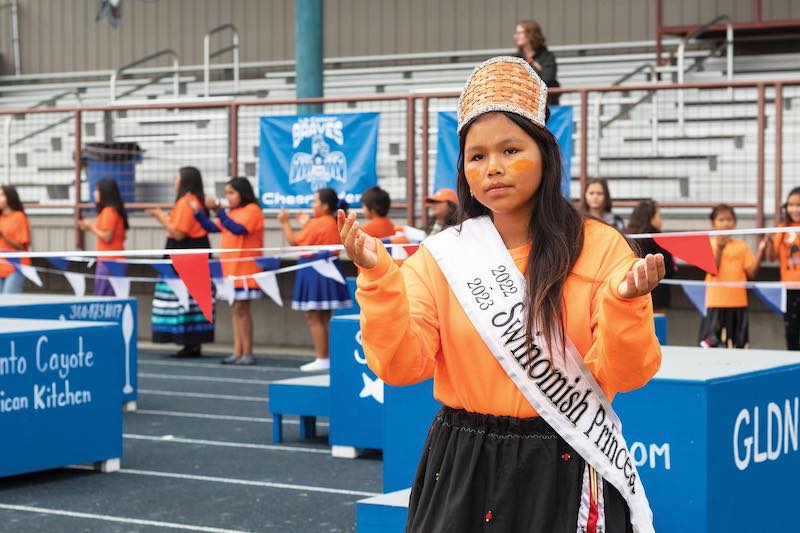
Nearly 170 years have passed since the signing the Treaty of Point Elliott. Since that time, the Swinomish have continued many of their traditional ways of gathering food despite being arrested for doing so even at their customary fishing, hunting, and gathering places. For decades the tribe has struggled to ensure that its treaty rights are recognized and respected. In the words of one of the Swedebs Park displays, “We continue that important work so that our resources, and the habits that support them, will be protected and cared for. The actions we take today uphold our way of life. We do this, not only for our people now but for seven generations in the future. We intend that our descendants may inherit, respect, and honor our traditional ways.”
But the benefit of cultural renewal for the Swinomish has a broader impact for us in the Skagit Valley beyond a sense of restorative justice. Through the tribe’s efforts to bring back the balance and sustainability that was once the hallmark of their way of life, they point the way for all of us to better steward our resources. As I write this final episode in the series on the evening of October 9, 2022 — the day before Indigenous People’s Day — the quote that most resonates with me is one from Swinomish Tribal Member Larry Campbell in 2008. “Everything starts and ends with the land. We have to take care of every bit of it, whether it’s the trees, the water or air. It all has some useful, helpful purpose with it if we ask. But we have to learn how to use it. And we can only do that if we’re there, listening.”
My hope as one of the New People is that the First People will have the continuing courage and pride to tell their stories through projects such as Swedebs Park, and that the rest of us will have the curiosity and grace to listen and respond.
To read the previous installments of this series:
Episode 1: Swedebs Park Tells the Swinomish Journey
Episode 2: After the Deluge
Episode 3: Treaty Time