Remembering Dick Fallis: Writer, Historian, Teacher…Breadman

“History is very important, and keeping the record straight is very important. That’s why I took this on years ago.” — Dick Fallis
Not long after I began the Meyer Sign series, “Tales of the Magic Skagit,” a reader remarked that my efforts at recounting stories of Skagit Valley history reminded them of the late Dick Fallis. Having recently encountered some of Mr. Fallis’ writings, I was both flattered and humbled by the comparison. One bit of wisdom that age has taught me is to accept any compliment sincerely given as a gift; and while modesty is indeed a virtue, responding to praise with anything less than heartfelt appreciation can seem an insult to the bestower of that gift.
Self-deprecation aside, I wouldn’t have the hutzpah to stack my resume up against Dick Fallis’ accomplishments as a chronicler of Skagit Valley history. What our narratives do have in common, however, is that we both came to this place from somewhere else, and we both became enchanted with the stories of the people who came here before us — going all the way back to “time immemorial.” Our way of responding to that enchantment was to share it with others in the hopes that they would return the favor. In that sense, I believe Dick Fallis and I have been similarly blessed, however differently we may have gone about our self-appointed tasks.
For the past year, one of the items on my editorial to-do list has been to write a tribute to Dick Fallis. This past April, on the occasion of my 73rd birthday, I purchased a copy of Bridgeside: Selected Stories of Dick Fallis, Skagit County Historian from the Skagit County Historical Museum gift store in La Conner, Dick’s much loved home for many years. This gave me an opportunity to get acquainted with some of the stories Dick contributed to a number of different publications over a period of decades. I also had the good fortune to meet Dan Royal, for whom Dick became something of a mentor, and who helped compile the stories in Bridgeside. Dan was gracious enough to loan me a set of files with clippings from articles by and about Dick, including a 2007 story about his life by journalist Tony Flynn that appeared in The Argus, written not long after Dick had suffered a stroke.
Richard E. Fallis was born January 31, 1926 in Jonesboro, Indiana. He was the fourth of five children with an ancestry of farmers, merchants, and Quakers. He served in the U.S. Navy in the Pacific during World War II, and afterward pursued a college major in English, communications, history, and education (no doubt with the assistance of the GI Bill). 1956 found him married to Bernice Levitsky and living in Seattle, where he made his “Quaker declaration” the following year on the occasion of the birth of the first of their three children.
It would be interesting to know what led Dick from the Midwest to the Emerald City, a migration similar to that of my own parents following the war (with the result of my being born at the westernmost edge of Manifest Destiny), but in the ‘60s he was teaching at Granite Falls High School, during which time he developed what would become his lifelong passion for local history. While at Granite Falls he founded “Railroad Days”, an annual event that continues to this day, and which foreshadowed acts of “historical activism” that would distinguish his time in the Magic Skagit.
Dick went on to become an instructor at the Oak Harbor branch of Skagit Valley College, which was when he became acquainted with Wallie Funk, himself a well known documentarian of local history as well as a newspaper publisher in Anacortes. Funk told him about a newspaper that was for sale in La Conner and encouraged him to look into purchasing it. The newspaper in question was none other than the Puget Sound Mail, which had the distinction of being the longest surviving weekly newspaper in the state (having been originally launched as the Bellingham Bay Mail in 1873 and relocated to La Conner six years later by its original publisher, James A. Power).
According to Tony Flynn, Dick’s initial impression of La Conner “…was that it was tired and run down, but full of history and ambiance. He learned that some prominent people in town were hoping the Puget Sound Mail would fail and that (owner Patrick) O’Leary would sell it to them cheap so they would have control over the news that went out to its citizens. Instead, Fallis made an offer and soon became its publisher, which didn’t please everyone, he noted.”
The same week that Dick purchased the paper, La Conner’s iconic Gaches Mansion burned down. Through Fallis’ coverage and historic background on the building, as well as his efforts through the newspaper, a grassroots campaign was created to rebuild and restore the site, then get it named to the National Register of Historic Buildings. Today, this gorgeous example of Tudor-style Victorian architecture is best known as the home of the Pacific Northwest Quilt & Fiber Arts Museum. Dick also got the town of La Conner declared a historic district, requiring all future building to meet historic building standards — which again did not please everyone.
When the Shelter Bay community was being created, Fallis teamed up with its developer to provide the purchaser of every lot with a year’s subscription to the Puget Sound Mail to help them become more familiar with their new home. This tactic paid off as subscriptions increased and the paper grew. Having once worked for a newspaper, I can attest to the fact that this is an enlightened approach to growing ad revenue.
According to Tony Flynn’s story, the newspaper came to an end when a rival emerged in the form of the Channel Town Press. “The Channel Town Press started up in opposition to me,” said Fallis. “They had the press and were able to put it out more efficiently than I was. I was a one-man operation.” Dick ended up selling the O’Leary Building. “It was a good time to sell,” he said. “The paper had served its purpose, and with my help, had saved La Conner. That’s something I’m very proud of.” It should here noted for the record that one of the reasons that Dick was able to survive as a one-man news operation was due to the fact that his wife Bernice was employed full time by Skagit Valley Hospital.
Following the sale of his newspaper, Dick returned to teaching at Skagit Valley College, this time at the Mount Vernon campus. He was also an advisor to the college’s Cardinal newspaper. After a couple of years of being a journalism instructor he decided to become a student and subsequently enrolled in SVC’s culinary arts program where he learned to bake bread — a decision that was no doubt inspired by his fondness of crusty Italian loaves. Dick found he had a talent for baking bread, and even his instructor Reid Bennett requested that Fallis bake extra loaves for him to take home. In comparing his roles as newspaper man and baker, Dick wryly remarked, “You can bake a loaf of bread and have fun doing it and no one will come up and say I didn’t put enough salt in it. I can make a good enough living at it. It’s enjoyable and I get no arguments from a loaf of bread.”
Increasing demand for his bread convinced Dick to become a full-time baker, and he started baking 30 loaves a week that were sold through Snow Goose Produce. As his reputation grew, Dick was selling bread as fast as he could bake it, and in 1993 he opened the Bridgeside Bakery inside the old Carnation Condensery Building in downtown Mount Vernon. A couple of years later he went to work for a bakery in Seattle — but after a couple more years he and Bernice decided to move back to the Skagit Valley. He started selling his loaves locally at the Saturday Farmers’ Market and expanded to take in the Wednesday Farmers’ Market at Skagit Valley Hospital.
Even as Dick was becoming known as “The Breadman of Mount Vernon”, the three decades following the sale of the Puget Sound Mail were also highly productive in terms of his output as a researcher, writer, and historian. He took on the role of the Skagit County Pioneer Association’s historian/memorialist, a position previously held by John Conrad. The two had worked together for a number of years since the Mail published annual Pioneer Editions of the newspaper. Most notably, he was instrumental in organizing the Association’s 100 year anniversary — a year-long celebration.
Other organizations that benefited from Dick’s involvement were the Skagit County Historical Society and Museum, where he served as Trustee and President, the Skagit Valley Friends Meeting, in which he served as charter member and clerk, the La Conner Rotary, the La Conner Legion Post, and La Conner Landmarks, where as a charter member he played a major role in the aforementioned effort of getting the town on the National Register of Historical Places.
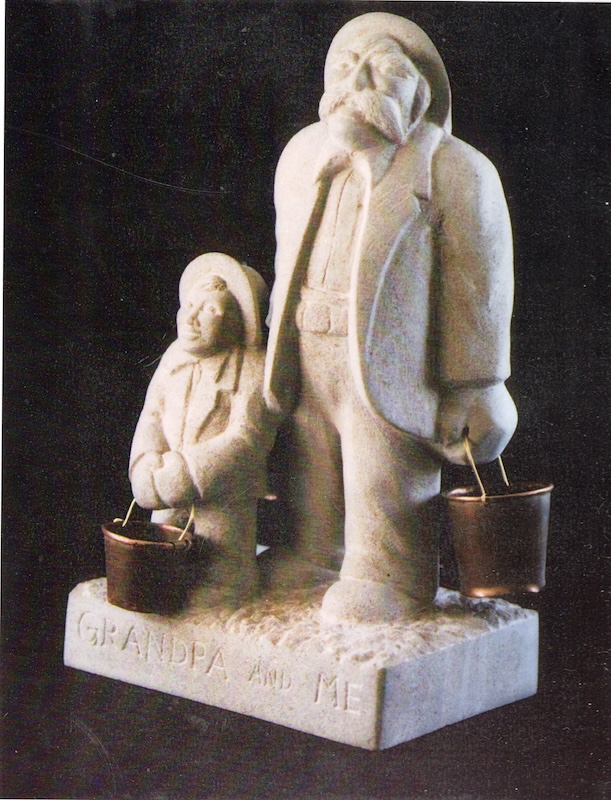
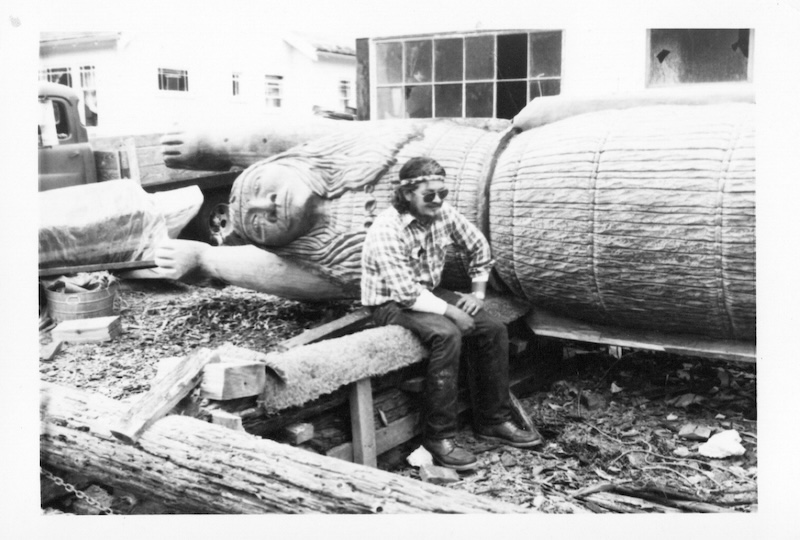
Dick produced many books on local history through his own Skagit-Advocate Publishing, including a biography on early Skagit County preacher B.N.L. Davis, and Amid Fields of Alyssum: A Year at Northern State. He wrote countless historical columns for the Skagit Valley Herald in the 1980s and the Skagit Argus in the 1990s. He promoted and found funding for monuments that included the Maiden of Deception Pass, the River Jam Memorial, and the Jasper Gates Father of Mount Vernon statue on First and Gates Street in Mount Vernon, all of which were done in collaboration with sculptor Tracy W. Powell. He kept the birthday of Skagit County, November 28, 1883 alive by baking an annual birthday cake for county commissioners.
In the summer of 2006, Bernice, Dick’s wife of 53 years, passed away, which led to his decision to retire the following year at age 81 from, as Tony Flynn described it, “the job he never officially had.” He had never been adept with computers and had relied on Bernice to typeset his documents. His duties with the Pioneer Association were passed on to his friend Dan Royal, who worked with the Skagit Valley Genealogical Society and whose roots in the Birdsview area stretch back to 1878. With Dick’s assistance, Dan began the task of compiling his friend’s historic columns and writings gathered from various county newspapers, including the Puget Sound Mail, the Skagit Valley Herald, the Argus, and other sources.
As Tony Flynn noted in his 2007 story, Dick wasn’t afraid of ruffling some feathers when it came to being faithful to history, especially where the treatment of indigenous people was concerned. “You make enemies. That’s one of the reasons I’m glad I’m retiring. These people who say I’m claiming to be the historian of Skagit County. I’m an historian. I’m not the final authority.”
Dick Fallis passed away in 2011. He left this world in a manner I hope I can duplicate: peacefully at home (the La Conner Retirement Inn) with family by his side. The previous year he was honored by Granite Falls, the place where his love of sharing history began, by being named Grand Marshall of the event he had founded, Railroad Days. The Skagit County Historical Museum became the benefactor and publisher of his written histories of the county. His daughter Sarah wrote, “He left behind a legacy of community service, a love of history, the environment and of life. He often remarked about the act of breaking bread with someone as the ultimate sign of trust and friendship, noting that the word ‘companion’ is literally taken from the Latin, ‘con-panis’ or ‘with bread’.”

I was at least two years too late in having the opportunity to meet Dick Fallis, but as I spend time with the stories he wrote and share them through future Tales of the Magic Skagit podcast episodes, I feel a profound sense of kinship. I think we would have gotten along quite well. For one thing, I really appreciate a good loaf of crusty Italian bread.
Thinking back to the compliment I related at the beginning of this tribute, I’m mindful of something my acoustic guitar hero, Leo Kottke, once said: “We all play through somebody.” I’ve reached an age when looking ahead two decades is more an act of aspiration than realism, but in the time I have left in the Magic Skagit my goal is to emulate rather than impersonate Dick Fallis. Even in the space of two decades it is doubtful that I can be as prolific, but my hoped for legacy in this place is to recruit and encourage a next generation of writers who will continue Dick Fallis’ legacy through Meyer Sign’s non-profit endeavor, The Skagit Valley Youth History Project. Given his love of teaching as well as his love of history, I think Dick would be pleased — and at some point before I too become a part of Magic Skagit history, whether as a chapter or footnote, I would like to see the launch of a Dick Fallis Memorial Scholarship for high school students who, like the person whose name it would bear, are deeply committed to telling the stories that explain us to ourselves.