Tales of the Magic Skagit: Tusko’s Rampage
ELEPHANT ON RAMPAGE, BREAKS UP DANCE AND RUINS YOUNG ORCHARD
SEDRO WOOLLEY, Tuesday, May 16, 1922 — Tusko, said to be 1,000 pounds heavier than the famed Jumbo, was on what his trainers termed a rampage here this morning.
Last night Tusko upset two automobiles standing by a circus tent, stalked down the street and broke up a dance, then ambled to the outskirts of the city and smashed down a fence and ruined a farmer’s young orchard.
The trainer was pursuing the beast three miles from Sedro Woolley today.
— The Seattle Daily Times
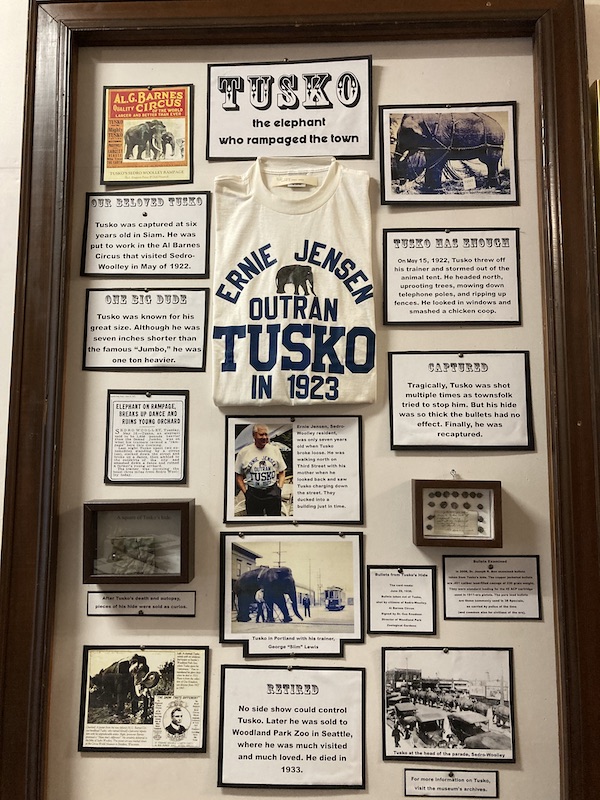
Near the front desk of the Sedro-Woolley History Museum hangs a framed display case that I’d managed to walk past with nary a glance on my previous visits. That changed during my most recent trip to the museum, when the display’s title finally registered on my consciousness: “TUSKO — the elephant who rampaged the town.” Obviously, I had to know more — and thanks to the dedication of some museum staff member or volunteer, the display satisfied my curiosity with captioned photos and artifacts that ranged from the quaint to the slightly more macabre.
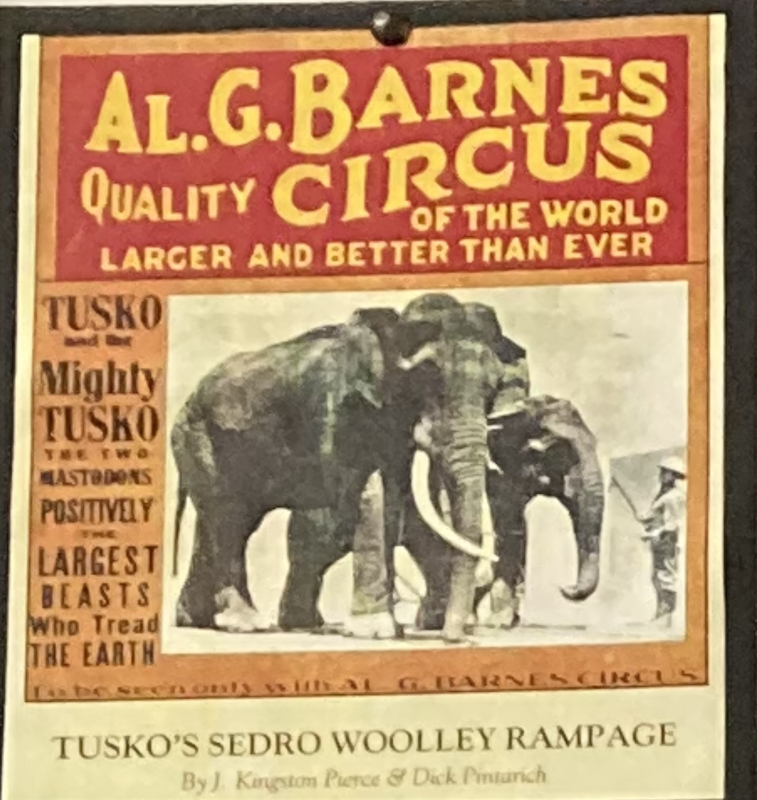
At the tender age of six, Tusko was captured in “Siam” (aka, Thailand) and went into the entertainment business (to put it delicately) with the “larger and better than ever” Al. G. Barnes “Quality Circus of The World.” In fact, Tusko appears to have been a headline act for the circus, judging not only from a playbill with his imposing image in the display case, but also from a photograph of the giant pachyderm (larger than the famous “Jumbo” by 1,000 pounds!) leading a parade in Sedro-Woolley during a visit from the circus in May 1922. Al Barnes advertised his circus (“3 trains double length cars,” no less) as “The Show That’s Different.” It certainly lived up to the hype on May 15, 1922, as the museum display chronicles.
“On May 15, 1922, Tusko threw off his trainer and stormed out of the animal tent. He headed north, uprooting trees, mowing down telephone poles, and ripping up fences. He looked in windows and smashed a chicken coop.”
“Tragically, Tusko was shot multiple times as townsfolk tried to stop him. But his hide was so thick the bullets had no effect. Finally, he was captured.”
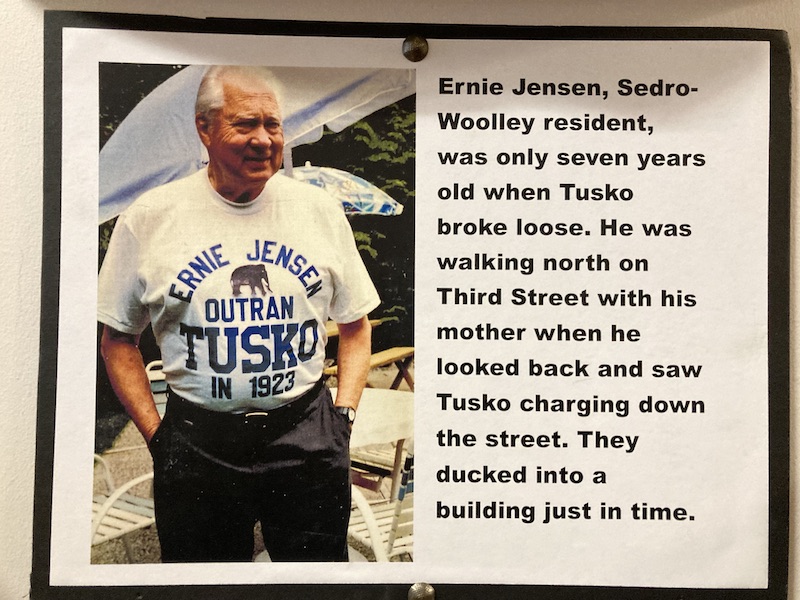
If the day was a memorable one for Tusko, it was certainly so as well for Ernie Jensen. The seven year old and his mother were heading north on Third Street when, as the display narrates, “he looked back and saw Tusko charging down the street. They ducked into a building just in time.” I think it’s safe to say that from this point on in Ernie Jensen’s life, whenever the conversation turned toward the topic of evading of enraged pachyderms, he could proudly boast, “Been there, done that…got the t-shirt.” Which he indeed did.
As for poor Tusko, who obviously could have benefitted from some anger management counseling, the fact that one of the display captions notes that “No side show could control Tusko” would lead one to suspect that the infamous rampage in Sedro-Woolley was not his first rodeo. In any event, he retired from show biz and was sold to the Woodland Park Zoo in Seattle, “where he was much visited and much loved.” He died in 1933, barely a decade after having scared the bejeezus out of young Ernie Jansen and his mom.
This is where the story takes its aforementioned turn toward the macabre. One of the museum display items is a square of Tusko’s hide, which was removed during an autopsy and along with other such gruesome mementos was sold as a curio to people who might also have collected braided hair wreaths.
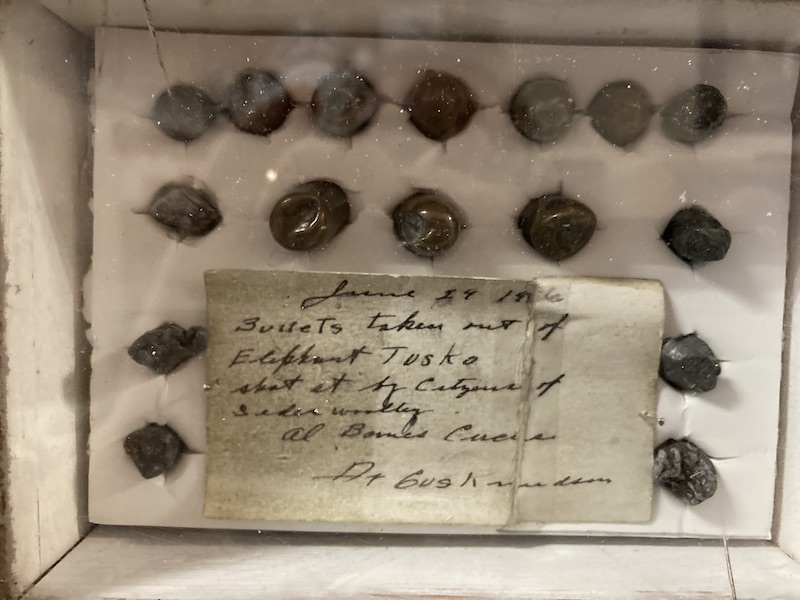
Also in the museum display are the bullets, fired at the enraged beast during his Sedro-Woolley escapade, that were removed during the autopsy. I counted 16 in all, which are included along with the 1936 notation from Dr. Gus Knudson, the director of the Woodland Park Zoological Gardens, that they had been “shot by the citizens of Sedro-Woolley.” An examination of these grisly artifacts by one Dr. Joseph R. Bee in 2006 further revealed that they were “copper jacketed bullets (that) are .451 caliber lead-filled casings of 230 grain weight” and were “commonly used in 38 Specials as carried by police of the time (and common also for civilians of the era).
You might think of this story, which could have turned out far more disastrously than it did, as just one more bit of historic trivia lovingly preserved by a local archivist with an eye for whimsy. But it is much more than that from the standpoint of hometown bragging rights. If you happen to live in Sedro-Woolley, you have the ultimate comeback for anyone who bemoans the more prosaic natural ravages of fire, storm, and earthquake. “Gee, that’s awful,” Ernie Jansen might have replied, “but has your town ever been rampaged by an elephant?”