Tales From the Magic Skagit: The Story of Pasek Cellars
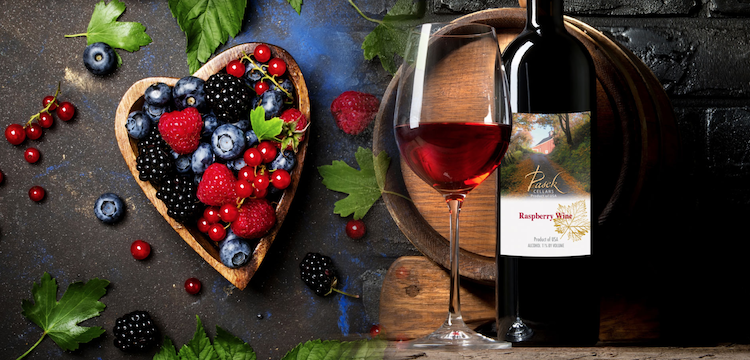
“Life is a bit of a random path, don’t you think?”
- Judy Pascale, Pasek CellarsI never fancied myself a fruit wine aficionado. I think it had something to do with the perception formed from countless ads for Annie Green Springs and Boone’s Farm. And then, of course, there was Bali Hai, a “grape wine punch” made by Italian Swiss Colony Wine back in the days not long after the end of Prohibition, when California winemakers were hoping that sugar and supercharged fermentation might lure people into putting aside their Schlitz and quaffing a glass of “fortified” fruit juice instead.
I still remember the TV commercial in which a zoftig Polynesian matron in a mu-mu lifted a jug of tropical themed vino and lustily exclaimed, “Ah…Bali Hai.” I recall thinking, “I’ll have what she’s having.” It would be many years, and some time in Italy, before I discovered what really good wine tasted like. Goodbye Matus and Lancers…hello old vine zinfandel. Yes, there was a time when the prevailing wine drinking gestalt among Americans might best have been summed up by a sign I once saw that read, “Wine: how classy people get loaded.” It’s sad to think that was true…but then, we also drank some pretty wretched coffee back in the day.

As it so happens, Judy Pascale, the co-owner of Pasek Cellars, didn’t start out as a fruit wine lover either. The fact that she and her husband, Dave James, now own a winery that produces fruit wines should probably be sufficient evidence that fruit wine, like my taste in vino, evolved for the better — thanks in large part to a patient dedication to the unique fermentation properties of berries.
For Judy, the road to wine making was lined with bathroom tissue. Born in Delaware, she moved across the country to Washington after taking a job with Scott Paper in the 1980s. “I started in toilet paper,” she says. It was there that she met Dave. They moved back east at one point to work at the Scott Paper headquarters, but returned to Washington when the company merged with Kimberly Clark.
Dave left the paper mill the following year and went to work for the noted Washington wine maker Chateau Ste. Michelle as their director of purchasing. “He was already getting into wine — purchasing it at a high level — then we had our son and he no longer wanted to commute to work, so he became a licensed agent selling wine for five different wineries,” Judy says. “And he loved going to wine shops.”
Her husband’s love of wine shops, Judy notes, led to a “bold reputation for covering a lot of territory because he just liked hunting around for stuff that he was interested in and selling wine.” Which is how Dave James met Gene and Kathy Pasek, the owners of Pasek Cellars.
Pasek Cellars began in 1995 producing cranberry wine. “It takes a lot of patience because it takes a while for fermentation to start with cranberries,” Judy explains, “but Gene figured it out and made a really high quality product.” Quality is what set Pasek Cellars apart from the Annie Green Springs and Boone Farms of the pop wine world. “A lot of fruit wines are flavored — pinot gris infused with juice — and some of them are just terrible,” says Judy. “Our wines are all whole fruit. I really appreciate the quality of what we put in the bottle.”
So did the owners of Whidbey Island Winery, whose wines Dave James had been selling as a licensed agent. They encouraged Dave to reach out to Gene and Kathy Pasek in the expectation that he could help grow their winery’s business. “Dave thought fruit wine was the dumbest thing ever,” says Judy, “but once he started selling Gene and Kathy’s wines he quickly realized that they filled a niche that isn’t satisfied by merlot, cabernet, chardonnay, and all those other varietals — and they couldn’t produce enough to keep up with the demand.”
Dave joined the Paseks as a partner in 2001 with the investment of additional wine making equipment. Like a well-aged port and a wedge of stilton cheese, the pairing of Dave and Gene’s talents were an excellent fit. “Gene was more of an artist, and Dave really understood the logistics of supply chains, so it was a good balance,” notes Judy. Dave studied Gene’s techniques, and as Gene’s health declined Dave took over more of the wine making responsibilities. In 2015 he acquired Pasek Cellars from Gene and Kathy, and Judy joined him in running it.

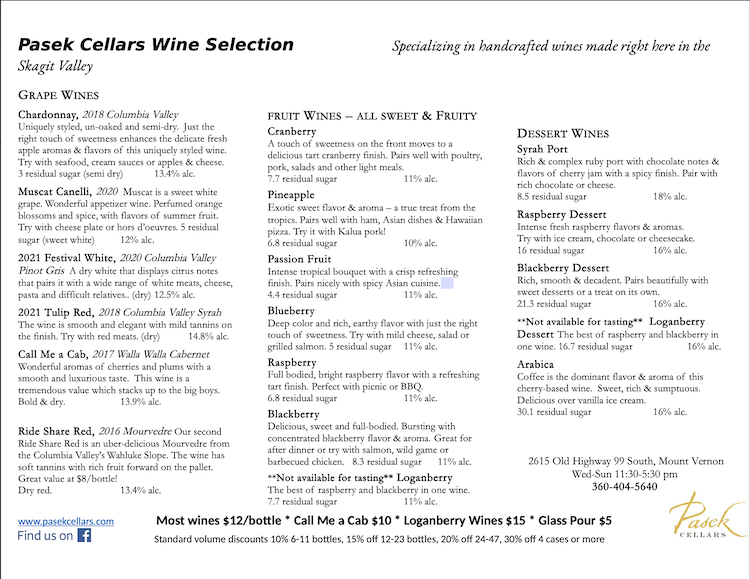
Today, Pasek Cellars’ wine repertoire encompasses some seventeen products, including five berry wines, two tropical wines (pineapple and passion fruit, anyone?), two dry reds, three white wines, and five port style dessert wines, including an “Arabica coffee wine” that I personally can’t wait to wrap my palate around.

From the mom and pop operation started by Gene and Kathy, Pasek Cellars has grown into a 10,000+ case wine producer, with Gene Pasek’s original cranberry wine accounting for one-third of total production. In July 2020, Dave and Judy moved their tasting room in Conway to a quaint little storefront at 2615 Old Highway 99 — conveniently located across the street from Meyer Sign. How handy is that after a long day of sign fabrication?
I’d be remiss if I didn’t share one other significant fact about Pasek Cellars: it is the official wine of the Skagit Valley Tulip Festival, and the winey’s tasting room always offers a dry red and dry white that feature a different original artwork label from each year’s event. This year’s Tulip Festival releases are its 2018 Syrah Tulip Red and 2020 Pinot Gris, and with bottle prices ranging from $8 – $15 (volume discounts apply) you can easily afford to collect them all — which is exactly what I plan to start doing on my next trip to Meyer Sign.
In vino veritas — in wine is truth — and the truth is that Pasek Cellars is yet another example of a local agricultural enterprise whose reputation, like that of our world famous blooms, has grown well beyond the Magic Skagit. I’ll drink to that.
