Citizens Academy: Welcome to Cop Class!
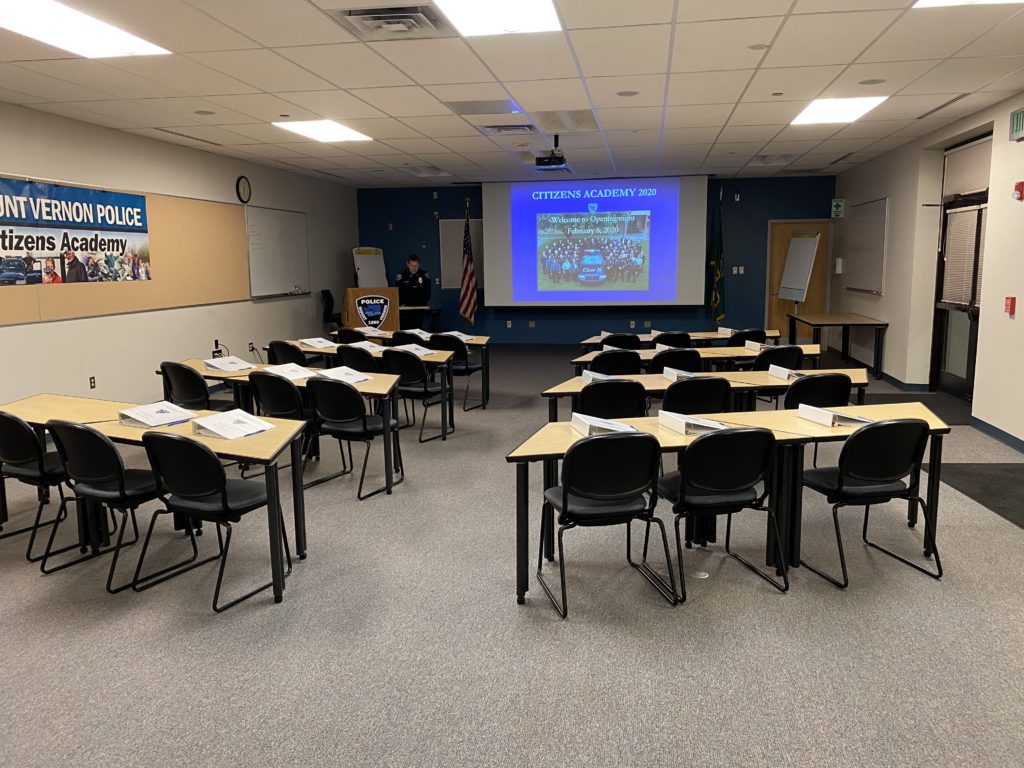
The agenda for the very first class of the 26th Citizens Academy packed a heck of a lot into a three-hour format — so much, in fact, that I’ve divided its subject matter into several parts. The first part (this blog) focuses on the philosophy and organization of the MVPD and the concept of “community policing” that underlays it. Subsequent parts will take a deeper dive into a key component of community policing: crime prevention and the role the community plays in augmenting “the thin blue line” that protects and serves its citizens.
Your First Night
On your first night at Citizens Academy, you’ll get your photo taken for the official ID badge you’ll wear on a cool blue lanyard. You’ll collect your course binder, complete with 15 color coded curriculum tabs and a cover emblazoned with the Mount Vernon Police Department badge (est. 1890). You’ll pick up your name plaque on folded card stock and claim your place in the brightly lit classroom. Get your pens and handouts ready, It’s time to get schooled about your police department…and your community.
You’ll most likely hear from Mayor Jill Boudreau, who started her own public service odyssey as a receptionist at MVPD and over the next seven years advanced to the position of community service officer. “The best weapon against crime is a well informed citizen,” she says from experience. In fact, Mayor Jill has now modeled the Citizens Academy program with one that the city of Mount Vernon has started, known as “Civic Saturday,” to provide a similar level of insight into the workings of city government.

You’ll also hear from Police Chief Chris Cammock on the MVPD’s philosophy of community policing to “solve contemporary problems related to crime and fear of crime, social and physical disorder and neighborhood decay.” With Lieutenant Greg Booth, who oversees the department’s Crime Prevention Team, as head instructor for the evening, you’ll be introduced to the officers that comprise his group, which is critical to delivering on MVPD’s vision of law enforcement.
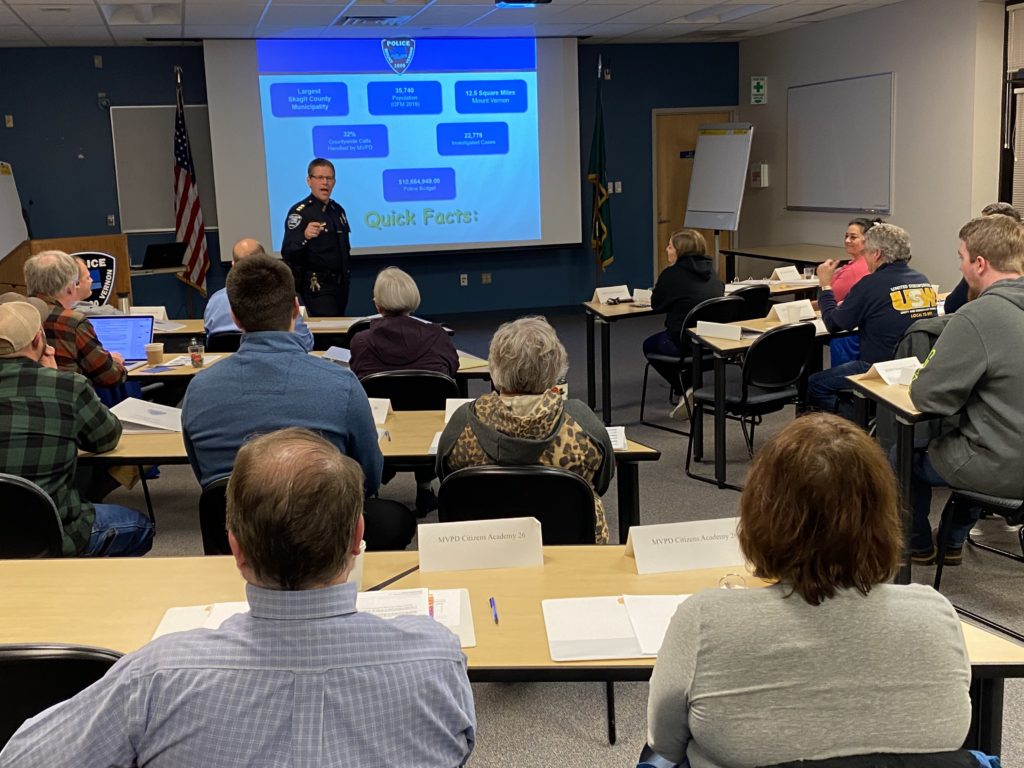
Along with the folks in blue, you’ll also make the acquaintance of your fellow citizen classmates, and learn through their introductions not only who they are, but why they’re part of Citizens Academy. As you might imagine, you’ll discover a wide variety of backgrounds. There are former police department employees; the person who knew a kid who went on to become a Mount Vernon cop; a Texas transplant; a person who works with kids with disabilities; a city engineer; and even a person who commutes from Oak Harbor and is currently studying criminal justice through Skagit Valley Community College.
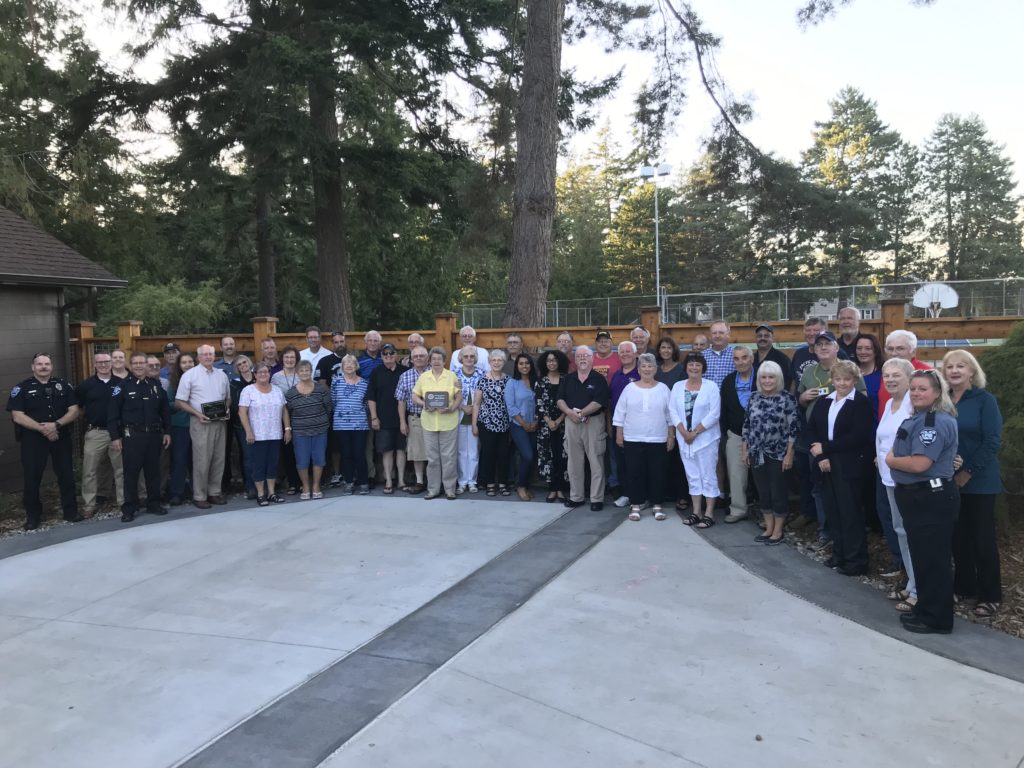
You’ll also be introduced to an esteemed group of Citizens Academy alumni who will be present at every class for the next 12 weeks: the members of Citizens on Proactive Patrol (COPP). While there are a multitude of narratives among Citizens Academy members past and present, however, what they all tend to have in common is a desire to be more involved in the community, an interest in the workings of our criminal justice system, and the belief that supporting our local police is an attribute of good citizenship. Some might go so far as to consider it a civic obligation. It takes humanity to make an organization humane.
Facts & Philosophy: Who is the MVPD?
To understand the Mount Vernon Police Department, you need to know a few basic facts about the town it is sworn to protect and serve. For starters, it is the county seat and center of services for the Skagit Valley. With a population of just under 36,000 spread out over a 12.5 mile radius, it is also a hub on a major north/south transportation corridor that sees thousands of people a day passing through.
As the largest municipality in Skagit County, it’s no surprise that Mount Vernon also boasts the largest police agency — one that handles nearly 23,000 calls a year (more than a third of all calls to county agencies). Responding to this need currently accounts for a budget of $10,664,949, which when combined with the fire department represents nearly 60% of the city’s total budget.
As Chief Cammock explains, “What you don’t see behind that budget number is that the majority of it goes toward people. This is a people-driven industry: it takes people to police people, and we augment them with technology.” And, as we will learn in this first session of Citizens Academy, it takes a dedicated cadre of volunteers as well.
In its broadest sense, the vision and mission of the MVPD comes under the category of “Developing Healthy Neighborhoods” in terms of city priorities. Viewed in this light, Chief Cammock explains, “It is a ‘hometown’ atmosphere where residents and government work together in a trusting environment. This is our belief system.”
“Our policing philosophy depends on a shared sense of responsibility,” he further elaborates. “Reduction of crime and fear, solutions to neighborhood problems and general issues of public safety are shared responsibilities. We have the training and equipment, but you have a function as a citizen. We have to pair together as eyes, ears, witnesses, idea generators. It’s a partnership.”
This essence of this partnership is distilled in two words: “community policing.” The concept is more than just warm and fuzzy. As espoused by MVPD, it is the method by which we ““solve contemporary problems related to crime and fear of crime, social and physical disorder and neighborhood decay.” The broader goals of community policing are responsive service, an informed community, and crime reduction through a deployment of resources that meets the varying needs of each Mount Vernon neighborhood.
“Our best success is through engagement,” says Chief Cammock. “We can’t become an expensive institution, which means we do this by being intentional about planning, how we police, a strategic focus on neighborhoods, and managing crime, actual and perceived.”
Organizationally, the MVPD is divided into service and operations bureaus. The latter bureau is comprised of three divisions: patrol (i.e., officers in uniform), criminal investigation, and crime prevention. These functions collectively employ a staff of 60, 46 of whom are commissioned police officers. The activities of these individuals involve much more than arresting bad guys. They focus on aspects of our communal life which will hopefully reduce the occurrences of people doing bad things, including education about crime prevention, increasing community resistance to crime, the fostering of human networks that connect the public to needed services and tools, and solving problems that improve the quality of life in our neighborhoods.
If you’re looking for an example of where the rubber meets the road when it comes to the reality of community policing, consider the example of S. 27th Street in Mount Vernon. Following some drive by shooting incidents, four houses were identified as the nexus. As Lieutenant Greg Booth recounts, “We worked with that neighborhood to turn the power base around so that the other 64 houses were in control.” Today, the majority of calls from the neighborhood are service calls rather than incidents.
Which brings up the issue of success metrics when analyzing the impact of community policing. While conventional wisdom might hold that decreasing the number of calls to a police department would be proof of its effectiveness, Chief Cammock prefers to define success in terms of a continuum of preferred outcomes: elimination of a problem, mitigation of that problem through measures resulting in fewer incidents related to it, the reduction of harm per incident (even if the number of incidents remains the same), improvement in the handling of incidents, and mitigating a problem in such a way that takes it out of the domain of the police/criminal justice system.
“People calling the police is a good thing,” says Chief Cammock, “because it means engagement.”
The importance of engagement becomes much more obvious when you explore the most critical component of community policing: crime prevention. We’ll delve more fully into this subject in our next blog.
See you in Cop Class.