Day Seven: Farewell, Chris Kraft
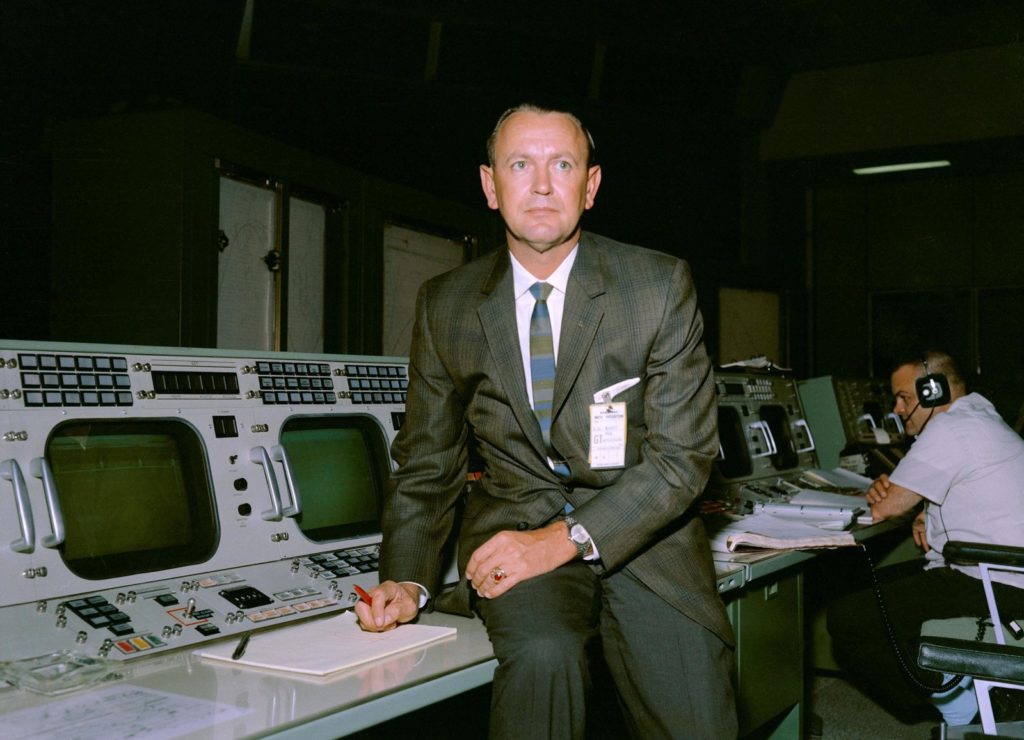
On July 22, 2019 — two days after the 50th anniversary of the Apollo 11 Moon landing — the man who shaped the culture of the organization responsible for that accomplishment passed away in NASA’s company town of Houston, Texas.
A Space Program Pioneer
Christopher Columbus Kraft Jr. was born in Phoebus, Virginia (now part of the city of Hampton) on February 28, 1924. His German immigrant grandparents had given his father the name of the famous ocean-crossing explorer and European discoverer of the New World because he was born in New York City on the dedication day for Columbus Circle in 1892.
Kraft enrolled at Virginia Tech in 1942. A childhood injury to his right hand (he was burned in a fire) prevented him from enlisting in the Navy during World War II. He instead concentrated on baseball and his studies, the latter of which included a new discipline at his school: aeronautical engineering. He was a quick study, finishing his aeronautical engineering degree at Virginia Tech in two years.
After graduating in 1944, Kraft went to work as an engineer at the National Advisory Committee for Aeronautics (NACA), NASA’s predecessor organization, where he helped design a space program from scratch. It was a mighty undertaking. In the late 1950s and early 1960s, Kraft led the team that created Mission Control, devising the first space flight plans and even designing a communications and tracking system to monitor the astronauts and their health. He came to believe that most of the work of guiding humans in space would happen on Earth, and his group created specific roles for ground controllers along with the rules to govern decision-making during missions.
When Kennedy made landing a man on the Moon by the end of the ‘60s a matter of national priority, Kraft described himself as “paralyzed with shock.” It may have seemed a strange admission coming from a man who epitomized the stereotypic rational detachment of an engineer, but it goes to show just how aware he was of the enormity of the task that his President had set before him and his organization.
NASA’s First Flight Director
Kraft became NASA’s first flight director and managed all of the Mercury missions, as well some of the Gemini flights. As flight director, Kraft was the one who gave the final “go” that blasted astronauts into space. He described himself as “shaking like a leaf” as Alan Shepard was poised to become the first American in space. “A man was sitting there on top of a rocket…the potential for disaster was never more than a moment away,” he later recalled.
Kraft’s temperament and management style stamped themselves on the culture of NASA, in which engineers and experts held sway over astronauts, agency bureaucrats, and politicians. His style could be confrontational. He once ordered Gemini 4 astronaut Ed White back into his space capsule during the first U.S. spacewalk in 1965. White would later declare this as “the saddest day of my life,” even as he obeyed Kraft’s command. He famously clashed with Mercury astronaut Scott Carpenter, the second American after John Glenn to orbit Earth, when Carpenter’s capsule ran low on fuel and splashed down in the Caribbean, 250 miles from its target. “He was completely ignoring our request to check his instruments,“ Kraft later wrote. “I swore an oath that Scott Carpenter would never again fly in space. He didn’t.”
“Much of the NASA culture as we envision it really derives from Chris Kraft,” said author Michael Cassutt, who writes about the space program. Another historian said of him, “He was the general in battle with his troops and, you know, he had to coordinate all of them. He had to digest all these bits of data that were coming at him from all these different systems, all these different flight controllers.”
Kraft was a senior planner during the Apollo lunar program, but by the time of the Apollo missions the job of flight director had been handed over to Gene Kranz. Kraft nevertheless was in the control room when the controllers he had trained monitored and guided Neil Armstrong and Buzz Aldrin to the Moon’s surface to fulfill the promise Kennedy had made eight years earlier. He later oversaw development of the space shuttle as the head of NASA’s Johnson Space Center in Houston. He retired from NASA in 1982, after having spent a decade as the director of the Johnson Space Center. He remained in Houston, where he worked as a consultant for the industry.
The Tragedy of Apollo 1
Kraft’s leadership was profoundly tested after the Apollo 1 launchpad fire in 1967 that killed three astronauts (including Ed White) during a countdown rehearsal. Kraft said he wrestled with whether the rush to the moon ultimately killed the crew, but was candid about where the buck stopped. “We allowed the poor workmanship to happen,” he said. “That was unforgivable, frankly. That we knew it was happening. We weren’t willing to stop the wheels to fix it.” Kraft said he never got over the disaster.
Kraft responded to that first loss of human life in NASA’s history by committing his organization to become better than before, and he and his team went about making significant changes to spacecraft design. “The hardware was bad. The planning was bad,” Kraft later told the Houston Chronicle. “It is a dastardly thing to talk about because it was the thing that ultimately saved the Apollo program. That is a terrible thing to say, but it’s true.”
Recalling the 1986 Challenger explosion, Kraft seemed to still think of himself as part of the team, despite having retired four years earlier, when he said, “We weren’t willing on the shuttle to fix the O-rings in the boosters. We weren’t willing to take the damn system by the hand and fix it before we said we were going to fly…We had a creed in Mercury that we came up with and that said we will never fly with a known problem that will kill us. Never…We did on the shuttle…That was unforgivable.”
A Vicarious Astronaut
In 2011, NASA renamed its historic mission control building the Christopher C. Kraft Mission Control Center. Following the Apollo mission, NASA began to focus more heavily on robotic landers, and this concerned Kraft, who wrote in his autobiography, “Any argument for dropping or curtailing manned space flight is fallacious. This nation can find no better investment in the health, safety, security, education, and overall well-being of the American public than for a visionary president to declare that Americans will land on Mars. And then make it happen.”
Ironically, the man who did so much to get humans into space once said that the only way he would have personally ventured into space was if he was “anesthetized.” But in a sense, he didn’t physically need to. ”I flew on every flight — vicariously. I didn’t have to go. I mean that. I used to tell people back then when we’re flying, I have this feeling that’s what we’re doing all the time. And then when we stop flying, I don’t believe we did it. That was a strange feeling…I was in my revelry when we were flying. My people were the same way. It was such a tremendous pleasure out of making things happen well and safely and knowing that they were contributing to that part of the program. I think it was extremely important to all of us and that was our payoff. We didn’t make any money working for the government. But we sure got a hell of a lot of enjoyment out of it.”
We need more public servants like Chris Kraft.