Day Four: The Vindication of John C. Houbolt
On July 20, 1969, two Americans set foot on the surface of the Moon. Fifty years ago, millions of people the world over held their breath and released it in a collective gasp of amazement at the courage, audacity, and brilliance of this feat. Half a century later, the world is reliving this moment through documentaries, news features, and the recollections of those who were a part of the endeavor as well as everyone born before 1960 who remembers where they were and what they were doing when Neil Armstrong announced to Houston, “The Eagle has landed.”
Much of the 50th anniversary celebrations of the Apollo 11 mission will revolve around the astronauts, to be sure, and around the technological marvels of the spacecraft and systems that took them safely to the Moon and home again — not to mention the organizational genius of NASA and the vision (however reluctantly pursued at times) of President John Fitzgerald Kennedy.
The Size/Weight/Fuel Conundrum
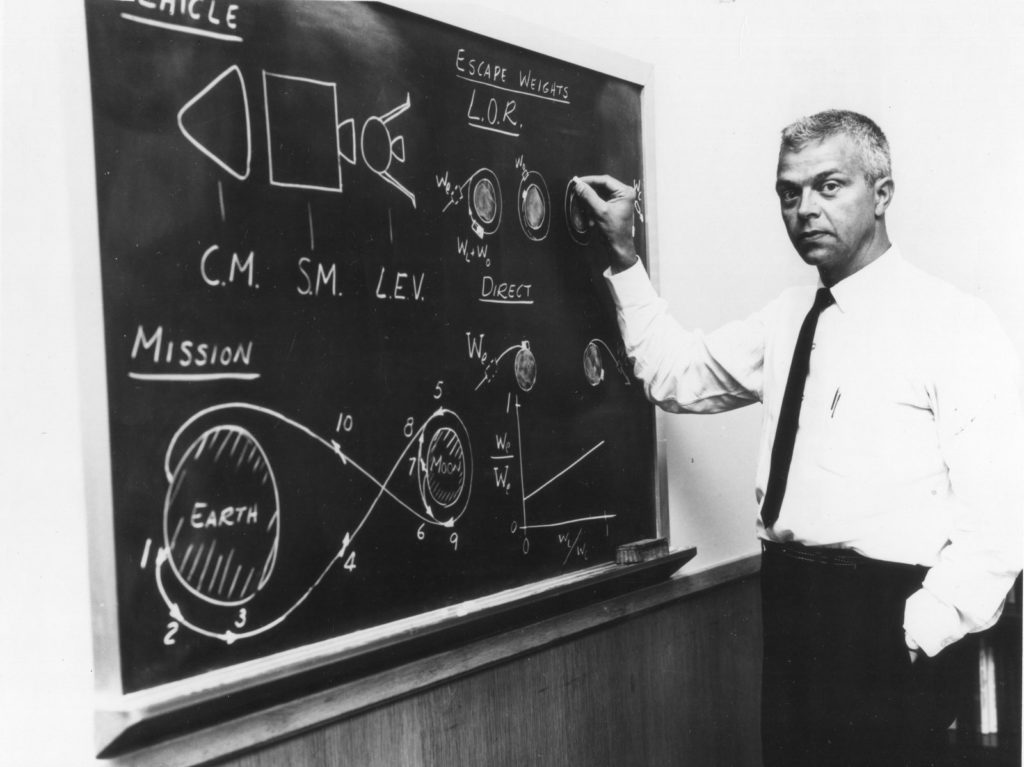
In the midst of the hoopla surrounding the event and the individuals who took part in it, you probably won’t hear the name John C. Houbolt — but you should. He was, after all, the individual whose persistent genius led to the solution of a problem that had been vexing NASA since the beginning of the Apollo program: how, exactly, does one go to the Moon? The answer, zealously promoted by Houbolt at no small risk to his career and credibility, was LOR: lunar-orbital rendezvous. It was LOR, as much as their spacecraft, that got Neil Armstrong and Buzz Aldrin onto the Moon and off again.
The most obvious way to get to the Moon is the way I had imagined it back in my Disney-Man-In-Space youth: direct ascent: a single rocket traveling to the Moon and back — vertical launch, vertical landing — just like in the science fiction movies. One of the biggest challenges to flying to the Moon is balancing weight and fuel. If you are flying a single rocket, it has to be big enough to carry the fuel required to leave Earth’s gravitational pull, get to the Moon and land, launch itself back off the Moon, then have enough fuel to return to Earth while carrying the weight of a heat shield heavy enough to keep it from burning up on re-entry into the Earth’s atmosphere. A single rocket to do all of this would be enormous — which would, of course, require a lot more fuel to propel. Fuel is heavy, and the more fuel you carry, the bigger the rocket has to be. The bigger the rocket, the heavier it is, and the more fuel you need…ad infinitum.
Rendezvous Science
An alternative to direct ascent with a single rocket is the use of multiple rockets. One to get you out of Earth’s gravitational pull and into Earth orbit, and another to get you to the Moon before returning to the orbiting craft for re-entry to Earth’s atmosphere. The necessity of bringing spacecraft together in space, however, raised a challenge as seemingly intractable as that of the fuel/weight/size conundrum: rendezvous. The complexities of rendezvous in space were so daunting that it was unclear that the mathematics and speed of computation required to bring two vehicles together at a precise point in space and time could even be developed.
The first people to start thinking about rendezvous in space were a group at NASA’s Langley Research Center in Hampton, Virginia. Not long after Sputnik, one of the Langley scientists went looking for books on orbital mechanics in the center’s technical library. His search turned up just one book: Forest R. Moulton’s “An Introduction to Celestial Mechanics.” Fortunately, it was the most recent version: the 1914 update of the original 1902 edition. By the summer of 1959, Langley had formed two different committees to study how to perform rendezvous, and both were chaired by a brilliant scientist, engineer, and analyst named John C. Houbolt. Such was his obsession with the challenge of space rendezvous that Houbolt became known as “rendezvous man.”
Houbolt set out to solve the problem of rendezvous by doing some heavy duty math. Even before Kennedy became president, he had sketched out the steps of a basic flight to the Moon. According to his calculations, you could save almost half the weight of a Moon rocket by using a lunar-orbit rendezvous, rather than hauling everything all the way to the Moon and back. This would mean being able to cut the total weight of a launch rocket and spacecraft by half. The seemingly impossible had become mathematically feasible.
LOR vs. EOR
You would have thought that the LOR science being researched at Langley would have been enthusiastically embraced by NASA. But Houbolt and his LOR team came up against no less a legend than Wernher von Braun, who championed the concept of Earth-orbit rendezvous (EOR). As envisioned by von Braun, EOR would require the construction of an orbiting work platform where parts of a Moon rocket could be assembled or fueled. Von Braun had a long held passion for an orbiting space station, as anyone who watched Walt Disney’s “Man In Space” series will remember.
In addition to the time and resources that would be needed by the EOR approach, each lunar mission would require at least two Saturn V rockets — never mind the cost in time and dollars of building a space station to assist a lunar mission. Whatever its engineering merits or deficiencies, EOR was a budget buster. Nevertheless, von Braun threw some heavy weight at NASA, and it appeared the EOR camp would prevail. Houbolt made a last appeal for LOR by way of an impassioned memo aimed over the heads of his supervisors. While it may have resulted in his no longer getting a Christmas card from his boss, it earned him a hearing with the decision body that would end the fierce 14-month debate that had been going on between the EOR and LOR camps. In a decision that emanated from Washington, LOR and its staunchest advocate, John C. Houbolt, prevailed — having even won over von Braun in the end.
The decision to land a man on the Moon via lunar-orbit rendezvous resulted in one of the strangest looking flying craft ever created…and the first spacecraft designed solely for use off of Earth: LEM. The fact that the lunar module would never have to fly through an atmosphere meant that it didn’t have to be structurally robust (its titanium skin was the thickness of three sheets of aluminum foil), nor did it have to be aerodynamic. It would only ever fly in space, and then part of it would be left in space, and part of it would be left on the surface of the Moon. Proving the engineering adage, “form follows function,” it was a study in cubism. And it worked brilliantly, thanks to lunar-orbit rendezvous…and John C. Houbolt.