Meet Doug Dosmann: A Conversation with the Designing Mind Behind Meyer Sign & Advertising
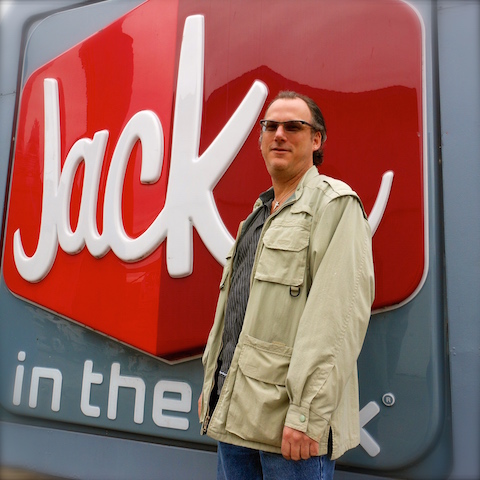
Doug Dosmann: a man who knows “you know what” about great signage!
If you are a parent — a role for which there is no early retirement — you’ve probably faced your share of “profound questions” as the children in your life have grown. Even including “The Talk,” the question I’ve found to be the most challenging is, “What should I be when I grow up?” The answer I gave my children years ago — and the one I stand behind to this day — was, “That’s something you’re going to have to figure out on your own; but one thing I can tell you is to find a way to be paid for your creativity. And with the possible exception of accounting, there are a lot of ways to be creative.”
Doug Dosmann, Meyer Sign & Advertising’s art director, experienced that epiphany early in life, and we’re thankful he did. I recently sat down with him to learn more about what he does and how he does it — and I think you’ll enjoy getting to know the “designing mind” behind our company as we discuss what makes sign design a unique creative discipline, the technology changes Doug has seen over the years, his grandest ambition as a graphic designer…and why neon still matters.
[Me] How did you end up in the Skagit Valley?
[Doug] I was born in Mishawaka, Indiana (spelled just like it sounds), right next door to South Bend — so I’m a Fighting Irishman. My family moved to the Seattle area when I was in second grade, and we stayed for a couple of years with my grandmother before going back to Indiana. My sister and I came back on our own a couple of years later and decided to stay. Indiana was flat and boring, and I hated the winters. There was so much more to do here with the mountains and the ocean. I thought I’d be helpful and find a place for my folks to live. I remember riding my bicycle to look at houses for sale and talk to the realtors, and then sharing that information with my parents. My dad eventually had a conversation with me about how this was a decision that he and my mom needed to make. I still love it here.
[Me] Where did you get your training as a graphic designer?
[Doug] I initially went to Cornish College of the Arts in Seattle, which is more of a school of allied arts — music, dance, fine arts, graphic arts, etc. It was a good school, but it was too slow a pace for me — I wanted to be out in the field designing stuff. We studied things like color theory and art history, and I was getting kind of bored with it, so I decided to enroll at the Art Institute of Seattle back when it was making its transition from being the Burnley School for Professional Arts. At that time — I was about 19 or 20 — I was struggling to decide if I wanted to stay in the grocery industry or become a designer. I eventually decided in favor of the Art Institute and graduated in 1987. My first job was with an awning company. Awnings were kind of the new thing, and I was actually involved with one of the first drive-through espresso places in Lake Forest Park. I stayed at the awning company for about five years.
[Me] When do you remember wanting to be a designer?
[Doug] I actually wanted to be an architect at a very young age and spent a lot of time building with Legos and Lincoln Logs. When I would sit down and sketch I liked to play around with perspective. I realized, however, that to become an architect I’d have to go to school for at least six years, and that just wasn’t on my agenda at the time. I got into graphic design to do the fun, creative stuff, but without being so precise. You get to color outside the lines.
[Me] What makes signs unique as a design discipline?
[Doug] The thing that interests me most about the sign industry is the fact that it’s really cool to see things you’ve designed in full 3D when you drive down the road, and to see it in another light when it’s lit up at night. That makes it all worthwhile, and as my portfolio has grown, I see more signs around that I did 10 to 15 years ago. It’s cool to see them still up and working.
[Me] Can you describe how the sign design process typically works?
[Doug] It has evolved over the years with technology, but the basics are still the same. I get input from the sales rep, and a sense of the direction that the client wants to go in — hopefully with some photos as well. We do the code research to see what options we have, and of course budget plays a huge part. I’ve been known to design “outside the box,” which can be a bit of a challenge for the fabricators — but it’s also my objective to get the “pretty picture” across to the customer and hopefully “wow” them. If I don’t, I feel I’ve missed the mark. Something I ask the sales reps about is what the client is like. What is their personality? What is their office like? What’s the decor? Do they have color suggestions?
[Me] Thanks to the technology, I would think that options you might not have been able to offer within the realm of a client’s budget in the past are now possible, yes?
[Doug] Absolutely, that’s true.
[Me] How have the tools of your craft changed over the years you’ve been doing it?
[Doug] Well, I used to push a lot of markers around on paper. That was fine for the initial “pretty picture” presentation, but if the client said, “I’d like to see that in blue instead of red,” that created a bit of a problem. I still have some of the old tools in case the power goes out, and I still have the knowledge of how to use those tools. People coming into the industry today might not have those basics, but just get behind a screen and start designing. To have the fundamentals down and do the sketching and concepts is important. I also have a huge physical library of books and reference materials, but nowadays all of that can be found online. You can punch in a description on Pinterest and get a ton of ideas and even directions that you might not have considered, so there are all sorts of approaches out there today. Pinterest and online trade magazines and organizations, as well as competitors, can give you a lot of ideas. I used to do a lot of neon in the casino industry. and I still feel that it has its place in the market. It has a big, strong impact. LED is certainly easier and less expensive to work with, but from a design point I want the pop that you get with neon.
[Me] If you could make a sign for anything in the world, what would it be?
[Doug] I would love the opportunity to do a theme park, something on the scale of a Disneyland — everything from the logo, to the ‘way’ signs, down to the bathroom signage — a design theme that extended to the whole property. Some of the casino projects I did in the past had a common theme, but it was all generated for the gambling industry, and I’d prefer something more family-oriented. It would probably be aquatic, since as a kid I wanted to live underwater.
[Me] In your career, what is the project that stands out in your mind?
[Doug] There was a project a couple of years ago that had a lot of passion in it, even though it was fairly simple. It was a plaque that I designed for a fire station in Bothell, Washington that incorporated pieces from the World Trade Center that were being displayed in memory of the first responders to 9/11. There was a lot of emotion behind that design. I started from photos of twisted metal, and I went from there.
[Me] In the time you’ve been with Meyer Sign & Advertising, what accomplishments are you proudest of as part of this team?
[Doug] Number one, I feel I’ve helped the company establish more of a presence in the marketplace with updating our website, designing the new logo, and establishing the direction we are going in with our “look.” I took this on as a personal challenge…a marketing scheme, if you will, for a company that had a dry look to it. It needed an update and some splash, and I feel that I’ve accomplished that in a short period of time. Today, instead of phone book ads we are relying heavily on our website and social media to promote our brand, and I encourage people to keep up with what we are doing by following us on Facebook. My long term goal is to change the “sign scape” here in the Skagit Valley.
[Me] While Meyer Sign & Advertising may not get all the sign business there is out here in the Skagit Valley, it seems to me that any company that is serious about the role that signage plays in their marketing efforts is going to want to have a conversation with you.
[Doug] Definitely!