Tales of the Magic Skagit: Welcome to the People’s Republic of Edison, Comrade!
“This looks like something you’d find interesting,” said my wife as she handed me an 8 1/2 by 11 trifold from the assortment of Skagit Valley tourist information that she has collected since even before we moved here nearly a decade ago. I should note that her collection would probably qualify our Mount Vernon address as a quasi-official tourist information bureau/chamber of commerce. It’s a collection that is constantly updated and replenished owing to the fact that our out-of-town guests never fail to return home absent a bulging folder of places-to-go and things-to-do in the Magic Skagit. I love this about my wife, who is also a source of inspiration for many a Tales of the Magic Skagit story idea.
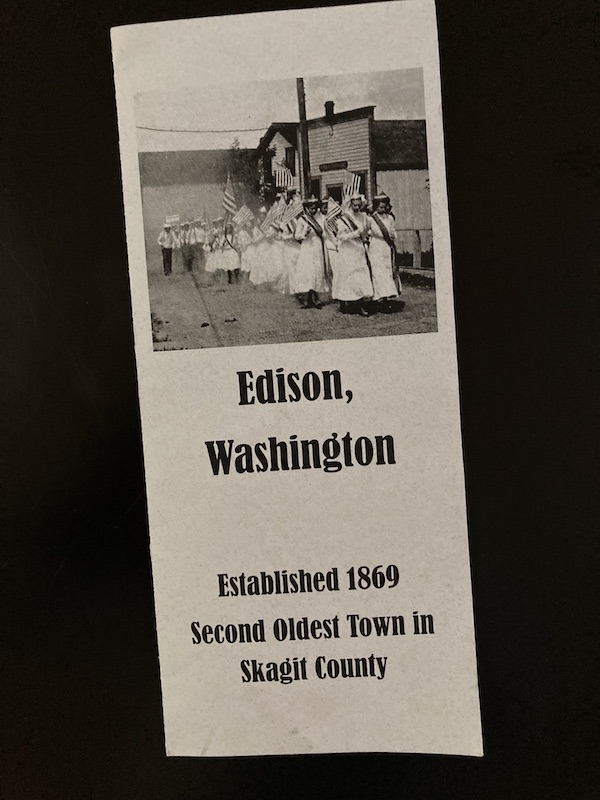
The particular brochure she handed me on this occasion bore the modest title, “Edison, Washington.” Just below the title, in slightly smaller type, the cover read, “Established 1869” and “Second Oldest Town in Skagit County.” The back of the brochure revealed that it was a 2014 reprint of a similar tract, “…originally written and produced by Irene Schumacher for the Edison Centennial in 1969” and updated by the Skagit County Historical Museum.
The original brochure was a product of The Edison Women’s Club, which was founded in 1910 for the lofty purpose of, and I quote, “…the betterment of their community and funding the street lights in Edison.” Imagine living in a world where you kept the lights on with bake sales and bingo nights. Such was life, however, in the second oldest town in Skagit County at the beginning of the 20th century.
The Past in Five Paragraphs
The first panel of the brochure was taken up with a preface that managed to cover a few millennia in the space of five paragraphs, and I was immediately struck by its economy of prose given the sweep of time it encompassed. I can do the preface no better justice than to quote it verbatim.
During the Ice Age, melting ice and snow brought down much water, silt and debris from higher elevations. This built up swampy tide flats and helped form the Samish River.
In early days, many Indians camped along the river gathering food for the winter. The bay furnished them with seafood and great stands of timber next to the river provided supplies of roots and berries.
The first white settlers were lumbermen who cleared the trees. Then came farmers who cleared the land. All transportation was by water in canoes or small sailboats, usually manned by Indians.
To keep the saltwater off the land, the first dwellers built dikes. The first bridges were built across waterways but did not connect to any roads because the ground was not stable enough on which to build roads. Dikes afforded a means of land transportation. When roads were finally built, they were constructed on slabs of lumber called “puncheons,” which traversed soft spots.
With the prospect of wireless communication and the railroad, Edison was “settled.”
Baada boom, baada bing.
I should at this point insert that I find the use of quotation marks for the last word of the preface to be intriguing. I like to think of them as written air quotes that convey a certain sense of irony — and as this story progresses, you may appreciate why.
Edison by the Numbers
A chronology of significant dates in Edison history comprised the three remaining brochure panels. A condensed version of that timeline is as follows.
Edison was established on the North Fork of the Samish River in 1869, and the brochure states that it was given its name in honor of Thomas A. Edison. It seemed highly unlikely, however, that the town’s founding and naming would have been concurrent, since the “Wizard of Menlo Park” would not achieve universal fame as inventor of the incandescent bulb for another decade. What we do know, however, is that in 1870 Ben Sampson became the first settler to claim land in whatever the place was called (maybe “Ben’s place”) back in the day.
The town’s first school followed four years later, and the first post office was established two years after that, with Edward McTaggert serving as Post Master. I subsequently discovered that it was, in fact, Mr. McTaggert who named the town after the great American inventor. The first bridge joining the two sections of town was built in 1881, and a year later Dan Dingwall opened a hotel and store, which failed after two years and was taken over by Colonel Granville Haller. Thomas Cain built the town’s first saloon (a venue usually among the first establishments to be built in a new town, but perhaps the denizens of Edison were of a more temperate bent) as well as the Union Hotel (which would burn down in 1932, to become the site of W. H. Schumacher’s Lumber & Building Materials in 1939).
In 1885, another bridge was constructed across the south side of the Samish River, and the following year Col. Granville Haller platted the town site. It was less than four acres in size. The next six years were busy ones for the little town of Edison: an Oddfellows Lodge (#45) was established; the town’s first physician, Dr. J.L. Jackson opened his practice; three churches were formed (Catholic, Lutheran, and Congregational); the town’s first water system was created, which brought water from White Hall Creek on Chuckanut Mountain via pipes constructed from hollowed-out logs; the town’s first drug store was opened by O.A. Loomis; and a second school was built at a cost of $4,000 (the enrollment at Union High School was 61 students).
Edison suffered a tragic setback when fire devastated the town in 1893, but it rebounded over the next couple of decades. By 1900 it had a newspaper (the Edison Eye), and by 1906 it had grown to include 23 businesses. In 1910, the aforementioned Women’s Club was founded, and the string of “firsts” continued over the decades: a boardwalk from Edison to E. Edison in 1913; town lights installed by Puget Sound Light Company in 1917; and a fire truck (a Ford Model T with a water tank) a year later.
In 1926, Edison built a new school for elementary through high school, and the following year Edison High School graduated its arguably most famous student: the legendary journalist, Edward R. Murrow. Between 1932 and 1937, fires again visited Edison, but like the mythical phoenix, it always rose from the ashes.
Over the years following the “Edison Centennial” commemorated by the brochure, the town demolished the old school and constructed a new one that could accommodate 500 pupils from kindergarten through 8th grade. That same year, 1996, Edison undertook a community sewer project. The sewer renovation uncovered Native American artifacts, including weaving remnants believed to be 2,500 years and which now reside in the care of the Upper Skagit Tribe. The last entry in the brochure’s historical chronology, presumably added during its update by the Historical Museum, marks the event by which I first became aware of Edison: the Edison Bird Festival, with its whimsical annual Chicken Parade.
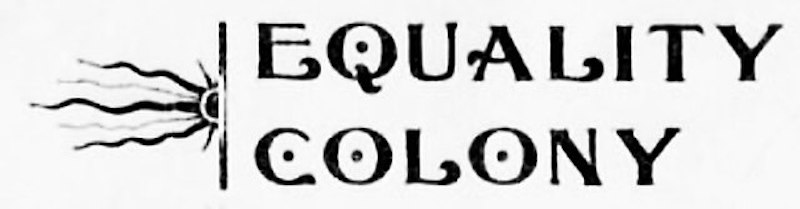
Among the notable dates in Edison history, however, there is one that is highly conspicuous in its absence: 1897 – the year Edison, Washington became the headquarters for a national utopian socialist project called “Equality Colony,” which was backed by an organization known as the Brotherhood of the Cooperative Commonwealth (BCC).
According to Wikipedia, “The socialist colony was established on 280 acres just outside Edison and it engaged in farming and timber milling and included a school as well as blacksmith and copper-working shops. The Edison-based Brotherhood also published a newspaper called Industrial Freedom for national circulation to its approximately 3,000 supporters.”
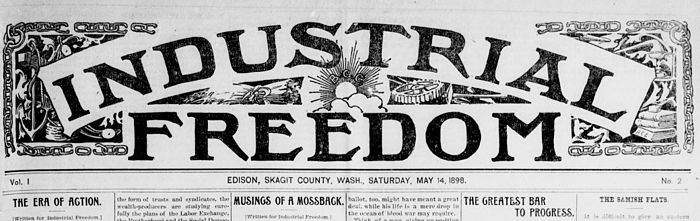
The origins of Equality Colony go back to the mid-1890s, when a couple of New Englanders named Norman Wallace Lermond and Ed Pelton were inspired by the first socialist political party in the United States, the Socialist Labor Party (SLP). The SLP envisioned a string of socialist “colonies” in a single western state, and Lermond and Pelton believed that their inhabitants would be able to initiate the collective ownership of the means of production in that state by voting in a socialist government. And to think that this vision existed long before anyone had heard of Berkeley, California.
Lermond advocated for the organization of many local unions that would provide the colonists with financial, material, and moral support, coordinated by a national “center or union” controlled by seven trustees. His immediate model was the New England Emigrant Aid Company, which colonized Kansas with abolitionists prior to the U.S. Civil War in order to make the territory a free state.
In 1895, Lermond announced he was setting up an “organizational meeting” to create a “National Union of the Brotherhood of the Cooperative Commonwealth” (BCC). The organization’s constitution outlined three goals: “1. To educate the people in the principles of Socialism; 2. To unite all socialists in one fraternal association; 3. To establish cooperative colonies and industries in one state until that state is socialized.”
By mid-1897 the BCC had about 2,200 members in 130 local unions. After brief tours in Tennessee and Arkansas, Lermond announced that Washington would be the most likely state for colonization, and on September 1, 1897 Ed Pelton left Maine for the Pacific Northwest to secure land for the colony. On October 15, after visiting several sites, he made a down payment of $100 to Mathias Decker, a “conservative Skagit County farmer,” for 280 acres of land in Blanchard, Washington, two miles northeast of Edison. The first 15 settlers arrived a few weeks later, and additional purchases and contributions were made. By the summer of 1898, the colony encompassed an area of 600 acres. It was named “Equality” after the title of a new book by Edward Bellamy, an American author, journalist, and political activist.
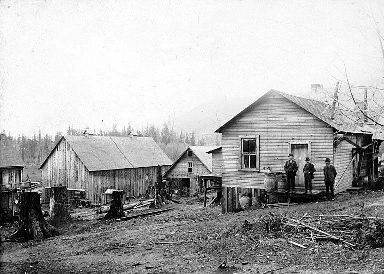
In Edison, the BCC board members leased a national headquarters for the Brotherhood, but tensions soon developed between the colonists at Equality and the BCC leadership. The colonists resented the fact that their money was being used to keep the administration in their in-town digs, while they lived in crude, unfinished buildings at the colony site. They also objected to the administration’s emphasis on the creation of a national organization and other colonies, feeling that the more immediate goal should be the completion of Equality. Who can blame them? To quote George Orwell’s famous fable, Animal Farm, “all animals are equal…but some are more equal than others.” I suspect “Equality First” ball caps could have sold well in Blanchard.
Equality flourished for a few years, building two large apartments, a barn, a dining room and kitchen, a school house, a public hall, a store room, a printing office, a saw mill, a root house, a blacksmith and copper shop, an apiary, a bakery, a cereal and coffee house, and a milk house. In 1900 and 1901, some colonists left Equality to found a new community on Whidbey Island called the Free Land Association, or Freeland. This colony should not be confused with Equality in its later stages, which was sometimes referred to as Freeland Colony. Note: Freeland still exists on Whidbey Island, located between Mutiny Bay and Holmes Harbor. It’s on my list of places to visit.
Dissension between colonists and the BCC organization weakened Equality’s viability, and the colony dwindled to about 100 socialistic souls by the spring of 1903, when only the “die hards” remained.
But the straw that broke the colony’s back occurred on the night February 6, 1906, when an unknown person (or group of people) set fire to several buildings. The worst loss was the barn, which burned completely to the ground, killing most of the colony’s cattle. The perpetrator was never identified, and the disputing factions blamed each other for the arson. A suit was filed in Skagit County to dissolve the colony and the BCC went into receivership. It came to an end when its land was sold for $12,500 to John J. Peth (more about the Peths of Skagit Valley in a later episode) on June 1, 1907. A few families stayed in the area on plots of land that they had owned individually, but by the time Edward R. Murrow was born a year later, Edison’s Brave New World had become one more failed utopian enterprise in American history.
Today, the legacy of Equality Colony lives on in the Magic Skagit place names Colony Road, Colony Creek, and Colony Mountain Drive, just a few miles northeast of Edison — a town named for the man who truly did believe in “power to the people.”