Tales of the Magic Skagit: Greetings From Perry’s Island!
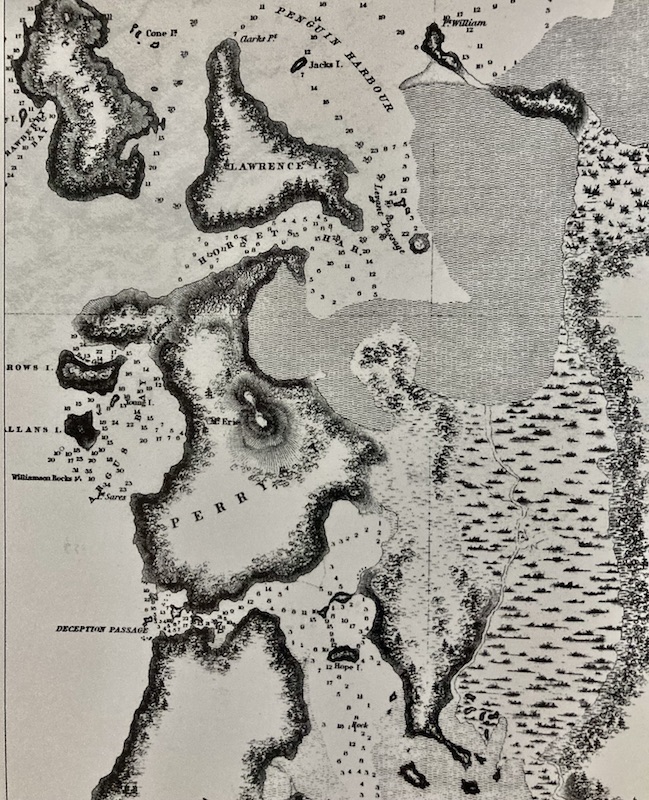
Among my most favorite islands in the beautiful San Juan chain are Lawrence Island and Perry’s Island. I seldom make it out to Lawrence Island, although it’s high on my wife’s and my list of day trip destinations. In the case of Perry’s Island, however, I’m a fairly frequent visitor. In fact, I’m pleased to say that I was there as recently as last Friday for an art fair.
As you savvy Skagitonians have probably by now divined, I’m of course referring to Fidalgo Island and its annual Anacortes Arts Festival. Fewer of you may know, however, that Fidalgo and its neighbor to the north, Guemes Island, did not always go by their current monikers.
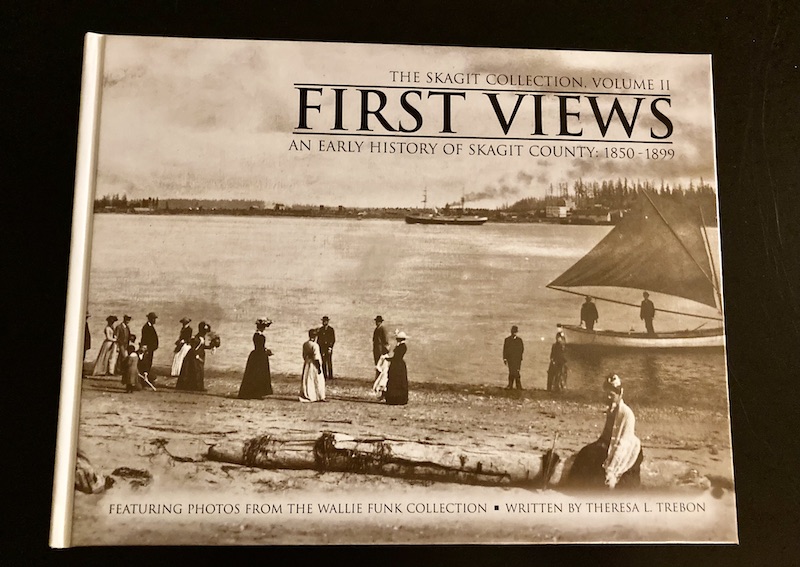
I came upon this historical insight thanks to a book I purchased the other day from the Skagit County Historical Museum in La Conner. The gift shop, which welcomes you at the entry to the exhibit space and museum wings, has a marvelous selection of books on Magic Skagit history. The one that caught my eye on this particular visit, to see the current feature exhibit on the glorious life of Lavone Newell-Reim, was First Views — An Early History of Skagit County: 1850-1899, written by Theresa L. Trebon, and featuring photos from the Wallie Funk Collection (a Tales of the Magic Skagit story in itself, at some future date).
To quote from Trebon’s excellently written history:
The place names of Skagit County provide the first clues to the region’s history. An eclectic mix of Indian words and the surnames of individuals from halfway around the globe, these names tie the area to different cultures and places. Upon investigation, the Skagit’s nomenclature also reveals much about the political landscape of an earlier time. Spanish and British explorers, for example, left their mark on local geography as they sought to extend their nation’s empires in the late 1700s. Fidalgo Island is one such place, named by Captain Juan Francisco de Eliza for his lieutenant , Salvador Fidalgo. But despite having named many landmarks on Washington’s northwest coast, Spain’s hold on the area would be short-lived, extinguished by 1818. Thereafter, Britain and the United States attempted to claim the area. Their territorial tug-of-war is reflected in the subsequent changes of Fidalgo Island’s name.
A mapping expedition of Puget Sound carried out in 1841 by the United States government replaced the Spanish place names it encountered with names honoring the heroes of America’s 1812 war with Britain. The expedition’s commander, one Charles Wilkes, renamed Fidalgo Island for Oliver Perry, whose heroic words at the Battle of Lake Erie, “We have met the enemy and they are ours,” earned him a place in American history and an equally famous misquote in the comic strip “Pogo” (“We have met they enemy, and they are us.”). Wilkes named Guemes Island “Lawrence Island,” presumably after some other American war hero.
The revised names were not destined to stand for long, however. The Oregon Treaty in 1846 fixed the border between the United States and Britain at the 49th parallel, and the following year, Theresa Trebon notes, “…British officer Henry Kellett erased many of Wilkes’ place names as he mapped the San Juan Islands for his country’s naval charts. Kellett’s determination to honor the area’s first European explorers, not American war heroes, effectively restored the Spanish names of many locations, including Fidalgo. And Fidalgo it remained, despite the efforts of patriotic Americans who persisted in calling it Perry’s Island through the turn of the century.”
As for Lawrence Island, it reverted back to its previous name, Guemes. As I shared in an earlier Tales of the Magic Skagit episode, its name did not have a European origin, but was known to the Salish people as Qwengqwengila, which translates as “lots of dogs islands.” Read our story, “Hair of the Dog,” and you’ll understand. Thanks to Theresa Trebon, I’ll never cross the Swinomish Channel from the Skagit Valley to Fidalgo Island without inwardly paraphrasing Oliver Perry’s stirring quote from the War of 1812 — “we have met the island, and it’s Fidalgo.” Maps, like history, are typically written by the victors.