Tales of the Magic Skagit: Hair of the Dog

Be forewarned: the following episode of “Tales of the Magic Skagit is a bonafide “shaggy dog story.” In the author’s defense, however, it was inspired by an exhibit at the Museum of Northwest Art (MoNA) in La Conner that I viewed back in November 2021, and has been on my editorial calendar ever since.
The MoNA exhibit featured the art of Dan Friday, a member of the Lummi Nation and a Seattle-based glass artist who spent a couple of decades working for other artists, including Dale Chihuly, Paul Marioni, Preston Singletary, to name a few. Aside from creating amazing glasswork, his artistic resumé includes teaching gigs at the Pilchuck School of Glass and University of Washington, along with artistic residencies at the Museum of Glass in Tacoma, WA, the Dream Community in Tai Pei, Taiwan, and the Haystack Craft Center.
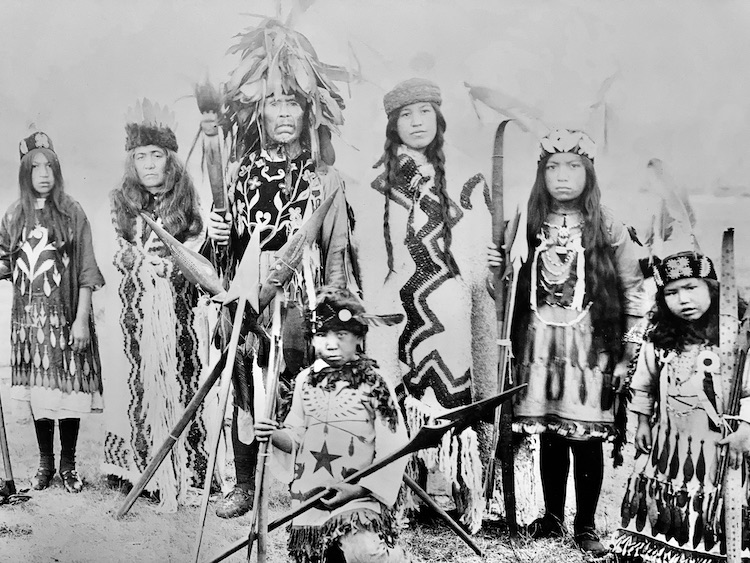
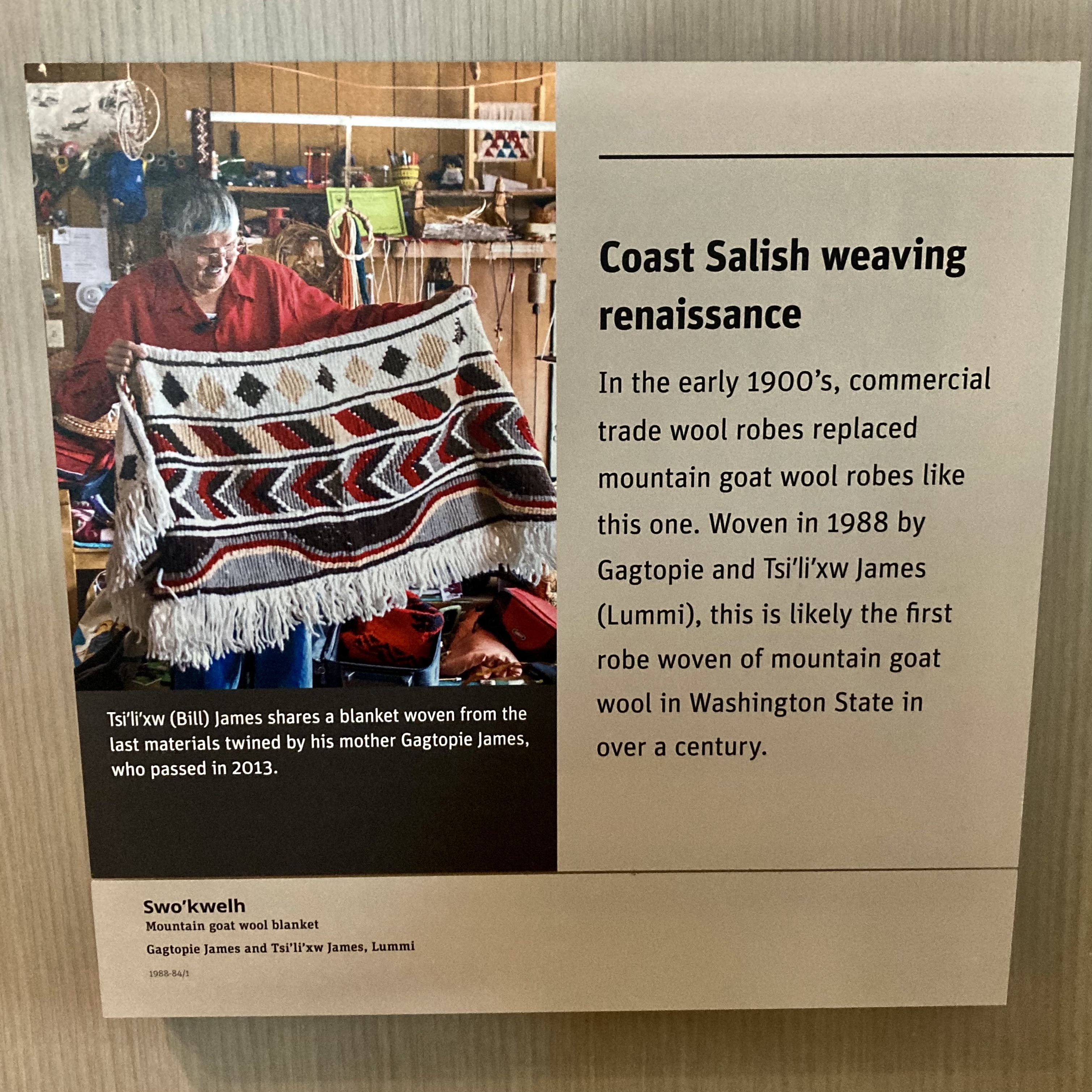
While marveling at Dan’s exhibit, which deserves its own “Tales of the Magic Skagit” episode (that’s on the editorial calendar as well, if I can just keep from being distracted by bright and shiny literary objects), I was intrigued not only by the art, but with the story the artist told of his ancestors and culture. I was especially drawn to a photograph of his great-great grandparents, Frank Hillaire and Agnes Haumea, and their children that was taken around 1915 and is now a part of the Library of Congress. In addition to their beauty and presence, what amazed me was the artistry of their clothing — especially the woven blankets, although “blanket” seems far too prosaic a description for the garments worn in Dan Friday’s family photo from the early 20th century.
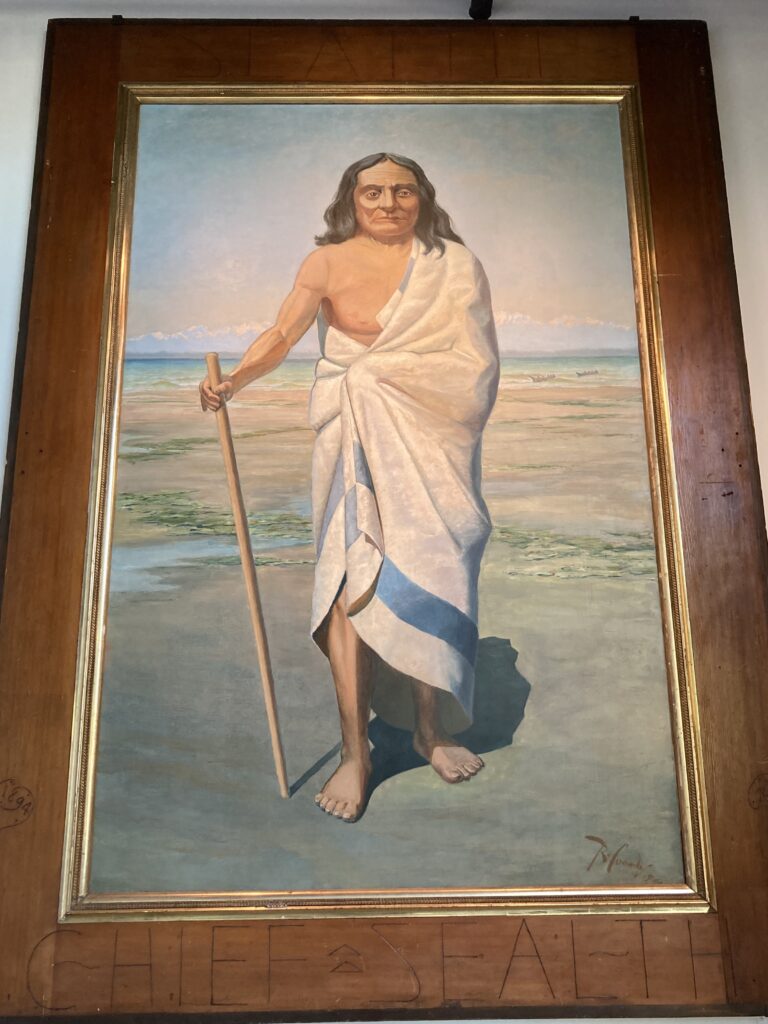
The photo also brought back the memory of a portrait of Chief Seattle that I had seen at the Burke Museum, painted by the artist Ralph Coombs in 1894. Draped in a garment that might be described as a blanket or robe, this great leader of the Puget Sound Suquamish and Duwamish peoples (whose Lushootseed name was translated as “Sealth” or “Seattle” by the non-native settlers who populated the area) displayed the gravitas of a toga-clad leader of the Roman Senate — who would hardly be described as wearing “blankets.”
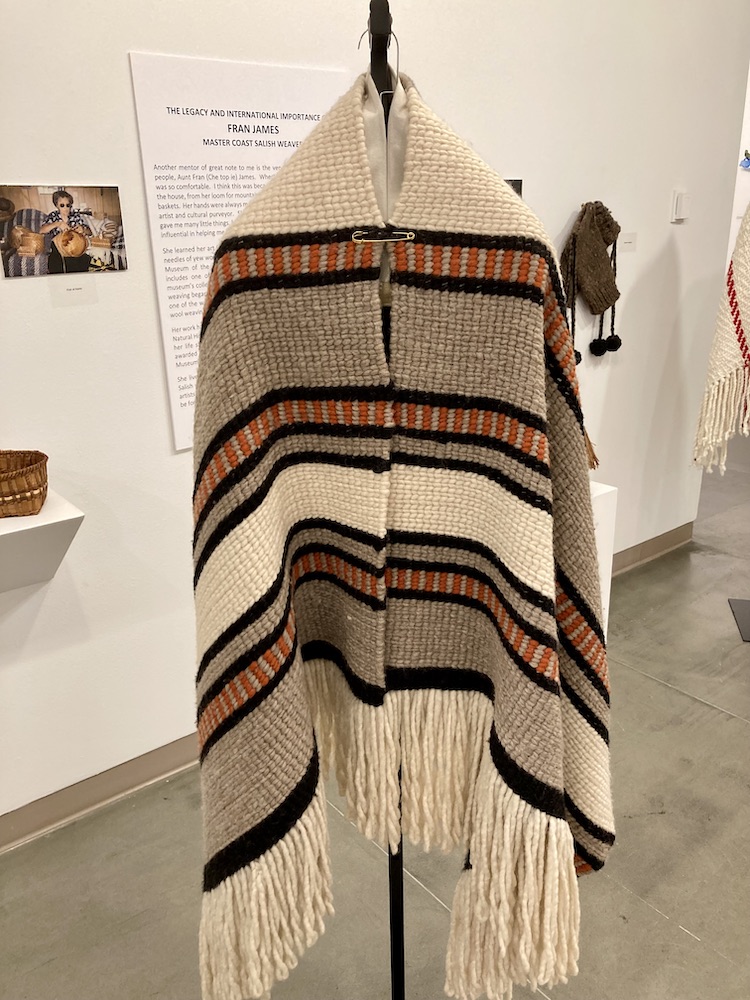
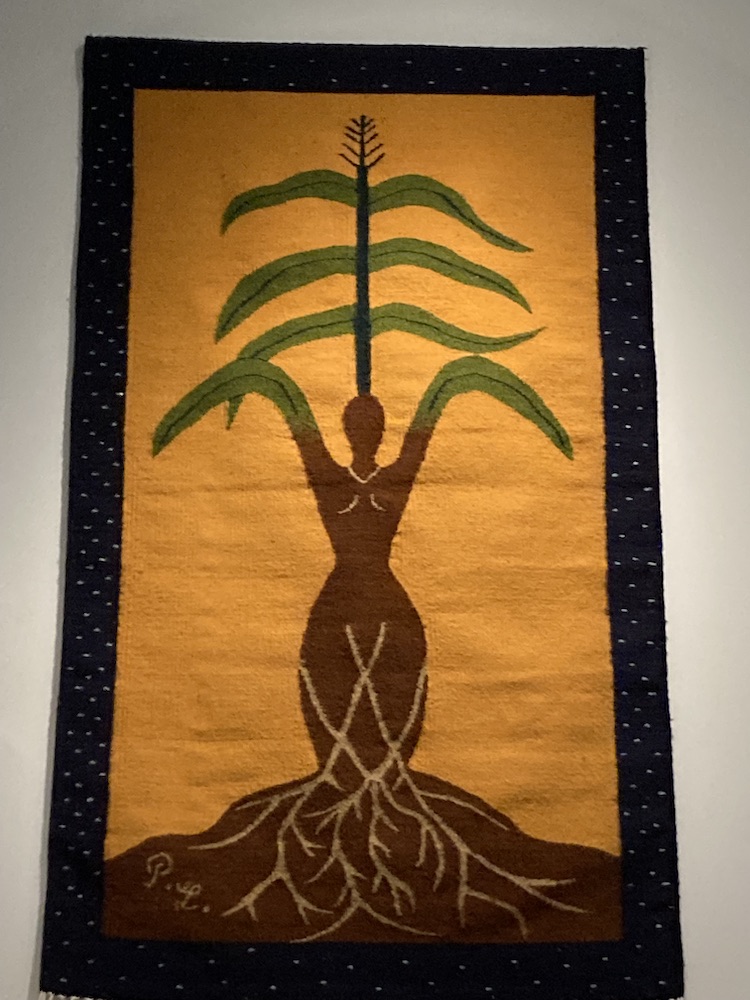
As it turns out, Dan Friday was similarly impressed with the woven arts of his ancestors — so much so that he devoted a section of his exhibit space to a display of Coastal Salish woven art. He offered the following explanation for his graciousness:
“Although I am a glass artist, I chose to add a section to this exhibition to explain, respect, and display the splendid artistic and cultural richness found in Coastal Salish weaving. The weaving is central to any understanding and appreciation of the history of the Salish people. They are a great inspiration to me.”
“To the Coastal Salish people, the blanket has always been an integral part of daily life. Often to pay off debts, to show gratitude, or to indicate status. A blanket is one of the most honored gifts to receive, not just because of the amount of time it takes to make, but also its ability to keep you in warmth and in health for the long winter.”
Historically, Native blankets were made from woven plant fibers, animal hides and fur, and eventually from fabric woven by hand from wool or cotton. Accustomed to seeing native peoples of the Pacific coast clothed in furs and skins, Spanish sailors on Juan Francisco’s 1791 European exploration of the Salish Sea noted how surprising it was to find Coast Salish villagers in colorfully decorated, woven woolens of their own manufacture — an observation that Captains Meriwether Lewis and William Clark would make as well when they journeyed here some 14 years later.

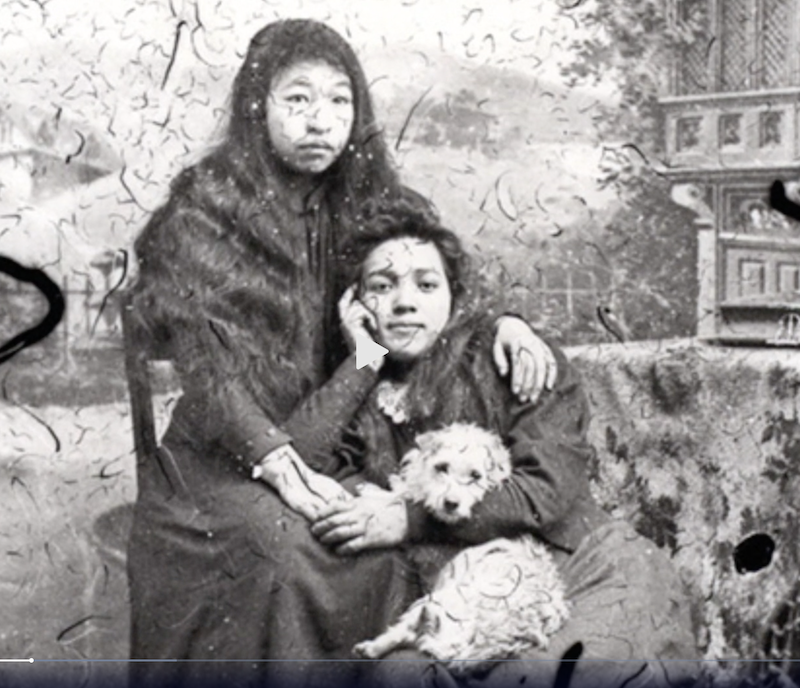
Unique to the woven art of the Northwest and the Coastal Salish, however, was the use of the fur from the Skexe, or the Coast Salish Woolly Dog. The Woolly Dog, now extinct, was a small, white, long-haired dog with prick ears, curled tail, fox-like face, and a thick coat. When Captain George Vancouver observed the Woolly Dog around the Puget Sound in 1792, he thought that it looked like a larger version of a Pomeranian.
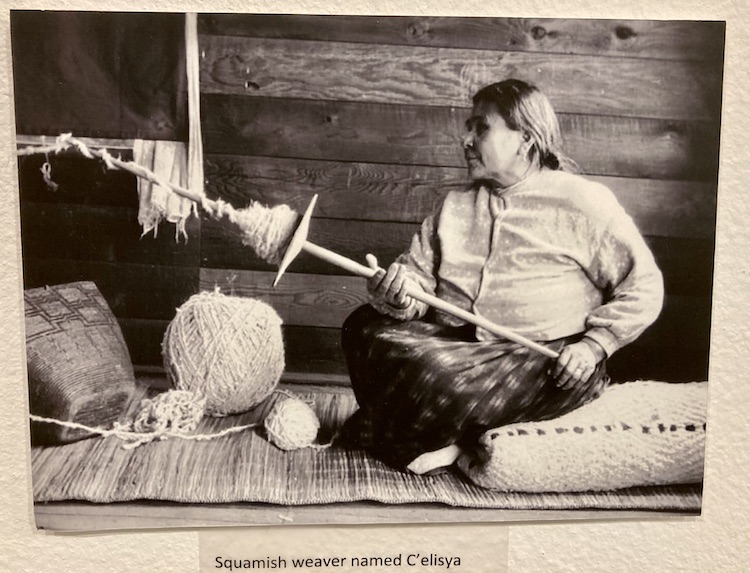
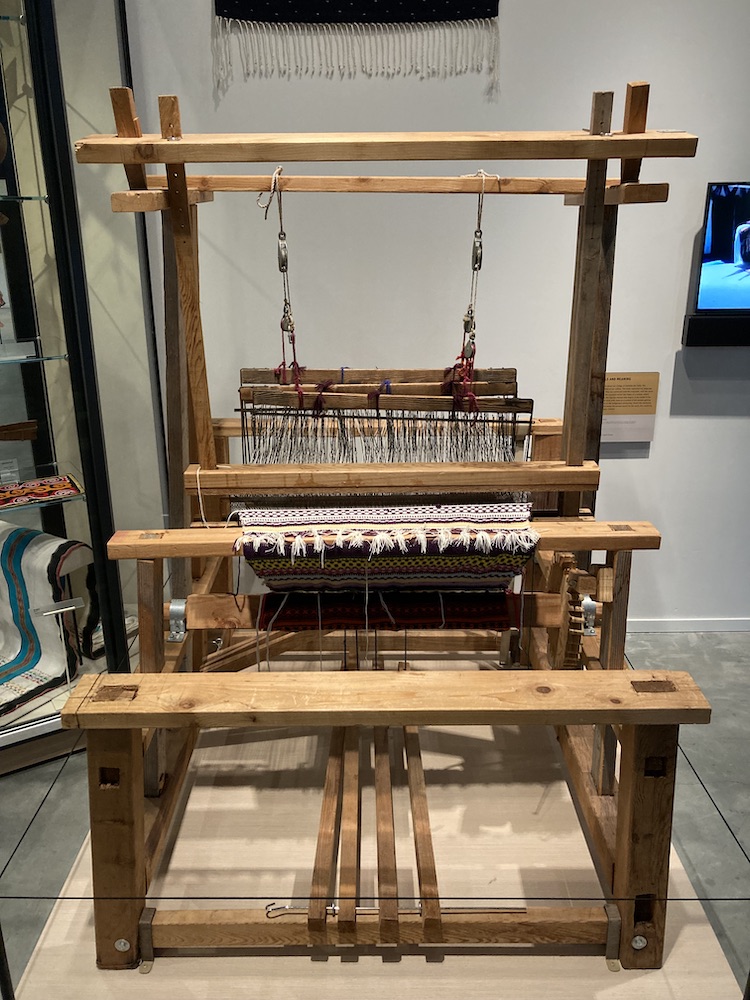
Other European explorers who came to the area in the late 18th century (including Captain Cook’s voyage of 1778) were astonished to see the technical and artistic sophistication of the Salish weaving, which included the raising of the Woolly Dogs, the spinning of yarn, the creation of complex designs and the weaving of beautiful items. The evenness of the spun wool and the artistry of the weavings, along with the presence of basketry and cordage in archeological excavations, suggest a lengthy history of making and using textiles in the Salish cultural areas. With weaving skill a Salish woman could earn status and material independence. A woman’s wealth could be measured in the number of Woolly Dogs she kept.
The Makah and Coastal Salish kept two types of dogs: one group was the village dogs, which typically had short brown hair and resembled coyotes. The other was the Woolly Dogs, which were bred for their soft, thick undercoat and were kept in small “herds” separate from any other type of dog, fed on salmon for glossy coats and sheared like sheep once a year. This meant that the Woolly Dogs were often confined to small islands around villages. In fact, MoNA acknowledged that it had recently learned that Guemes Island in the San Juan Islands of Washington was known to the Salish as Qwengqwengila, which translates to the “lots of dogs island.”
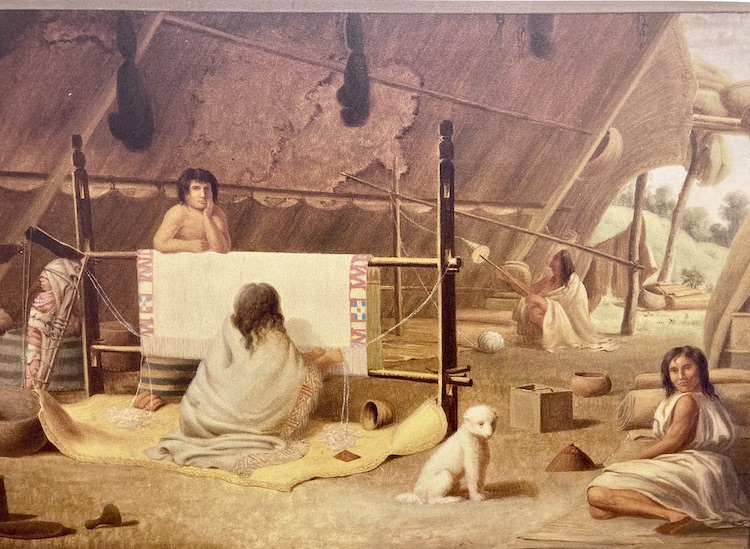
Perhaps the most important European documentation of the importance of the Woolly Dogs to Salish culture is found in artist Paul Kane’s painting, “A Woman Weaving a Blanket” done between 1849 and 1856, which shows the advanced, sophisticated Salish weaving operation, featuring the white Woolly Dogs of Guemes Island.
Among the many things that changed in the lives of the Coastal Salish after contact with Europeans was their woven arts. The introduction of Hudson’s Bay Company commercially woven trade blankets blunted the necessity of the Woolly Dog’s contribution to blanket art. By the mid-19th century, dog wool was phased out, and the Woolly Dog disappeared as a distinct breed not long after as they interbred with dogs brought by the New People of the westward migration.

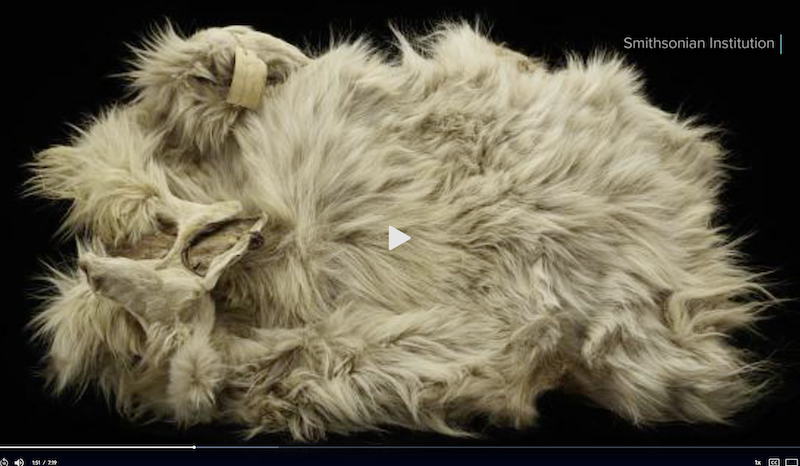
For those who might still be inclined to think of this as a “shaggy dog story,” well, it certainly is; but not in the colloquial sense. Exhibit “A” of its veracity lies in an 1859 collection of the Smithsonian National Museum of Natural History, which includes the preserved pelt from a Woolly Dog, although it wasn’t discovered in the collection until 2003. This anomaly conjures up the final scene in “Indiana Jones: Raiders of the Lost Ark.” I have some dresser drawers that also conjure up that same image. It should be noted as well that the Burke Museum at University of Washington has a verified Woolly Dog blanket among their artifacts — but it hadn’t been confirmed as such until 2016.
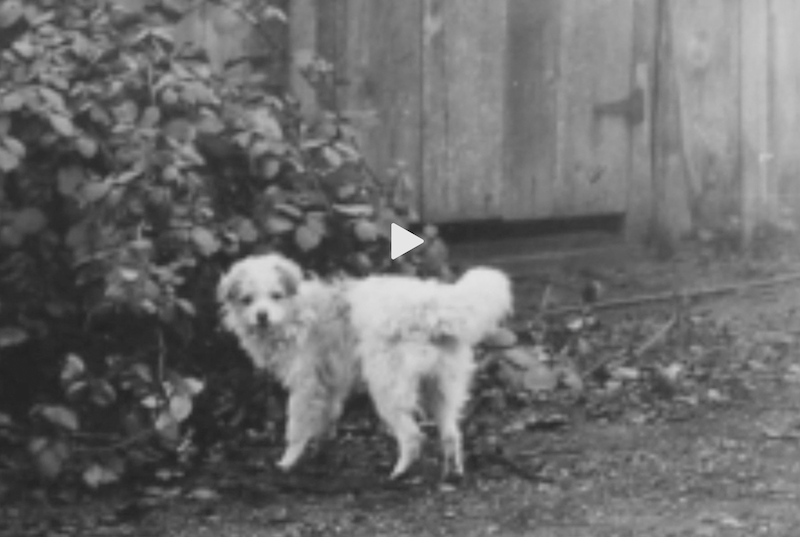
While I previously used the word “extinct” in my narration of the Woolly Dog’s history, I might be guilty of jumping the gun. A photo taken on Vancouver Island in the 1940s of a dog closely matching the description of a Woolly Dog would at least suggest that they didn’t disappear overnight. My theory is that they retreated into the mountains to become support canines for Sasquatch. The thought is almost as comforting as a Woolly Dog blanket on a northwest winter night.
As a historic footnote, I might also add that dogs played a critical role in Lewis & Clark and the Corps of Discovery’s journey along the Columbia River. It has been estimated that the expedition consumed more than 200 of them during the course of its mission. Although prized by the rest of the Corps, it was a delicacy that was lost on poor Captain Clark, who just never developed a taste for Lassie. But this is a more fitting subject for a future episode of “Core of Discovery: A Lewis & Clark Traveling Companion,” brought to you by Meyer Sign. In the meantime, I can assure you that no dogs, woolly or otherwise, were harmed in the creation of this story.