Across The Great Divide: Seven Days in September (Part 1)

I like to think of the journey of the Corps of Discovery as the Odyssey of the American West. As an epic of Homeric proportion, it is fraught with perils overcome by courage, heroism, and sheer tenacity — or as Lewis & Clark scholar Stephen Ambrose referred to it in his history whose title bears this same description, “Undaunted Courage.”
Throughout the telling of this epic, there are a number of points at which the very survival of the Corps and its mission hung on a razor’s edge. The first came when Lewis & Clark faced down an armed band of Teton Sioux along a bank of the Missouri River, about four miles north of what is today the city of Fort Pierre, South Dakota. A few months later they would endure a long and brutal winter among the Mandan and Hidatsa tribes in North Dakota. Another extreme test of the Corps’ mettle would be the portage around the Great Falls of Montana, as they continued their upriver journey along the Missouri in search of Thomas Jefferson’s hoped for Northwest Passage.
But it was seven days in mid-September, 1805 that nearly meted out to Lewis & Clark the fate suffered just forty years later by the infamous Donner Party on another forbidding mountain range. However, before we unfold this tale in seven acts of tragedy narrowly averted, we would do well to set the stage.
Foreboding Glimpses
Meriwether Lewis caught his first glimpse of the Rocky Mountains on Sunday, May 26, 1805. Captain Clark had been walking along the shore of the Missouri River that morning, while Lewis and the rest of the Corps (which along with the captains totaled 32, not including Sacagawea’s infant son and Lewis’ Newfoundland Retriever) made its way upriver, principally by the arduous use of towlines. Clark ascended some nearby hills and returned to inform his fellow commanding officer that he had seen “an irregular range of mountains” in the distance.
Later that day, Lewis ascended the summit of “one of the highest points in the neighborhood,” and reported in his journal that, “I thought myself well repaid for any labour; as from this point I beheld the Rocky Mountains for the first time…”.
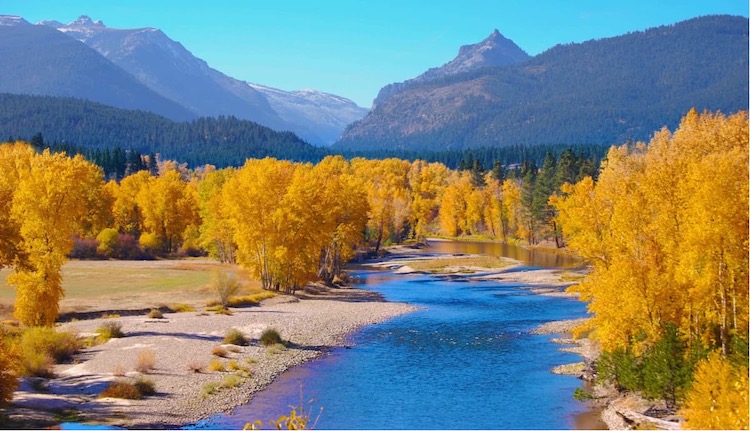
Lewis’ journal entry also revealed the conflicting emotions he felt in observing the snowy peaks in the distance. “While I viewed these mountains I felt a secret pleasure in finding myself so near the head of the heretofore conceived boundless Missouri; but when I reflected on the difficulties which this snowy barrier would most probably throw in my way to the Pacific, and the sufferings and hardships of myself and party in them, it in some measure counterbalanced the joy I had felt in the first moments in which I gazed on them…”.
Four months later, the Corps of Discovery would find themselves at the foot of the Bitteroot Mountains. They had been successful in obtaining horses from Sacagawea’s tribe, the Shoshone, among whom they had also engaged a guide they named “Old Toby” — who so happened to be the war chief of a band of Western Shoshone and whose name was actually Pikee Queenah (Swooping Eagle).

Lewis and Clark were confident that if Indians were able to traverse these mountains, they would certainly succeed. The events of the next seven days, however, from September 15 to September 21, would sorely test this optimism, and they would soon discover just how prescient Lewis’ May 26 journal entry would prove. The following is a chronicle of those seven days as they were described in the journals of Meriwether Lewis and William Clark.
Sunday — September 15, 1805
(From the journal of William Clark)
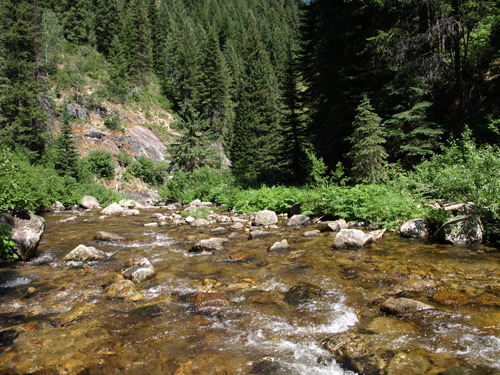
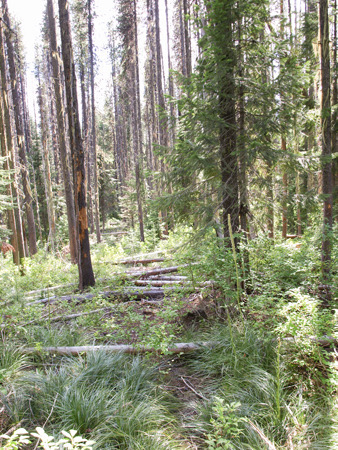
The Corps set out early on a cloudy morning and travelled four miles along the Flathead River (known today as the Clearwater River) over terrain that Clark described as, “steep points, rocky and bushy as usual” to “an old Indian fishing place.” At this point their trail left the river and ascended the mountains, “winding in every direction to get up the steep ascents and to pass the immense quantity of fallen timber.”
The Corps struggled up the mountain for four miles and stopped at a spring to let the horses rest and feed, and they remained here for a couple of hours as the rear of the party caught up — “much fatigued, and horses more so.” Along the way, several of the had horses slipped and rolled down the steep hills, “which hurt them very much.” One of these unfortunate creatures had been carrying Capt. Clark’s desk and small trunk. It “rolled down a mountain for forty yards and lodged against a tree, broke the desk.” Amazingly, the horse “appeared but little hurt.”
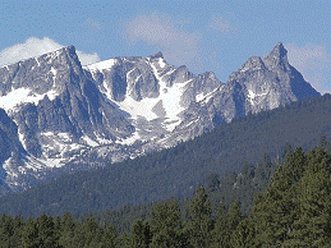
From the spring where the Corps had halted, Clark noted in his diary that he “observed a range of high mountains covered with snow from S.E. to S.W. with their tops bald or void of timber. The Corps continued their climb for another two hours, making camp for the evening at the top of a mountain. With no source of water nearby, they boiled snow to cook the remnants of a colt they had killed the day before at a fork along the Clearwater River that still bears the name Colt Killed Creek.
Clark observed that it was “very cold and cloudy.” The temperature and exertions took their toll on the horses, two of which “…gave out, poor and too much hurt to proceed on and left in the rear.” The only success the hunters had was killing two pheasants.
Reflecting at the end of a grueling day from his mountain top encampment, Clark wrote, “From this mountain I could observe high rugged mountains in every direction as far as I could see.” He soberly observed in his captain’s log that even with “…the greatest exertion we could only make 12 miles…”.
The Bitterroots loomed ahead.
Monday — September 16, 1805
(From the journal of William Clark)
Three hours before day break it began to snow, and it continued snowing all that day. The snow in the morning was four inches deep, which when added to the old snow amounted to an accumulation of between six to eight inches when the Corps broke camp. Keep in mind that this was not November, or even October. It was mid-September. Clark took the lead in order to search out the “Indian road” they had been following. It was a difficult task — the snow had filled the tracks they had hoped to follow. At noon they halted at the top of another mountain to try as best they could to warm and dry themselves and let the horses graze on some grass they had found.
Steep hillsides and fallen timber continued to make their progress arduous, which didn’t, however, prevent Clark from making note of eight different kinds of pines along the way — all of which were covered with snow. “I have been as wet and cold in every part as I ever was in my life. Indeed I was at one time fearful my feet would freeze in the thin moccasins which I wore.”
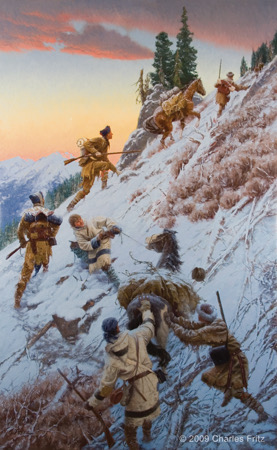
One needs to pause the narrative at this point to let the full effect of Clark’s observation sink in. He was crossing the Bitterroot Mountains wearing thin moccasins. Sadly, Gore-Tex would not be invented until another 164 years.
Clark took one man with him at mid-day and covered six miles as quickly as they could until they reached a small branch of the river passing to their right. They halted here and built fires in anticipation of the rest of the party, who arrived at dusk “very cold and much fatigued.
“We camped at this branch in a thickly timbered bottom which was scarcely large enough for us to lie level, men all wet, cold and hungry. They killed a second colt, “which we supped heavily on and thought it fine meat.”
Clark saw four blacktail deer before setting out that day and tried seven times to shoot a large buck, but the gun failed to fire. Close examination revealed that the flint on his rifle was loose. This was a mere aggravation compared to the challenge of finding the now snow covered trail, and Clark and the party were only able to do so because of the traces of rubbing on the trees left by Indians who had recently traveled it.
Tuesday — September 17, 1805
(From the journal of William Clark)
It was a cloudy morning, and the Corps was unable to get started until one o’clock because the horses had scattered. Snow was falling not only from the sky but from the trees as well, “which kept us wet all afternoon.” Clark describes the “road” as “excessively bad.” The Corps passed over several “rugged knobs” and several drains and springs that passed to their right. They crossed over a ridge “dividing the the waters of two small rivers,” and due to the difficulty of the terrain they were only to make ten miles that day.
Worse, they were only able to kill a few pheasants, which wasn’t nearly enough food for the size of their party. The situation, said Clark, “…compelled us to kill something. “A colt being the most useless part of our stock, he fell a prey to our appetites,” Clark cooly observed. Along the way, two horses fell and were injured. The Corps made camp that night on the top of a high knob of the mountain, and with his officer’s log succinctness, Clark stoically summarized their progress at the end of Day Two of the Bitterroot Mountain crossing as follows: “We proceeded on as yesterday, and with difficulty found the road.”
Wednesday — September 18, 1805
(From the journal of Meriwether Lewis)
The Corps’ situation was dire enough at this point to convince Lewis & Clark that they should divide their group, sending Clark on ahead with six hunters. “There being no game in these mountains, we concluded it would be better for one of us to take the hunters and hurry on to the level country ahead and there hunt and provide some provision while the other remained with and brought on the party.” This was not the first nor the last time the Corps would divide. Thanks to having two Captains of equal authority and competence made this a viable, if risky, option.
Lewis was delayed because one of his party, Willard, lost his horse. Lewis sent him back to look for it and set out with the rest of the group at half past eight in the morning. At four that afternoon, Willard overtook them…without his horse. Nevertheless, they were able to make 18 miles that day and encamped on the side of a steep mountain. “We suffered for water this day, passing one rivulet only; we were fortunate in finding water in a steep ravine about half a mile from our camp.”
They finished up the last of the colt that morning, and supplemented it with “a scant proportion of portable soup, a few canister’s of which, a little bear’s oil and about 20 pounds of candles form our stock of provision, the only recourses being our guns and packhorses. The first is but a poor dependence in our present situation, where there is nothing upon earth except ourselves and a few small pheasants, small gray squirrels, and a blue bird of the vulture kind about the size of a turtle dove or jay bird.”
A couple of things worth noting about Lewis’ journal entry. The first has to do with the mention of “20 pounds of candles” as part of the Corps’ “stock of provision.” If this seems like a comestible of last resort, keep in mind that the Corps’ candles were made from tallow, and therefore packed a high caloric value at time when the party would have been expending a lot of calories in staving off hypothermia, not to mention sustaining their exertions in traversing snow covered mountains. The second thing worth noting is that not even the impending threat of starvation interfered with Meriwether Lewis’ observations as a naturalist. Thomas Jefferson would have been proud indeed.
Clark’s party, being less encumbered, was able to make an impressive 32 miles this day, and he and the hunters camped on a creek he named “Hungery” Creek —a place name of obvious understatement. You can still camp beside that creek in Montana, but with a fully stocked cooler and plenty of North Face and REI gear.
Will the Corps of Discovery find its way over the Bitterroots, or will they die of exposure and hunger? Spoiler alert: you already know the answer if you remember anything from your public school history curriculum — but you’ll want to stay tuned for Part 2 of our story, even if you know how it ends. It’s still a cliffhanger…literally.