Tales from the Magic Skagit: A (Tulip Poplar) Tree Grows in Mount Vernon (Pt. 1)

“I think that I shall never see a poem as lovely as a tree,” penned Joyce Kilmer in his now famous arboreal ode, Tree, published in August 1913 in Poetry: A Magazine of Verse. I don’t believe we know if there was a particular tree that inspired Kilmer to write the poem that countless Baby Boomers have recited at some point in their public school careers — but given the fact that he was born in New Jersey, Kilmer may very likely have beheld a tulip poplar tree when the muse blindsided him. It’s impossible to imagine not being overwhelmed by the majesty of a fully grown tulip poplar.
If a tree is a poem, a tulip poplar is an epic of Homeric proportion.

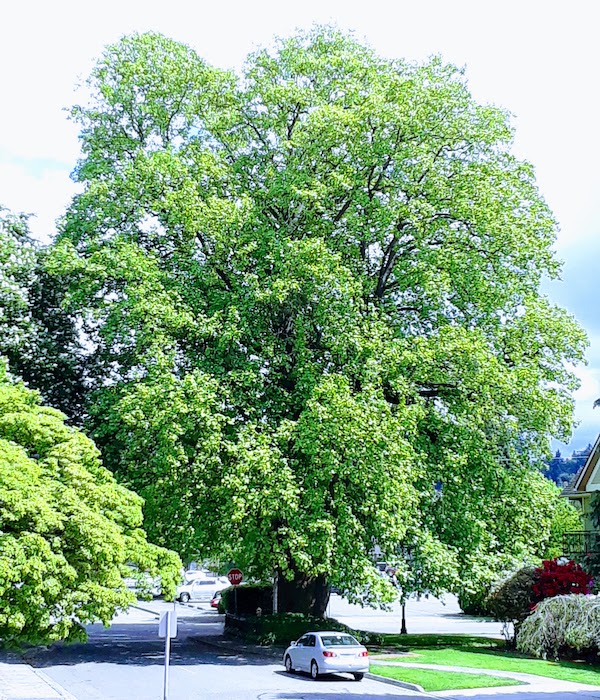
Which is why I was gobsmacked by the tree at the corner of Cleveland and Snoqualmie, just south of Kincaid, the very first time I laid eyes on it — and, truth be told, I’m similarly affected pretty much every time I drive past it to this day. Kitty corner from the Mount Vernon Public Library, it spreads itself like a leafy mother hen over the entire corner, partially obscuring the lovely two story pioneer-era home — now converted to office suites — which it grows next to.

I’ve been curious about the origins of Mount Vernon’s epic tulip poplar for a long time now, and it occurred to me that it really begged for a story. And who better than another long time resident of Mount Vernon to tell this story than Meyer Sign & Advertising. At least, that’s what I told our owner, Ken Hitt — and as with many of my harebrained ideas, he gave me a genuinely puzzled look and shrugged. I took this as an “affirmative” and began my research on what I have subsequently discovered to be the “Official Tree of the City of Mount Vernon.” But I’m getting ahead of myself.
What’s In a Name?

Let’s start off instead with a general primer on Liriodendron tulipifera — which according to Wikipedia is alternately known as the tulip tree, American tulip tree, tulipwood, tuliptree, tulip poplar, whitewood, fiddletree, and yellow-poplar. Whatever name you choose, you’re talking about the tallest native hardwood in eastern North America, growing from Southern Ontario and possibly southern Quebec to Illinois eastward to southwestern Massachusetts and Rhode Island, and south to central Florida and Louisiana. It can grow to more than 50 m (160 ft) in the virgin cove forests of the Appalachian Mountains, often with no limbs until it reaches 25–30 m (80–100 ft) in height, making it a very valuable timber tree.
The name Liriodendron is Greek for “lily tree”. It is also called the tuliptree Magnolia (my wife correctly identified it as some sort of tulip tree, though not a magnolia, when she first beheld it years ago). And although it is sometimes referred to as a yellow poplar by the American lumber industry, it is no more related to poplars than it is to tulips or lillies. The “tulip” reference comes from both the shape of the tree’s leaves and the external resemblance of its blooms to the iconic flower of the Skagit Valley. The allusion to the poplar comes from the fluttering motion of the tulip poplar leaves in the wind. It also happens to be the state tree of Indiana, Kentucky, and Tennessee. You have to wonder if there have ever been arguments over that shared claim.

Good Wood

The tulip poplar has a long relationship with humans in the New World. The tree’s traditional name in the Miami-Illinois language is “oonseentia”. Native Americans so habitually made their dugout canoes of its trunk that the early settlers west of the Appalachian Mountains called it Canoewood. The color of its wood also gave it the name Whitewood.
The tulip poplar is fast-growing, without the common problems of weak wood strength and short lifespan often seen in fast-growing tree species. Its soft, fine-grained wood is known as “poplar” (short for “yellow-poplar”) in the U.S., but is marketed abroad as “American tulipwood,” and is very widely used where a cheap, easy-to-work and stable wood is needed, comparing in texture, strength and softness to white pine. It is commonly used for the interior finishes of houses, for siding, for carriage panels, coffin boxes, pattern timber, and wooden ware.

And if you’re looking for an interesting bit of cocktail trivia (remember cocktail parties?), please note that the tulip poplar is the wood of choice for use in organs, due to its ability to take a fine, smooth, precisely cut finish and so to effectively seal against pipes and valves. It also has a reputation for being resistant to termites, and in the Upland South (and perhaps elsewhere) house and barn sills were often made of tulip poplar beams.
The Pioneer
If you look up “tulip poplar trees” on the internet you’ll find some magnificent examples amongst the images in your search return, including an original tulip poplar planted by George Washington on the grounds of (you guessed it) Mount Vernon, his home on the Potomac. At 145 feet and more than two centuries later, the tree continues to stand, and in 1976 it was formally declared the Independence Tree by Parade Magazine, which resulted in a nation-wide clamor for seeds from this very special poplar.
No offense to the Father of Our Country, but you’d be hard pressed to find a more impressive example of a tulip poplar than our own Mount Vernon specimen. So how did a tree that is indigenous to the eastern part of the United States end up in Washington’s Skagit Valley — and what’s the story behind its planting, since we can safely assume that the seed from which it sprang wasn’t carried aloft on a westward breeze? This is the question I set out to answer, while recognizing that some tales are forever lost to the proverbial mists of time.

My search for that answer is the subject of Part Two of this series. In the meantime, if any readers have some knowledge they’d like to share about Mount Vernon’s tulip poplar, I’d love to include it along with the interviews with city and county officials that make up the next installment of this story. If you can add to this story, we’ll make it worth your while — even if it is just a personal reminiscence.