Citizens Academy: An Ounce of Prevention
Here’s a question for you. On any given evening in a town of roughly 36,000 souls, how many of Mount Vernon’s finest are on duty to respond to a law enforcement incident? Five? Ten, perhaps?
How about one third of those numbers? That would be closer to the reality of policing in the 21st Century.
If it seems as though “the thin blue line” is maybe a little too thin, there are two things you need to keep in mind. The first is that interagency cooperation assures us that in the event of a major incident, the number of law enforcement personnel needed to cope with the situation will be on hand, be they state troopers or police from neighboring municipalities.
The second thing has to do with the central operational strategy of the MVPD, which is to prevent crime before it occurs. This is the essence of crime prevention, and a subject of the first session of Citizens Academy.
Crime Prevention: Why it Works
Responding to criminal activity is one thing. But how do you go about minimizing the possibility of its occurrence? Lieutenant Greg Booth has what might seem a deceptively simple answer. “Preventing crime is actually easy. It starts with just being aware,” he tells the Citizens Academy class. “You are our eyes and ears in the community.” This answer also explains why Lt. Booth, who heads MVPD’s crime prevention team, considers Citizens Academy to be “the flagship program” of crime prevention. “It is key to opening communications and fostering relationships, safety, wellness, and quality of life.”
But what do these “warm and fuzzy” attributes of public awareness have to do with catching bad guys? Lt. Booth explains that three things have to be present for crime to occur: motive, opportunity, and method. There is very little that a police department can do to affect the first and third legs of the crime stool, but public awareness can remove the second of them.
Crime prevention by its very nature is outward facing and proactive, so it should be no surprise that the programs it supports bring its officers (who for the most part do not carry a gun) into constant contact with the citizens of Mount Vernon. These programs fall into several key areas that include public education and community events, C.P.T.E.D (Crime Prevention through Environmental Design), T.E.A.M. (Teach. Encourage. Advise. Mentor), and COPP (Citizens on Proactive Patrol). Before we expand on these efforts, let’s meet the officers who manage them.
Meet the Team
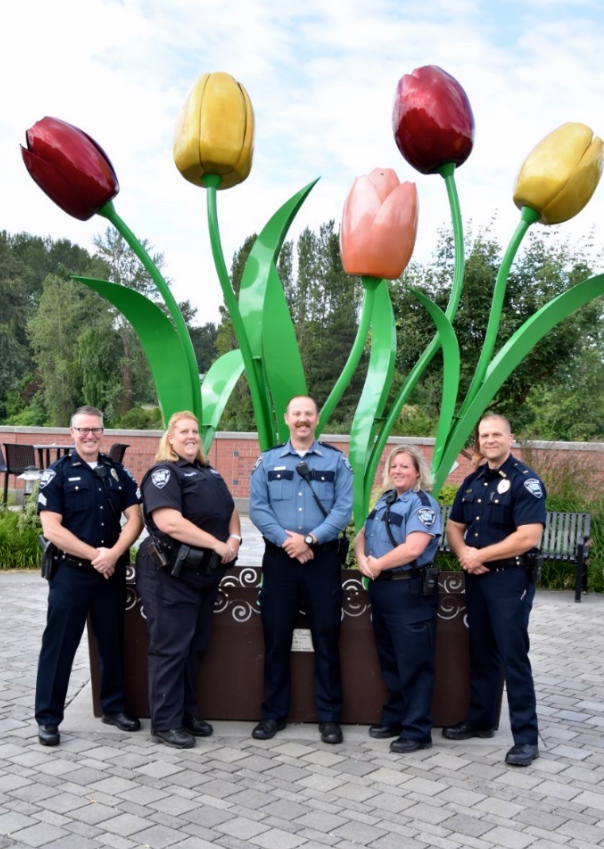
Heading up the Crime Prevention Staff is Lieutenant Greg Booth, who has been with the department for 25 years and began his career as the Kulshan Creek neighborhood resource officer. Following his promotion to sergeant he served on patrol for four years before his advancement to his current rank. His second in command, and the only member of the team besides Greg to carry a firearm, is Sergeant Brent Thompson, who has been with MVPD for 19 years and grew up in the Skagit Valley. As part of the crime prevention team for the past four years, his resumé also includes tactical team, field training officer, detective, and patrol officer. He is the embodiment, as the saying goes, of “real police.”
Two of the members of the crime prevention team bear the title of Community Service Officer. Officer Megan Murphy began her law enforcement journey in 2003 when she attended Citizens Academy. Another local kid made good, she hired on with MVPD twelve years ago as a front desk receptionist and moved into community service when an opening occurred. Officer Adam Walker joined MVPD a year and a half ago, having taught and coached at Mount Vernon High School. He brings a background of social work and youth mentoring to the team.
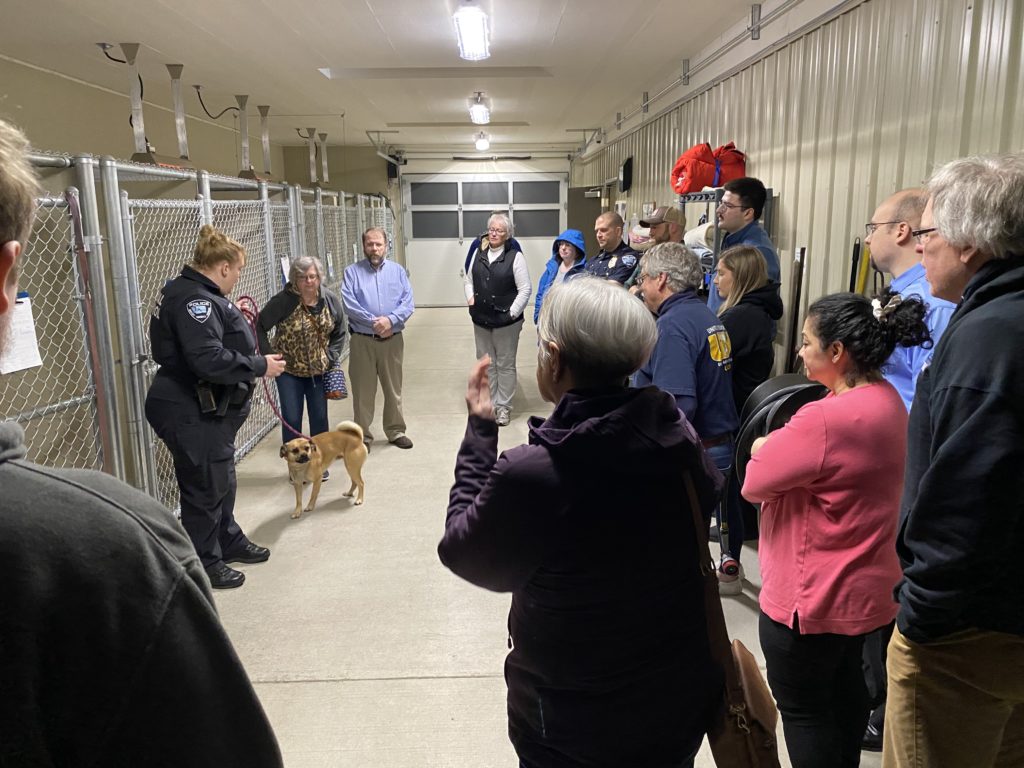
Officer Emily Den Hartog has one of the most unique jobs in policing. As an animal control officer for nearly seven years, she parlayed a 16-year career as a veterinary technician to serve the non-human residents of Mount Vernon as a cop, commuting all the way from Sumas where she lives with a collection of fur babies that includes dogs, cats, a horse, and cows. Our first night department tour included a visit to a new kennel facility that along with Officer Den Hartog makes sure that our four legged citizens are treated as humanely as our two legged ones, in the event that they come under the care of law enforcement.
Crime Prevention: How it Works
By now you’ve probably run across the crime prevention theory that postulates that a broken window in an abandoned or dilapidated home will lead to more broken windows and the progressive decay of a neighborhood. It turns out that the theory is right. One antidote to this decline in quality of life is the modification of human behavior through modification of the environment. This is the goal of Crime Prevention Through Environmental Design. Within the crime prevention unit of the police department, C.P.T.E.D, as it’s known, takes many forms. None in themselves are magic crime bullets, but applied collectively and consistently they make a difference.
As defined by the Mount Vernon Police Department, C.P.T.E.D is a design approach to our environment that makes “effective use of the built environment (that) can lead to a reduction in the incidence and fear of crime — increasing the quality of life.” Make note of the fact that “fear of crime” is included right along with its occurance. This is a theme we’ll be returning to in this series. Among the approaches to C.P.T.E.D as practiced by MVPD are the following:
- Access control through pre-design (lighting, placement of landscaping, mechanical and human gatekeepers.
- Natural surveillance.
- Modification of human behavior in the design of public facilities, which could be as simple inhibiting loitering through park bench design.
- “Territorial reinforcement” to distinguish private areas through fencing or the use of murals, plantings, or design textures.
To bring the community on board with the principles of C.P.T.E.D, the crime prevention team performs site survey assessments for businesses and organizations and provides them with a summary of recommendations that will make them less likely to be targets of criminal activity (i.e., removing one leg of the crime stool). The team further reinforces these by leading a variety of trainings for businesses, groups and organizations on a broad ranged of subjects. These include personal safety, robbery response, fraud/ID theft, gangs/graffiti, active shooter, and de-escalation.
Community Events
If you’ve never imagined a “lighter side” to police work, then you’ve never hung out with the crime prevention team at a downtown Halloween parade. In addition to its participation in Mount Vernon’s annual Trick or Treat/Light the Hill event, there are a number of other “officer friendly” happenings that let you get up close and personal with a group of people who are as friendly as they are professional.
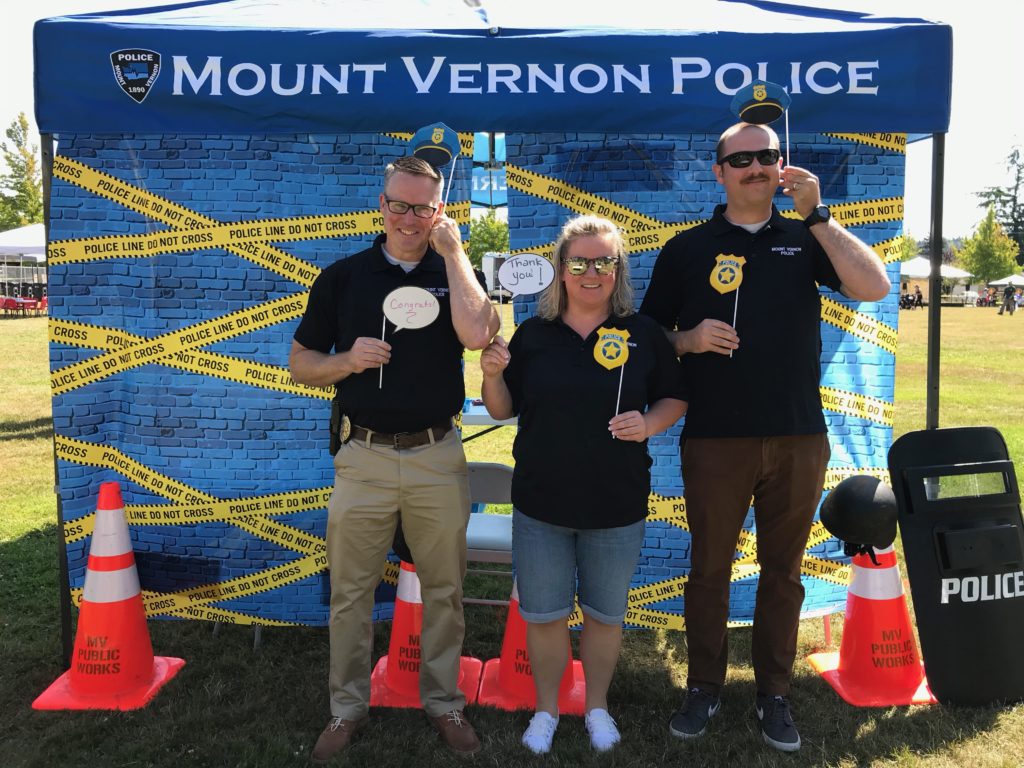
There’s Illuminight, a January celebration of art, light, and the Skagit ecosystem sponsored by Tri-Dee Arts, the Skagit Watershed Council, and the Mount Vernon Downtown Association Parks Department (by the way, the most recent addition to the MVPD is its first ever Park Ranger — but more about that when our topic is “police ops”); the Children’s Art Festival at Hillcrest Park (photo opportunities and kid activities), 4th of July River Fest (safety, bike patrol, traffic control), Skagit County Fair (try on SWAT gear!); and, of course, the annual Christmas Parade.
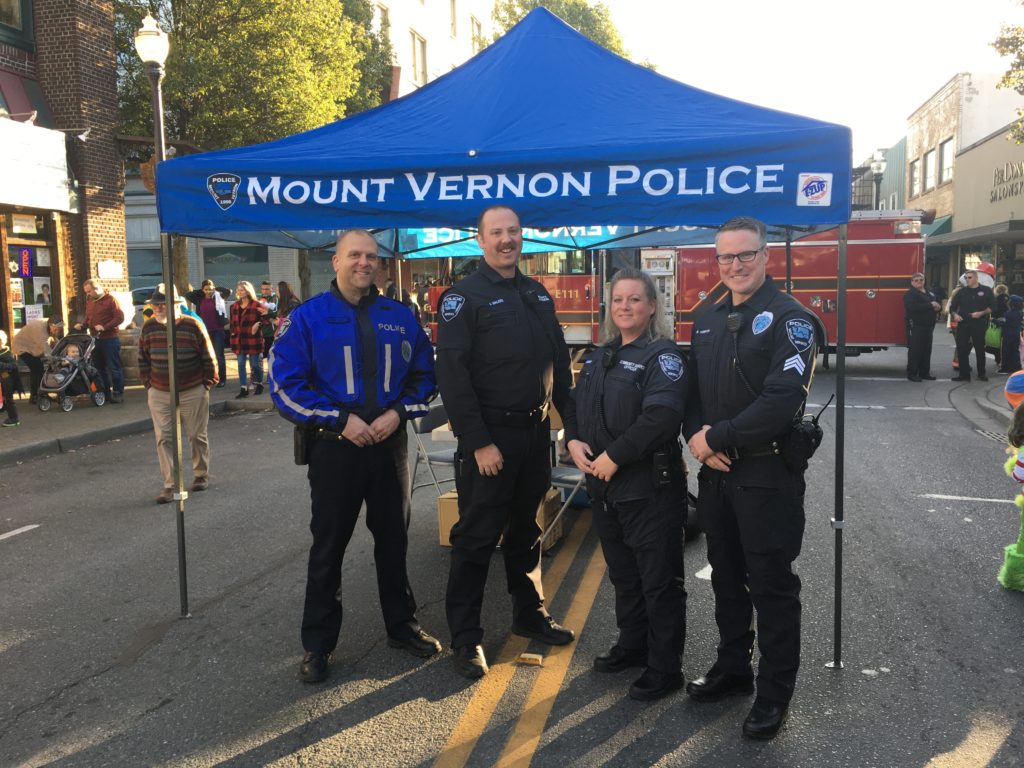
Sprinkled throughout the calendar are police department tours (such as the one Citizens Patrol attendees receive at the end of their first class session), school visits (kids love a person in uniform), and neighborhood clean ups (where I first met Chief Cammock back in his days as a Lieutenant but obvious up and comer).
T.E.A.M
What do real police and the military have in common? Acronyms, baby…acronyms. In the case of T.E.A.M we’re talking verbs, not nouns: Teach. Encourage. Advise. Mentor (you can see why Adam Walker was hired, right?). A key element of this overall effort, which involves several other officers outside the crime prevention staff, is aimed at kindergarten through 5th grade, and focuses on drug and alcohol prevention, deterring gang membership, recognizing domestic violence, anti-bullying, cyber safety, and “stranger danger.” None of these are things that we as parents would ever wish we had to teach our children about, but we do so in order to keep them safe. Thankfully, as a community we have a resource in the form of our local police who can speak to these issues not only with authority, but with the kind of care and compassion that comes with wanting to keep our kids safe, and knowing through experience how to earn their trust.
Another form of T.E.A.M outreach is the Crime Prevention Communication Network, which provides “information sharing and collaborative problem solving through open lines of communication.” This network functions through organizations such as Block Watch (remember our previous story about S. 27th Street), Business Watch, and Manager’s Net. The crime prevention group also maintains a Graffiti Board that identifies and responds to incidents of graffiti (i.e., graffiti abatement) — a situation that can quickly get out of control if not confronted. A similar approach is taken to junked or abandoned vehicles — another eyesore and manifestation of neighborhood decay.
When you look at the breadth and depth of pre-emptive law enforcement that MVPD provides through its crime prevention team, it’s hard to imagine how five individuals, regardless of their training and professionalism, are able to accomplish the mission and goals of their organization. In point of fact, this only happens because of another major component of crime prevention: a source of community volunteers who are willing and able to support it.
Which is the theme for our next blog installment on the role volunteerism plays in the concept of neighborhood policing: The Ties that Bind.
See you in Cop Class.