You’re a Grand Old Flag: Mount Vernon’s First Fourth of July
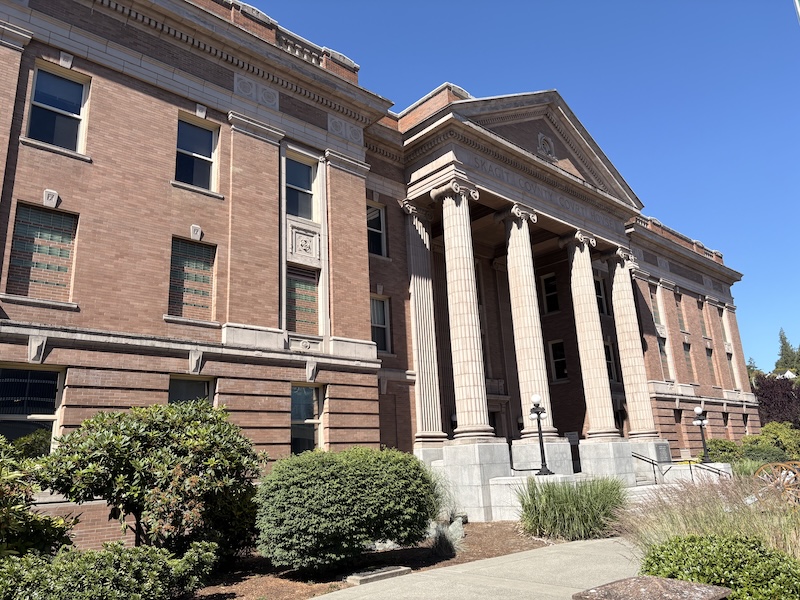
Over the many years that I’ve lived in Mount Vernon, I’ve only had one occasion on which to enter the Skagit County Courthouse on Kincaid Street. I did so not because I had any official business to conduct, but because I had read a story by our beloved local historian, Dick Fallis, entitled, Early Day Flag Still “Flies” at Courthouse. As part of our Tales of the Magic Skagit series on downtown Mount Vernon’s historic buildings, I had to see this bit of history dating back to the town’s founding for myself.
Once past the security checkpoint, the polite guards directed me to the object of my search. I didn’t have far to go. To my immediate left was a large display case with what appeared to be an oddly corrugated and somewhat faded Old Glory. On the opposite wall was a plaque describing its origin story, including how it had come to be enshrined in Skagit County’s neoclassical administrative heart, dating back to 1922.
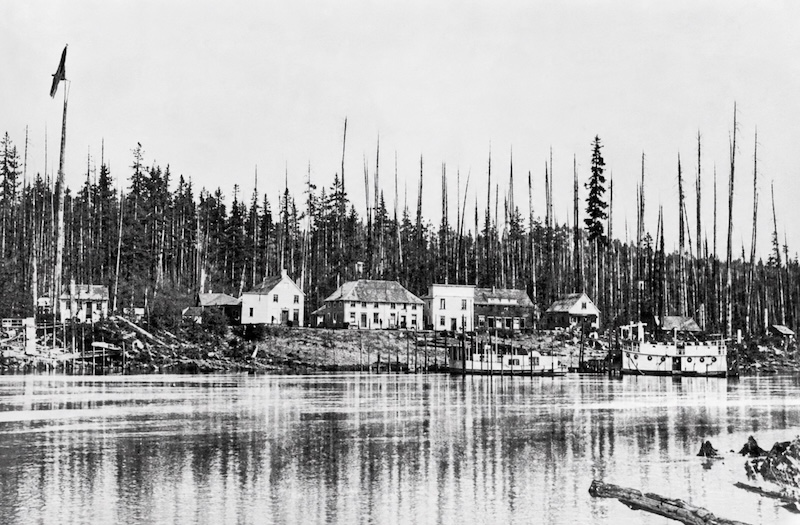
In July 1877, the Skagit Valley hamlet known as Mount Vernon (in honor of the home and final resting place of America’s first president) was planning to celebrate its first Fourth of July. The pioneer village on the banks of the Skagit River had been founded only five months earlier by Harrison Clothier and Ed English, and this particular Independence Day had an additional significance: it would mark 100 years since the first Stars and Stripes had been unfurled from an American man-of-war at Portsmouth Navy Yard.
There were about seventy settlers living in and near Mount Vernon at the time, and while they were looking forward to observing their nation’s birthday in their new settlement, they were troubled by the absence of an essential celebratory symbol: a flag. One of the settlers, known fondly as Uncle John Lorenzy, plaintively remarked to Ed English that it would be the first Fourth of July he had ever celebrated without a flag — but there were none to be purchased, and it would be 117 years before they could place an order on Amazon. What to do?
Fortunately, in addition to founding Mount Vernon, Harrison Clothier and his partner Ed English had also established its first store. Through it they placed an order for $75 worth of bunting — enough to stitch together an Old Glory that would measure 24×36 feet, with stripes 18 inches wide.
The townsfolk got to work, and according to the historical narrative displayed at the Courthouse, a Mr. Charles Towne cut out the stars, and for several days “all the ladies of the neighborhood gathered in the parlors of the Ruby House Hotel. Mrs. McNamara and Mrs. Papin, the wives of the hotel proprietors, served lunches to the following team of patriotic seamstresses: Mrs. Minerva Kimble, Mrs. Clarinda Gates, Mrs. Dennis Storrs, Mrs. George A. Hartson, Mrs. J. F. Dwelley, and Mrs. Schott. They used the first sewing machine in the community to do the stitching, and to celebrate the flag’s completion they and their friends held a picnic in the spruce grove on the Kimball farm just south of Mount Vernon.”
With the flag now completed, the next task was to choose a prominent place from which to display it. It so happened that the Ruby House stood near the boat landing, the center of all activities (for travel was only by water), and also nearby stood a magnificent cedar tree. Uncle John Lorenzy, despite being more than 60 years old, scaled up this stately, living cedar some six feet in diameter at its base, clearing its branches as he ascended, and topping it at the dizzying height of 147 feet. It was from this natural flagstaff that Mount Vernon’s Old Glory was first unfurled on the Fourth of July 1877, and from which it would be proudly displayed by the patriotic pioneers of Mount Vernon for future state occasions.
The last of the 38 stars that was sewn on Mount Vernon’s flag represents the admission of Colorado as a state in 1876, and the flag was flown at half mast for the first time when President James A. Garfield was assassinated July 2, 1881. Ten years later a fire destroyed the cedar flagstaff, and afterward the flag was lovingly carried in parades in patriotic celebrations in the county. The last of these occasions was Armistice Day, November 11, 1924.
In describing this day, I’m going to turn the narrative over to the anonymous teller of the story that is memorialized in the Skagit County Courthouse. The language is a bit more floral than my comparatively restrained prose, but it deserves to be heard exactly as it was written. They just don’t write ‘em like that anymore.
Cold, drizzling rain, leaden skies, a sobbing wind from the East — such was Armistice Day November 11, 1924.
At three o’clock in the afternoon, the battalion of clouds had lowered their serried ranks at all points of the compass half way down to the horizon, leaving a vault of blue overhead, and the sun sent shafts of golden light over the cloud rims. High above, soaring majestically among dark clouds into the blue field of light, came a great bald Eagle, pausing as in reverence, to circle gracefully just above the old Pioneer American Flag. Many looked at the large Eagle, recognized him and marveled at the coincidence. Daughters of the American Revolution were unfolding the flag, and twenty Skagit Pioneers were supporting it from the sides and corners, ready to take their place in the Armistice Parade.
When the American Legion Bugle Band played the “Reveille” and the procession took up its march, the Eagle led the way for a distance and was lost to view in the gold rimmed clouds above. Lower and further the clouds retreated as the vibrant note of martial music and rhythmic tread of marching feet brought the old Pioneer Flag back to its starting point and final resting place. Then a flood of sunlight filled the day, the breeze sank to rest, autumn leaves hung motionless in crystal air, drops of dew glittered on emerald lawns. It was indeed Armistice Day.
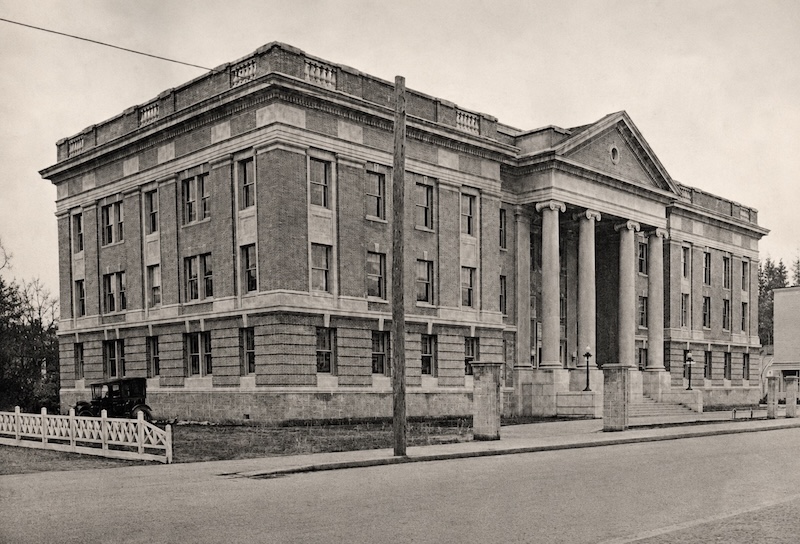
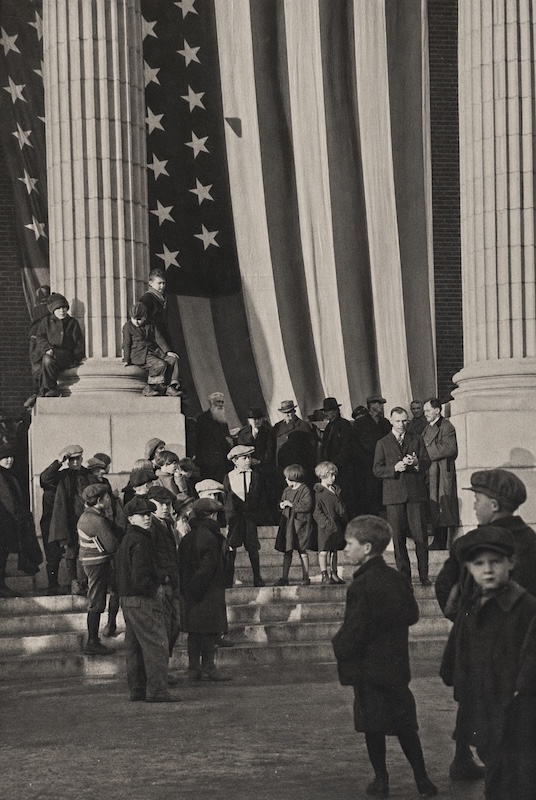
Peace, Light and Serenity had triumphed, as it had done six years before, when came the order, “Cease Firing.” It was the divine benediction and then, as now, the American Eagle was the herald of Peace and Light. Loving hands that had helped to make the Flag draped it between the great pillars of the new temple of Justice and County Administration Building. Then, a boy who had grown to honored manhood during the life of this old flag recounted the story of its birth and activities. As he stepped aside, the old Flag was slowly furled for the last time and a Daughter of the American Revolution sang “Taps” to the softened accompaniment of the bugle, played by a World War veteran. Then the old Pioneer Flag, hallowed with memories of the old days. was tenderly placed in the new sanctuary, which marks the birth of a new era in local history.
For many years the flag was loaned, and no one seemed to take any special care of it. Until Judge E. Crookston assumed a paternal interest and guarded it zealously in his office in the City Hall for the last ten years. Mrs. John Munch has also been interested in the flag since she first saw it unfurled from the cedar flagstaff in 1891. She knew personally every one of the ladies who worked on the flag, and also Ed English, and from them them gathered the historical data here given. It was she who first interested the Ann Washington Chapter, Daughters of the American Revolution, who enthusiastically ordered this case and installed it here, that this historic flag may be preserved as an inspiration for generations to come.
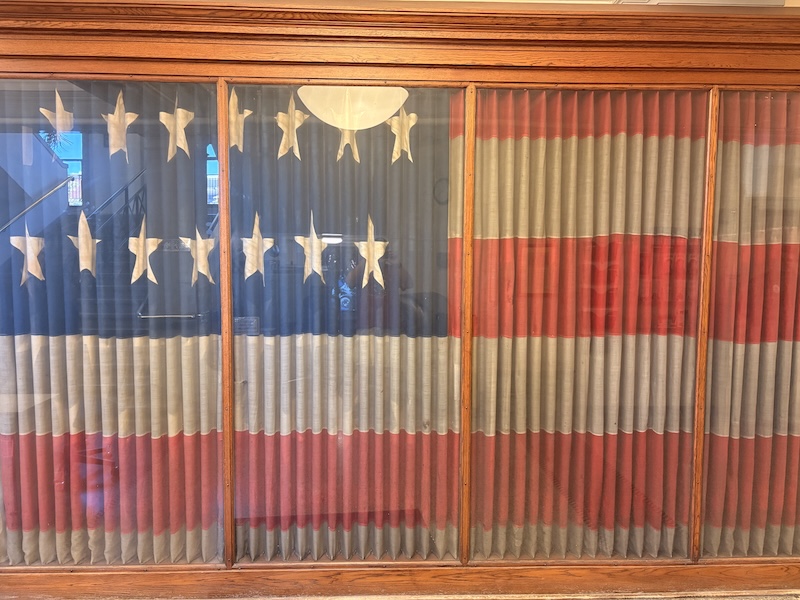
Now that, my friends and fellow Americans, is stirring stuff.
I should point out that in Dick Fallis’ telling of this story (which you can listen to through the podcast link below), he notes that “several accounts of the early event are in circulation, differing from each other in some details…One problem with this account is that the Ruby House did not come into existence until 1879, concurrent with the gold excitement at Ruby Creek, some distance up the Skagit River beyond the jam that had not yet been cleared away by the earlier date.”
In closing, I’d be remiss in not again recognizing the efforts of Mrs. John Munch, who as the above account recalls “had been interested in the flag since she first saw it unfurled from that flagstaff in 1891.” It was she, as Mr. Fallis cites, who “rallied the support of Ann Washington Chapter, Daughters of the American Revolution. They in turn raised the funds and provided the oak and plate glass case now at the county courthouse building, as a place to preserve and yet display this proud emblem from the early days of the community.” It is indeed a Grand Old Flag.