Day Trippin’: Visiting the Skagit River Bald Eagle Interpretive Center

What would it be like to be an eagle for a day in the Upper Skagit? The dim January sun is rising. Twenty of your fellow eagles perch in nearby trees. Your eyes scan the river gravel bars below for food. You spy gleaming fish scales and swoop down to sink your talons into a tasty morsel of chum salmon.
Landing on the gravel bar you tear off a piece of fish and gulp it whole. A raven swoops down and tries to steal your catch. You rise to the defense holding onto your meal, warily watching for other intruders. Barring other interruptions from fellow scavengers or from humans on the river, it won’t take you long to finish feasting. Feeling satisfied you fly to a perch above the river for a rest.
In the early afternoon the sun breaks through the clouds. Spreading your wings, you fly out into the warming air, soaring round and round, circling to catch rising columns of warm air. As the sun sinks west, you fly away from the river to the cover of sheltering trees greeted by the shrieking calls of other eagles.
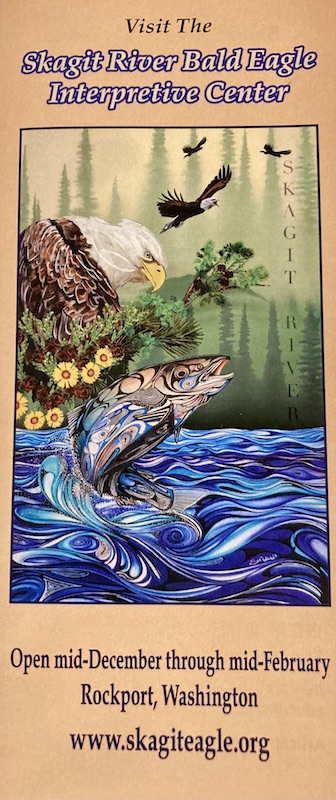
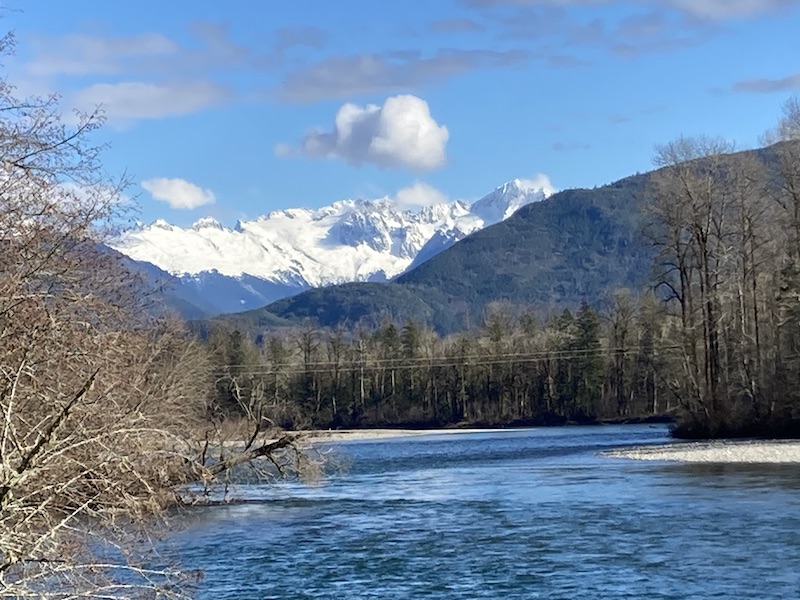
Fifty miles from Mount Vernon along Hwy. 20, and about as many minutes driving time, you’ll find yourself at a pullout at Mile Marker 100 and deep in the heart of the Skagit Wild and Scenic River System. Near the confluence of three major rivers, prime eagle watching, abundant fisheries, and outstanding scenic beauty are the hallmarks of this remarkable landscape.
Along this stretch of water a dramatic event unfolds each year as spawning salmon return to the rivers followed by hundreds of hungry bald eagles. As the salmon’s life cycle ends, their rotting carcasses are left behind as food for the eagles. Bald eagles are seen in the Upper Skagit primarily from late December through early February. During this period there are a variety of opportunities to view eagles in their natural environment and to enjoy educational programs and activities.
The Skagit River Bald Eagle Interpretive Center in Rockport, Washington is open each year on Saturdays and Sundays, 10AM to 4PM from mid-December through mid-February. It is located at Howard Miller Steelhead Park, just off Hwy. 20 at 52809 Rockport, Rd. Its mission is “To increase education about, appreciation for, and stewardship of the Skagit River watershed ecosystem.”
Activities include guided nature walks to spot eagles and other wildlife along the Skagit River. There are also speaker presentations, a children’s corner, a photography exhibit and other activities (see www.skagiteagle.org for an updated activity schedule) as well as a gift shop that features handmade items from local artisans, interpretive center souvenirs and educational wildlife material. Sales of these items support the Center, which is operated by The Skagit River Bald Eagle Awareness Team (SRBEAT), a non-profit, 502(c)3 volunteer organization.

The Interpretive Center provides maps and directions to salmon spawning and eagle viewing sites (the Center also loans out complimentary binoculars for adults and kids), and trained eagle watchers help visitors view wildlife from safe locations. You can schedule special programs for groups through the website.
Howard Miller Steelhead Park offers all-season camping along the wild and scenic Skagit River. In addition to tent and RV sites, boat launch, and even a couple of cabins and a clubhouse, the park has trails that traverse forest, wetlands, and riparian areas that include the confluence of the Skagit and Sauk Rivers.
The Skagit River is one of the last northwest river systems to host native stocks of all five species of Pacific salmon. These salmon species include Chinook (King), Sockeye (Red), Pink (Humpy), Coho (Silver), and Chum (Dog), as well as anadromous trout including Steelhead, Bull Trout, and Cutthroat.
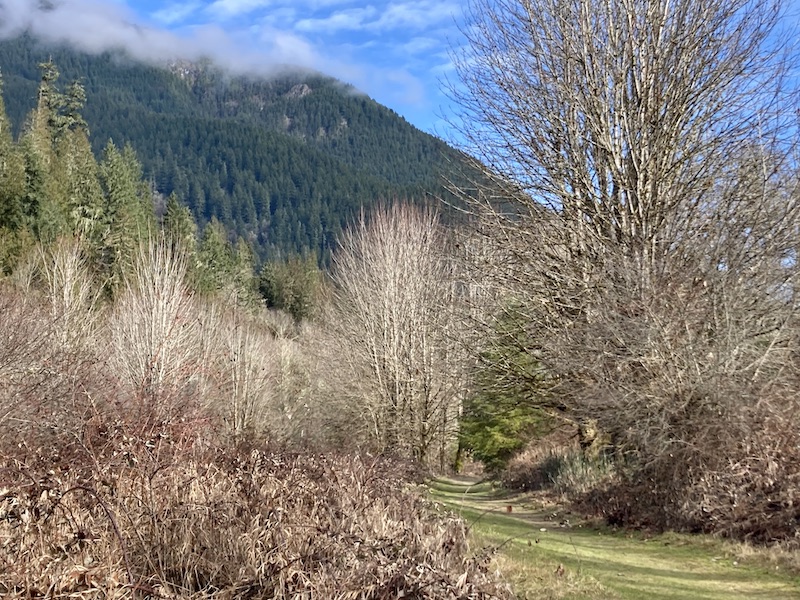
Salmon are anadromous, meaning they hatch in freshwater streams, migrate to the saltwater ocean to mature, and eventually return back to freshwater to spawn and die. During their life cycle, salmon face tremendous challenges both natural and human-caused — from paving over of wetlands to water pollution to fishing and predators. Due to these challenges, salmon mortality is incredibly high; out of several thousand eggs, only 0-2 may survive to spawn. As an indicator species, salmon are literally the “canary in the coal mine” for Pacific Northwest rivers.
Thanks to the Skagit River Bald Eagle Interpretive Center’s annual celebration of America’s apex raptor you’ll have an opportunity to do more than spot bald eagles and learn amazing facts about their lives — you’ll also discover the ecological web that sustains them, courtesy of the volunteer naturalists who lead guided tours along the Howard Miller Steelhead Park Skagit-Sauk Reach Trail and Wetland Wildlife Trail.
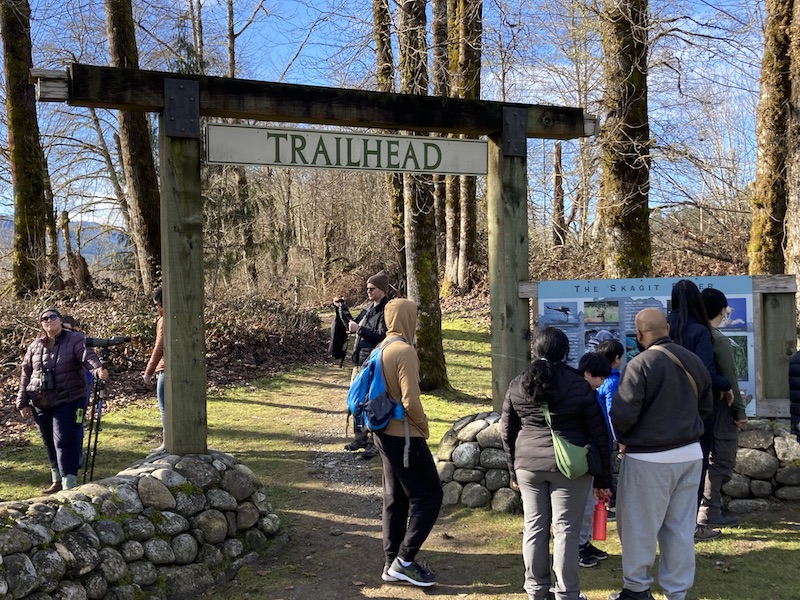
Spotting scope in hand, our guide Amanda led a group that my wife and I joined on a recent Saturday morning along the park’s trail system, where we spotted eagles in trees and in circling flight patterns called “kettles” — an odd reference to cauldrons being stirred by invisible spoons. What is, of course, going on with these flocks of juvenile and adult bald eagles is a seemingly effortless riding of thermal drafts to spot potential food sources. Eagles can see between six and eight times better than us humans, and can detect objects at distances between one and two miles.
Among the other interesting eagle facts that we learned from Amanda:
- Bald eagles measure 31-37 inches in height with a wingspan of six feet or more.
- Eagles weigh between 9 and 14 pounds. Females are one-third larger than males.
- Adults have dark brown bodies and a white head and tail, with bright yellow beaks and feet. Juveniles are brown or blotchy brown all over.
- Bald eagles may live up to 30 years in the wild. They mate for life and they may use the same nest for several years, raising one or two chicks.
- Bald eagles’ diets consist exclusively of meat. They hunt, steal and scavenge for their food, conserving energy while dining or whatever food is available — which is one of the reasons that Ben Franklin was opposed to the bald eagle as a national symbol. He seemed to think that scavenging was an activity beneath the dignity of his newly founded nation. Whatever.
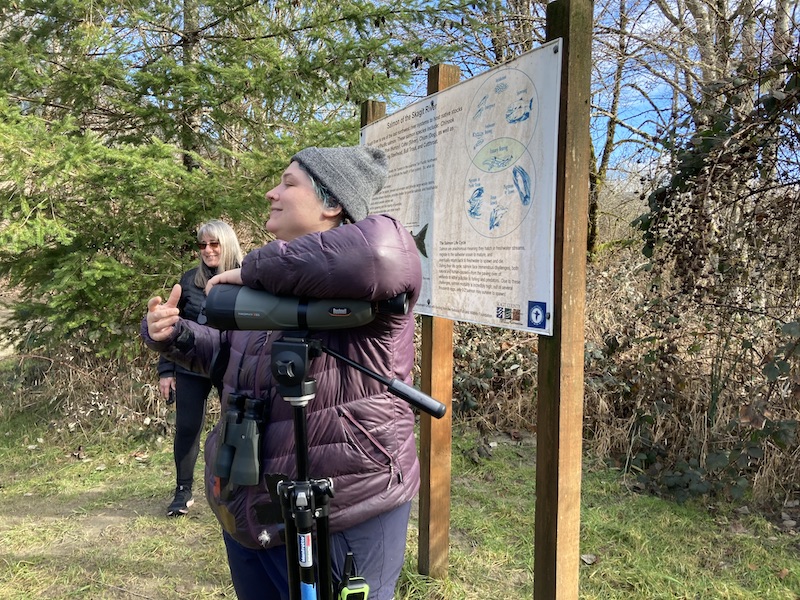
More than just a fact-filled eagle walk, however, Amanda’s guided tour focused on the circle of life in which eagles thrive or perish. Howard Miller Steelhead Park and Mile Marker 100 are encompassed within The Skagit River Bald Eagle Natural Area. Located near the community of Rockport, this special area was founded in 1976 by the Nature Conservancy and Department of Fish and Wildlife and is dedicated to habitat protection, conservation and educational efforts.
A key to these conservation efforts is the protection of riparian zones — narrow strips of vegetation on both sides of a stream or waterway that mark a transition between aquatic and terrestrial ecosystems. As it turns out, bald eagles need not just salmon but also trees. Riparian trees help filter pollutants, slow stream bank erosion and shade the water, keeping it cool for salmon. Trees provide leaf litter as habitat, as well as food for insects which juvenile salmon eat. Even dead trees, as fallen logs and woody debris, help salmon: they create pools and provide protective cover for juvenile salmon.
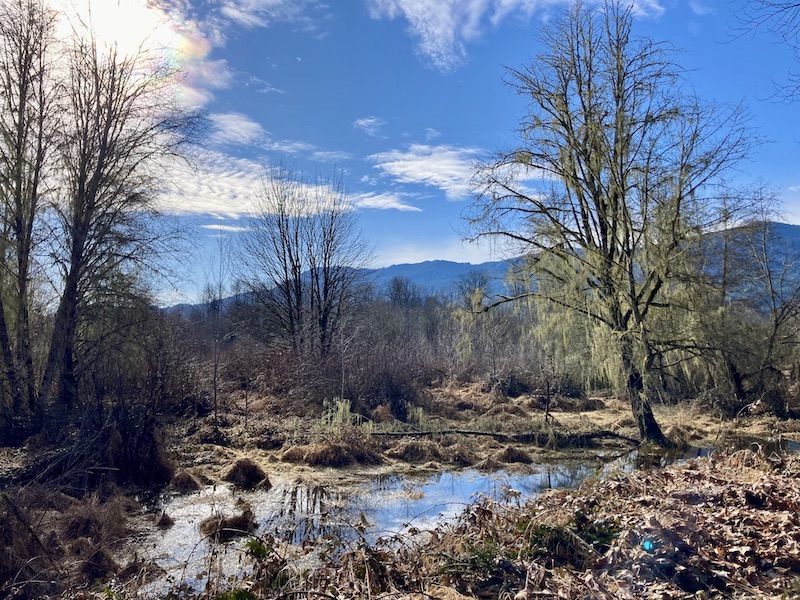
And as is often the case in the symbiotic nature of things, trees need salmon as well. After spawning and dying, salmon carcasses rot and release a wealth of nutrients into the riparian ecosystem. With the help of nature’s scavengers, such as bald eagles, ravens, gulls, and bears, this “salmon fertilizer” nourishes the trees via animal droppings. In fact, salmon are one of the reasons that the northwest forests are so healthy and the trees are so big!
Salmon populations are a fraction of their historic numbers due to over-harvesting, competition from hatchery stock, hydropower development on our rivers, and habitat loss. Restoring and protecting healthy habitat is very important because without it wild salmon will become extinct. If you’d like to be a part of the solution to this threat, consider getting involved with the Skagit Fisheries Enhancement Group (SFEG), one of 14 nonprofit Regional Fisheries Enhancement Groups around Washington State. SFEG is dedicated to conserving wild salmon for future generations through community education, involvement, and habitat restoration.
Volunteers in partnership with SFEG have planted thousands of native trees and shrubs to increase the riparian zone bordering the Skagit River within Howard Miller Steelhead Park. If you are interested in becoming a member or volunteer with SEG, you can learn more via their website at www.skagitfisheries.org.
By the way, if you have trouble remembering the five salmon species that populate the Skagit River system, you can always refer to the “five finger guide.” Start with your thumb, which rhymes with “Chum”(Dog). You can poke an eye with your index finger, so think “Sockeye.” Your middle finger is your largest digit, so that stands for “King” (Chinook). Your ring finger might wear a silver ornament, representing “Coho” (Silver), and your pinky finger naturally stands for the “Pink” (Chum) salmon. Now, aren’t you glad you read Tales of the Magic Skagit?
Note: Content for this Tales of the Magic Skagit episode was derived primarily from information posted at Howard Miller Steelhead Park and the Skagit Wild and Scenic River System.