Tales of the Magic Skagit: The Upper Skagit Claim their Place in the Historical Narrative of the Sedro-Woolley Museum
Given my long running love affair with history, it was only natural that I was eager to learn the origin stories of the Magic Skagit when my wife and I moved here from Boise, Idaho some ten years ago. I assumed that, like Boise, the Skagit Valley’s historical roots would have their starting point around the time of the Great Western Migration — which is to say in the mid-19th century. I’m somewhat embarrassed to admit that it took me at least two years to realize that this assumption suffered from an ethnocentric blind spot. When it comes to the human settlement of the Skagit Valley, my conceptual timeline was slightly off…by about 10,000 years.
While it’s been said that history is written by the victors, it’s probably more accurate to say that it’s written by those who had a system of written language to begin with. And when an indigenous people whose transmission of their history has been oral, the eradication of their language amounts to the extinction of their history — an erasure that took place through the removal of tribal children from their families and communities and their placement in Indian Schools that operated under the mantra of “kill the Indian, save the man.”
This is an ugly chapter of history that should make all of us who call ourselves Americans, whatever our origins, uncomfortable in confronting. But that confrontation is a necessary part of fulfilling the promise of our nation’s founding principles — principles that, as we’ve discovered in learning the indigenous history of America, were reflected in the cultures and societal norms of its First Peoples, and even helped shape the Constitution of the United States of America.
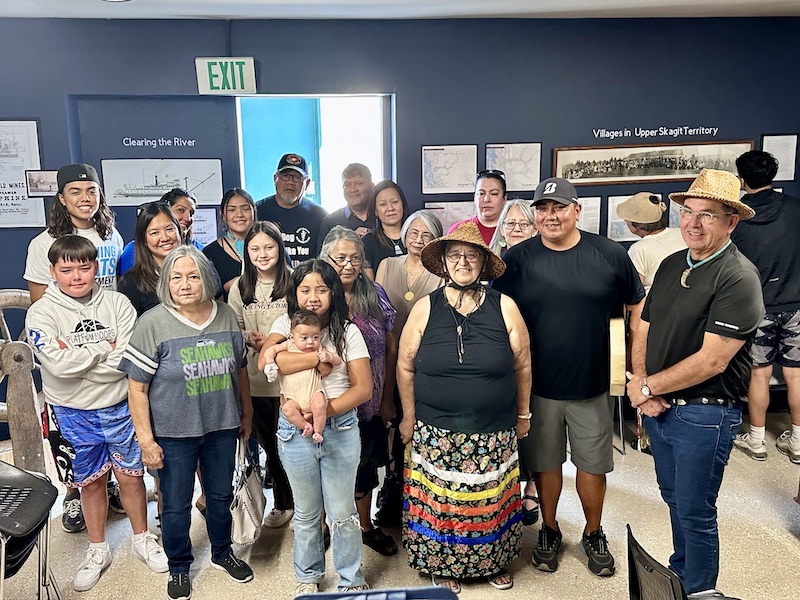
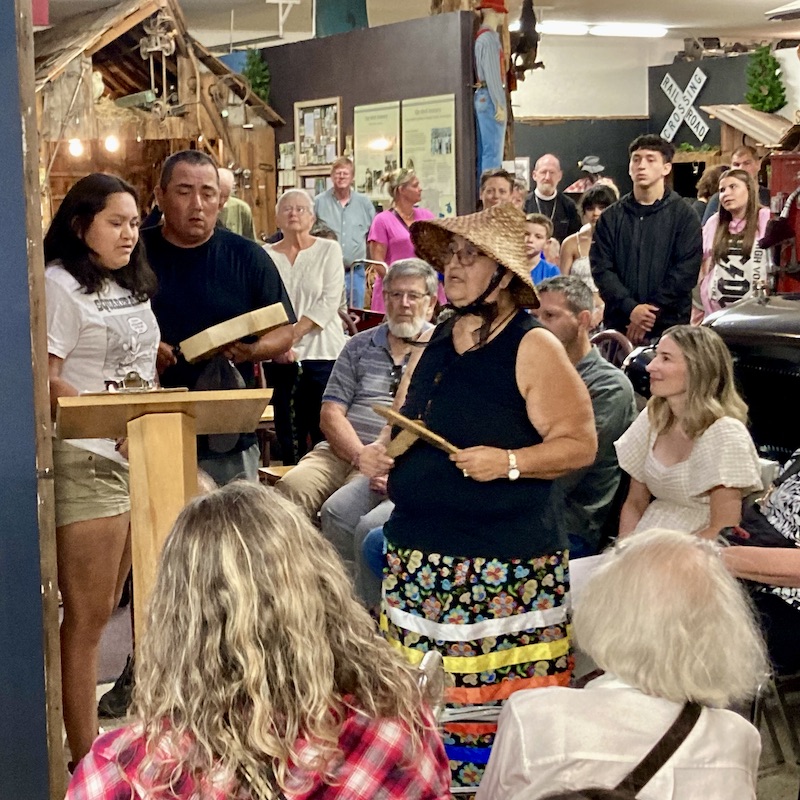
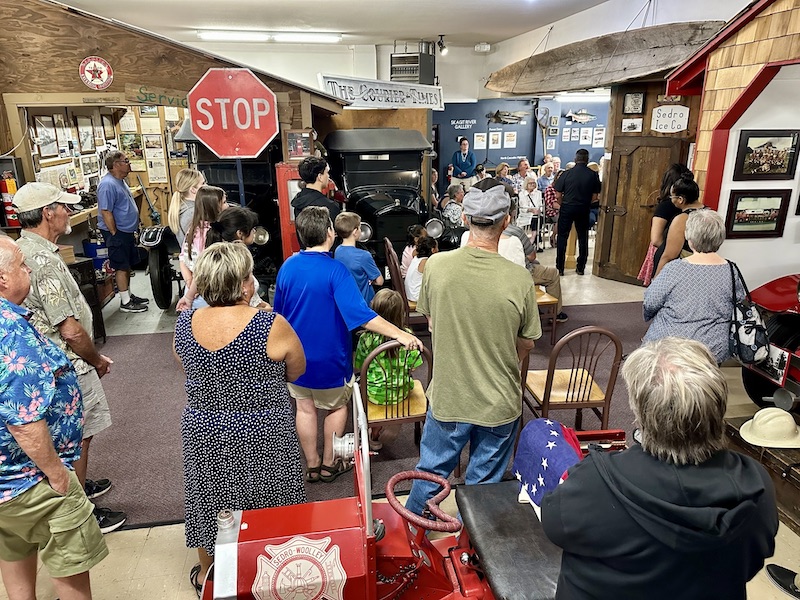
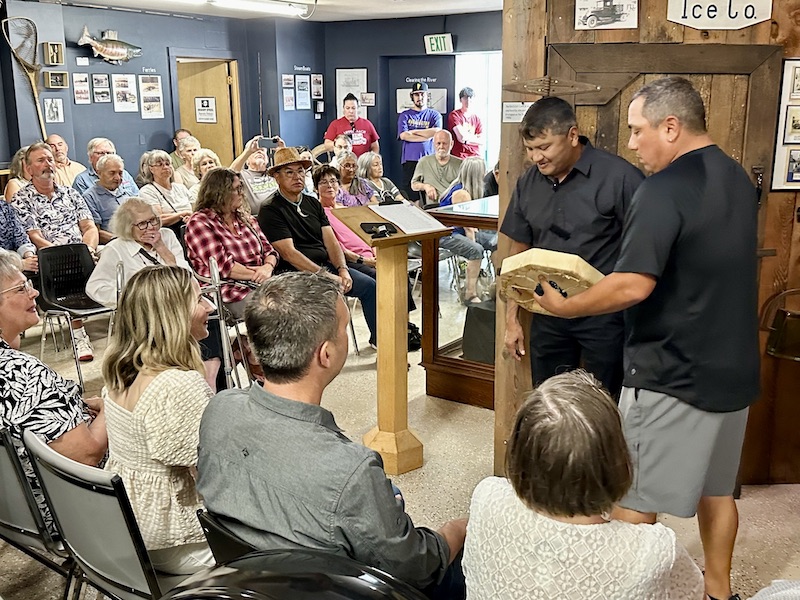
Which brings me, albeit in a fraught and longwinded way (my apologies), to the story of an important step in restoring some balance to our historical notions of who we are as Skagitonians. It started with a visit to the Sedro-Woolley Museum from a woman whose husband had discovered an artifact that, according to museum president and executive director JoEllen Kesti, “turned out to be not only rare but of cultural significance.” That discovery culminated in the August 19, 2023 unveiling of a new museum exhibit dedicated to the history of the Upper Skagit Tribe before a standing room only gathering of not only tribal members, but those of the broader Skagit Valley community as well, including my wife and I.
Upon receipt of the discovered tribal artifact, JoEllen reached out to Scott Schuyler, the Upper Skagit tribe’s policy representative for natural and cultural resources, and he came to the museum to look at it. In the ensuing discussion about its historical value, the concept of an exhibit in the museum’s Skagit River Gallery took shape.
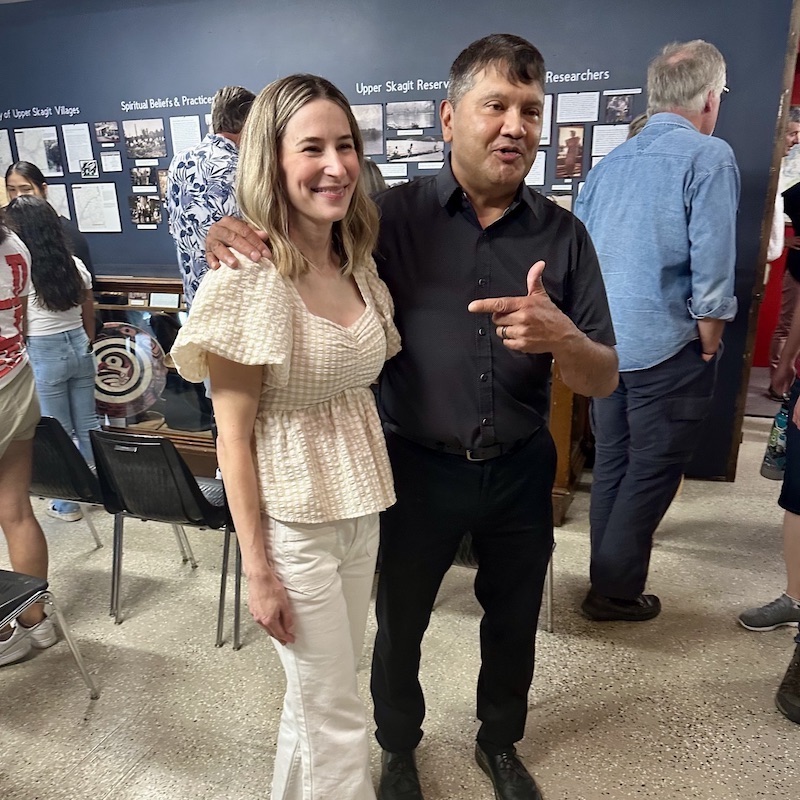
“Scott came and met with us, and we chose the things to be displayed,” Kesti told the museum audience during her introductory remarks at the gallery unveiling. “It just really blossomed from there to what we have today — all from the woman who brought that particular piece in. The end result of that initial exchange, over a period of weeks and months, is what you see here today.”
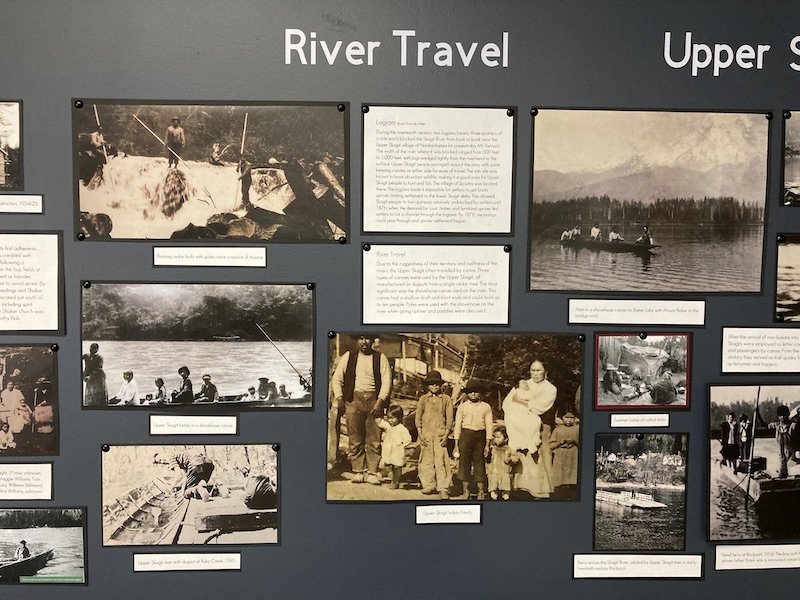
The new exhibit is housed in the museum’s Skagit River Gallery and tells the history of the tribe through maps, photos, stories, and artifacts. Above the gallery’s entrance is a dugout canoe, while just inside is a display case with a variety of artifacts that include baskets, mortars and pestles, clothing made from animal hides, a drum, and antlers. Photographs with accompanying text speak to the tribe’s history in the area, and one of the walls provides maps that identify the numerous villages that once lined the river, taken from a publication detailing the tribe’s history, “Upper Skagit Tribe Atlas.”
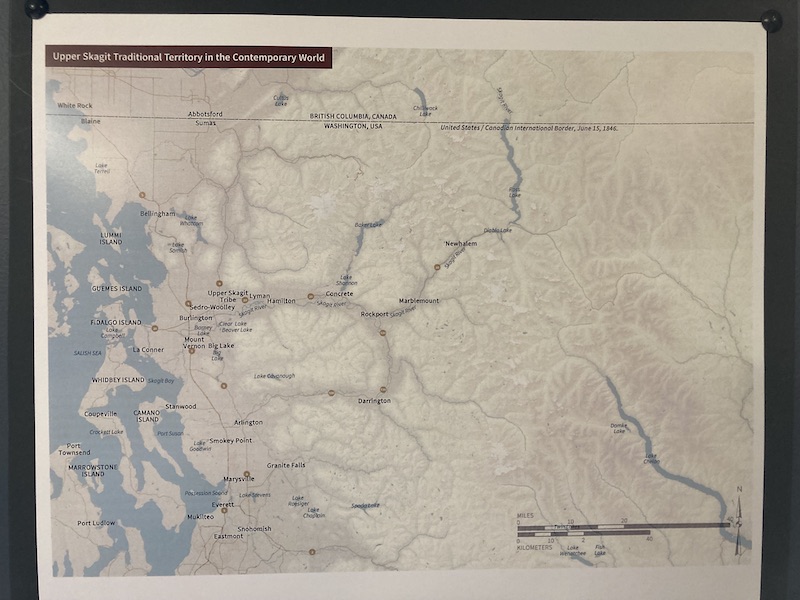
To appreciate the significance of this exhibit to the Upper Skagit, whose reservation is located just a few miles upriver from Sedro-Woolley, I can do no better than provide a verbatim transcript of Scott Schuyler’s remarks to the audience that gathered at the museum for its dedication, and that followed a song of welcome by tribal council vice-chairman Edwin Mathias. (It should be noted that Scott’s ancestor, Patous, was one of the signers of the Point Elliott Treaty of 1855 in Mukilteo — the lands settlement treaty between the United States government and the Native American tribes of the greater Puget Sound region in the recently formed Washington Territory).
Today is a great reflection on the progress and growth that the city and the tribe have made over the four decades since I went to school here at Sedro-Woolley High. Things have really changed. This humble exhibit that we share today is not intended to be a definitive exposition of the history and culture of the Upper Skagit people — this story can be told by the tribe at a future date and in a facility of our own some day. We want to bring people together to generate a conversation about the “history before history” and spark our pride in that history. The reward that we get from including that history in our K-12 education is to see how excited our children get, the questions they ask, and the pride we see from our native kids as well, and we hope this becomes a springboard to learn more about the indigenous history of this area. This exhibit is just a small slice of our way of life and learning and acceptance between neighbors.
Normally we prefer artifacts to be returned to the ground, but sometimes that’s not possible due to the danger of their being damaged or destroyed. Some of these artifacts have come from private collections.
Modern archeology has confirmed that our ancestors’ history of oral tradition has been spot on, because we can now confirm that the locations and dates surrounding these artifacts and activities associated with them is accurate — which is really amazing considering that the Upper Skagit history goes back thousands of years, predating even the great civilizations of Egypt.
Our stone technology remained the same for 10,000 years, changing very little until “first contact” about 170 years ago, at which point our people began adapting to new technologies — but we retained our cultural identity and way of life. The exhibit contains cedar used in our ceremonies and essential to our way of life; our cedar plank longhouses lined the Skagit from Mount Vernon upstream to the Seattle City Light project area. One of these longhouses at Marblemount was reported to be 1,000 feet long and housed 25 individual family members. The great cedar forests provided our people with clothing, baskets for cooking and gathering, and the canoes for which our people were renowned.
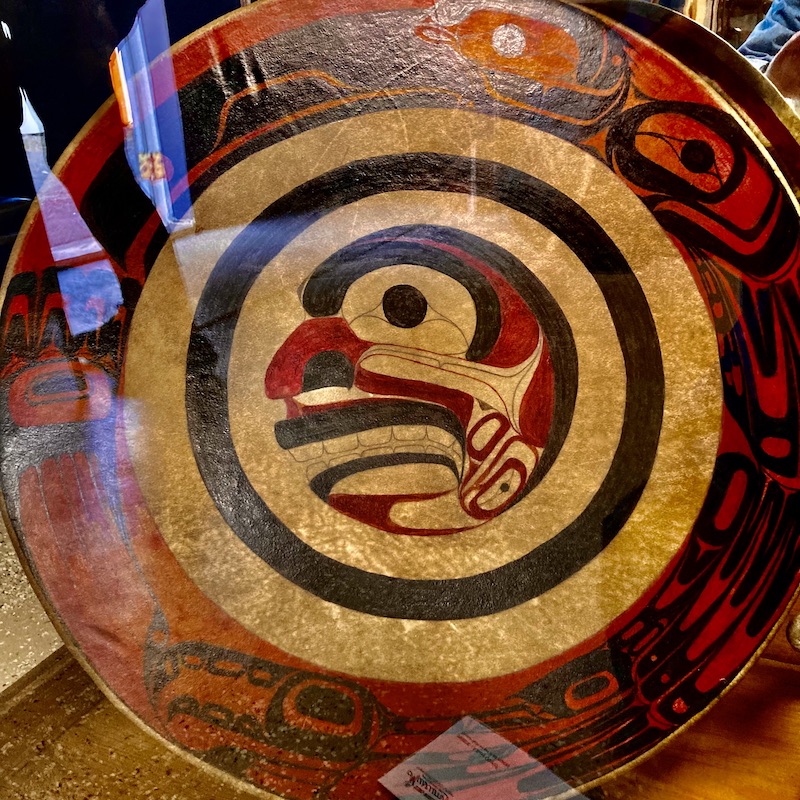
The ceremonial drum in this collection highlights our culture, and was a gift from the Samish Indian Nation. Its face is that of Walter Sam, a powerful Indian doctor from Eastern Washington who was married to my great grandmother. She and my great grandfather lived for decades in a log cabin along the river near Marblemount. They had no running water and no electricity, but they were happy and content. The goat wool you see here was gathered by our people and used in weaving wool blankets for the cold winters and was a valuable trade resource with other tribes that did not have goats. Elk and deer horns were used in everyday tools like spears, needles, and weaving combs. The Upper Skagit were considered expert hunters for deer, elk, and goat. They also hunted bison, and their trading influence extended as far away as Oregon.
Our stewardship of the river continues. We have recently asked the City of Seattle to restore the flow of the river, which was de-watered in 1921, by allowing fish passage over all three Skagit River damns, which they have agreed to do. In 2023, we saw these efforts come to fruition. In 2002 we asked Puget Sound Energy to help us rebuild the nearly extinct Baker Sockeye run, but to bring it to a level higher than historic levels, and today we are approaching nearly 65,000 returning fish. In 1985 the run had dropped to only 80 fish. The pre-2002 historic high was 20,000.
Today we are borrowing this land from our kids and their kids, and seeing everyone gathered here is the beginning of something bigger down the road as we continue to write our interwoven history, to be told and enjoyed for years to come.
In thinking about my introduction to this Tales of the Magic Skagit episode, it occurs to me that it might be interpreted as portraying the victimization of an indigenous people, but I’m very sure that Scott Schuyler and the Upper Skagit community members who gathered to sing and celebrate at the Sedro-Woolley Museum’s exhibit unveiling would reject such a narrative. After all, they remain…as does their culture and history. As JoEllen Kesti pointed out during her introductory remarks, “The exhibit recognizes the fact that in telling the history of the Skagit River you must include the story of its first inhabitants. The gallery is a work in progress that will continue to evolve as more information and artifacts become available through the involvement of the Upper Skagit Tribe.”
To me, the significance of the steps that the Sedro-Woolley Museum has taken with its Skagit River Gallery is less about righting a historic wrong than about simply bringing a measure of balance to what Scott Schuyler so aptly described as “our interwoven history.” It’s a history that all of us — First People and New People alike — can share and celebrate.