Tales of the Magic Skagit: “Dear Skagit County Fair, How Old Did You Say You Were?”
Meyer Sign is proud to have the Skagit County Fairgrounds as our flagship media partner. For the second year in a row, Meyer Sign will sponsor a fair history booth, hosted by Tales of the Magic Skagit creator, Michael Boss (c’est moi!), and Mr. Magic Skagit himself and man about town, Don Wick.
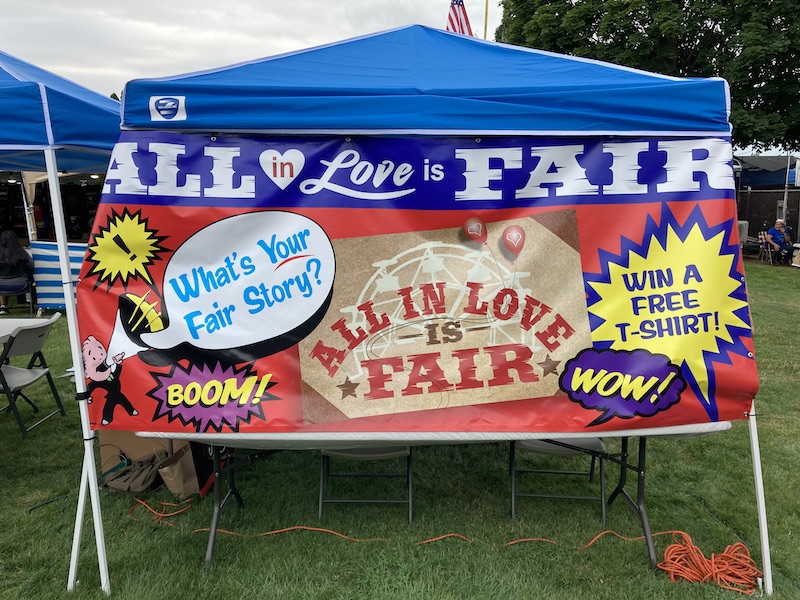
Last year, with the audio assistance of Skagit Valley College radio station KSVR, Don and I did a series of podcast interviews (“All in Love is Fair”) with folks who have been instrumental in organizations that are the beating heart of the fair, such as 4-H and FFA. We also did a number of impromptu interviews with Skagitonians who were gracious enough to share their own fair memories, including long time performers like Wren the Juggler and Sunday Speedtrap.
This year, Don and I are hoping to “widen the net” with more interviews with kids — they’ll be the ones most likely reflecting on history from a late 21st century perspective, so let’s give them something to remember about the way we were in 2023. I’m also hoping to do more video interviews with all sorts of people, from vendors to presenters…and, of course, entertainers.
But there is another agenda at work for Mr. Wick and me. We would like to interview more people whose Magic Skagit roots intertwine with those of the Skagit County Fair. Since its inception, Tales of the Magic Skagit has proven to be a great forum for “crowd sourced history” about this place that his been called home by many people over many millennia.
The Skagit County Fair occupies just one piece of that larger history, but it’s one that has played an important role in how we think of ourselves as Skagitonians. Don and I would love to hear your thoughts, memories, and anecdotes about that role — and if you sit down and do an interview with us, not only will it “air” on Meyer Sign’s podcast channels (Spotify, Apple Podcasts, Google podcasts), but we’ll make it worth your while (yes, we will resort to bribery).
To kick off our efforts at telling the history of the Skagit County Fair, let’s start with probably the most basic question: “When was the first Skagit County Fair?” This should be a slow pitch over center plate, right? It turns out, however, that the answer to this question isn’t so easy; which is the subject of the following Tales of the Magic Skagit story.
See you at the Fair!
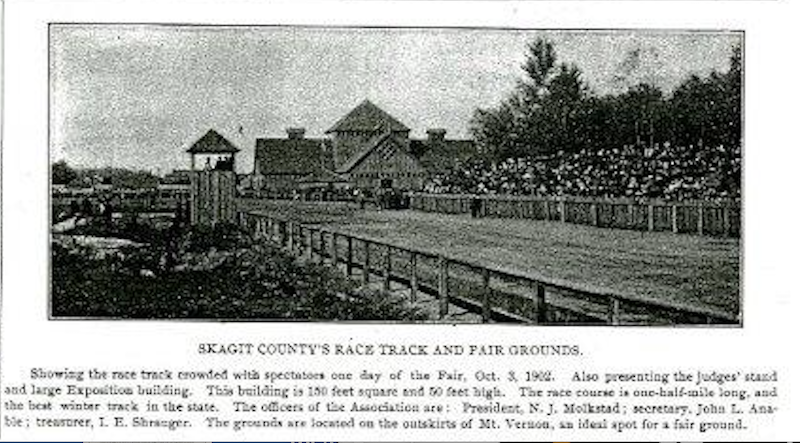
“The Skagit County Fair Association, which was organized last summer, has its race track and exhibition grounds located just on the outskirts of the town. The association is capitalized for $15,000, and most of the stock has been sold to citizens of Skagit County. The track is pronounced by experts to be the best winter race course in the state, on account of the sandy soil which constitutes the track. The exhibition building is 150 feet in size and built in Maltese cross style. The grand stand will be sufficient to hold 8,000 people, which will be completed, before another fair is held. In October this present year a most successful four-days exposition was held, and every one who visited the grounds were amazed at the excellent track and buildings. The very best of sheds have been built for race horses and stock of all kinds. N.J. Moldsadt is the president of the association, and John L. Anable is its secretary.”
Sebrings Skagit County Ilustrated (1902, pg.1405) Not long ago, Skagit County Fairgrounds manager, Aric Gaither, shared an article from the 2010 Fair Guide (four fairs before my arrival in the Magic Skagit), written by Bret Lunsford, who had once served in Aric’s capacity. It also turns out that Bret is a local history buff (I haven’t met you, Bret, but I like you). The subject of his story was the origin (place and time) of the first Skagit County Fair. Bret raised the question of how many fairs had transpired prior to 2010. “It depends,” he observed, “on what year you count from.” Having issued that caveat, he boldly asserted 1898 as the fair’s inaugural year, and then went on to explain the controversy, or at the very least the confusion, behind determining its starting point.
Throughout its celebration, Skagit County Fair month has occurred in October and September, as befits a harvest festival, but most often it was held in August. Although the fair chose to declare 1998 as its official centennial, Mr. Lunsford was doubtful, citing the historical record (see the reference to the Sebrings Skagit County Illustrated above) of a new fair association that was formed in 1901 by H.A. March, Emerson Hammer, N.J. Moldstad (president) and others who established a four-day October event in Mount Vernon.
It should be noted that Moldstad’s grandson, Kelly, who was vice-president of the Fair Advisory Board, has a copy of the 1902 fair “premium book,” titled the Second Annual Fair and Races. So we’ve now at least pushed the starting point back another two years to 1900.
For most of the 20th century, however, each year’s official fair program counted back to 1911 as the first Skagit County Fair — the year the fair moved to Burlington on the grounds of the current Fred Meyer store. Horse races and car races were on the program that year. Following the 1930 Skagit County Fair, the Great Depression caused the fair to be scaled back substantially, and prior to World War II it was referred to as the Skagit County and 4-H Fair.
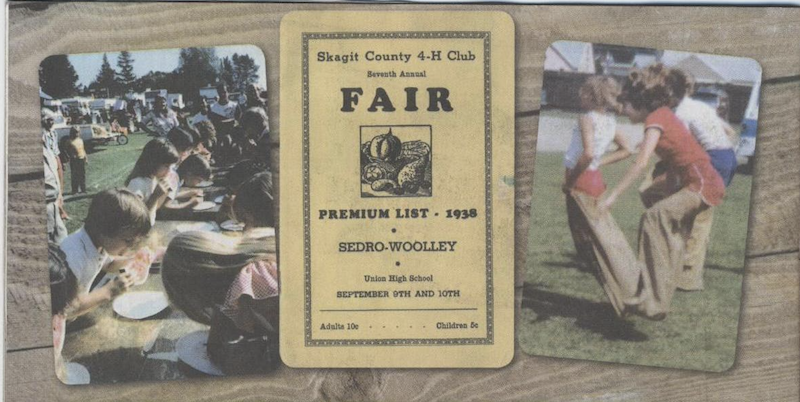
In 1938 the fair was located at Union High School in Sedro-Woolley, where it was hosted for most of the decade. In 1941 the event was relocated to the “new 4-H Fair Grounds in Mount Vernon” for what was then called the “Tenth Annual” fair. But who’s counting, right? The Skagit County Fair was suspended for most of World War II, based on the gap in the archives of premium books from that period. By 1945, the fairgrounds had been renamed the “Evergreen Classic Pavilion” for the “Twelfth Annual” fair. Skagit County Fair organizers appear to have been math challenged.
After 1949, fair premium books no longer referenced the previously stated 1931 starting date, and after 1959 the name “Evergreen Classic Pavilion” was also jettisoned. From 1960 on, the site of the fair has remained where it is today, known simply as the “Skagit County Fair Grounds.”
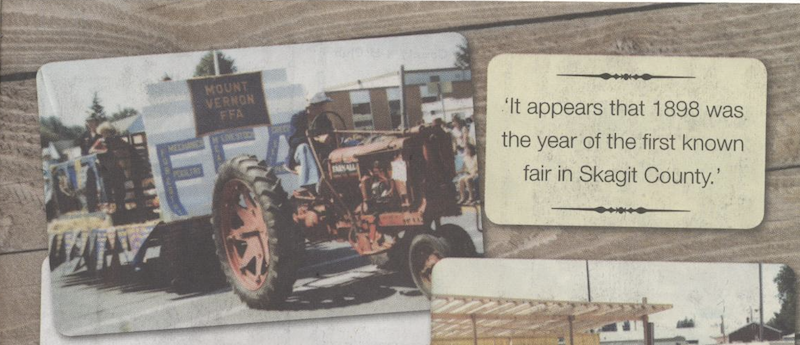
It was during the 1980s when people began referring back to the 1911 fair as the start of it all: “75 Years and On The Month” was the theme for the 1986 fair, which is also about when the name “Fair Grounds” was contracted, becoming “Fairgrounds” as we know it today. Things continued to get confusing in the ‘90s when promotions referred to a first fair in 1900, with the theme for 1995 being “We’re 95 in ’95”. Are you confused yet? The count again changed with the new millennium and the determination by Bret Lunsford that 1898 was the year of the first Skagit County Fair, and 1998 was officially declared the “Centennial Fair.”
So, what can we conclude? Although there are historic references to the establishment of a fair association in 1900, Bret Lunsford maintains the belief that the first Skagit County Fair occurred two years earlier. And while we know there were some gaps in the fair’s annual occurrence since 1898, he felt confident in declaring the 2010 fair to be its 112th anniversary. With a one year hiatus during the pandemic, the 2023 fair will mark the Skagit County Fair’s 124th year — which means that you might want to preorder those 125 Year Anniversary t-shirts. They’re going to be collectors’ items.
Postscript:
Since my original draft of this story, I’ve gotten some feedback from Bret Lunsford, who was gracious enough to point out a math error that I immediately corrected! He also added the following:
“To add to the commentary, let’s bring in Dick Fallis, whose 1981 piece News of Skagit Fair dates back to 1873 appears in Bridgeside, a book compiling his articles published by Dan Royal.”
“The next mention of a fair was in 1898, which was described as ‘a prosperous year with good crops and business activity. In the fall the people celebrated their good fortune by holding a county fair, which began October 6th and lasted three days, proving a grand success. The beautiful and varied displays showed the great resources of Skagit County to be such as the inhabitants themselves had not realized. The attendance during the three days was fully six thousand.'”
I’m going to have to track down that 1981 article by Dick Falls.