Across The Great Divide: Seven Days in September (Part 2)

This is the second part of our two-part series describing seven days in September 1805 that Meriwether Lewis, William Clark, and the Corps of Discover spent crossing the Bitterroot Mountains on their way to the Columbia River — and on to the the object of their quest: the Pacific Ocean.
When we left off after Day Four (Wednesday, September 18), Lewis & Clark had decided to divide the Corps in order for Clark to go on ahead with a party of six hunters to search for game. Lewis would follow with the rest of the party, who were by now feeling the effects of hunger and exertion.
Thursday — September 19, 1805
(From the journal of Meriwether Lewis)
Lewis and his contingent broke camp just after sunrise and continued “the same course as yesterday” — southwest. They followed the ridge they were on for six miles, at which point it ended, “and we to our inexpressible joy discovered a large tract of prairie country lying to the S. W. and widening as it appeared to extend to the West.”
Their guide, Old Toby, pointed in the direction of the Columbia River. The plain before them looked to Lewis to be about 60 miles in distance, but Old Toby assured them that they would reach its borders the next day.
“The appearance of this country, our only hope for subsistence, greatly revived the spirits of the party, already reduced and much weakened for the want of food.” Regardless, he and his party still had some stiff work ahead of them. Having left the ridge they were traveling on, they ascended and descended several steep mountains for six miles, where they struck a creek about 15 yards wide. They continued up the side of this creek for another six miles. Lewis made note of eight distinct species of pine as they struggled onward.
Lewis described the road they traveled on along this creek as, “excessively dangerous…being a narrow rocky path generally on the side of a steep precipice, from which in many places if either man or horse were precipitated they would inevitably be dashed to pieces. Frazier’s horse fell from this road in the evening and rolled with his load over a hundred yards into the creek. We all expected that the horse was killed but to our astonishment, when the load was taken off him he arose to his feet and appeared to be but little injured. In 20 minutes he proceeded with his load. This was the most wonderful escaped I ever witnessed.”
The Corps covered 18 miles that day, and camped on the side of a little ravine. They had some of their portable soup, “and retired to rest much fatigued.” Several of the men were by this time suffering from dysentery, and “eruptions of the skin” were “common with us for some time.”

Meanwhile, Clark and his hunters proceeded up Hungry Creek for six miles, where they discovered a horse in a glade. The men begged Clark to let them kill it for food, and he gave his permission. While one part of the group skinned and prepared the horse to be cooked, another group went hunting, but could not even find an animal track of any kind. After satisfying their hunger, the group hung up the bulk of the horse for Lewis and the rest to find.
Friday — September 20, 1805
(From the journal of William Clark)
Clark and the hunters set out early and “proceeded on through a country as rugged as usual, passed over a low mountain into the forks of a large creek, which I kept down two miles, and ascended a steep mountain, leaving the creek to the left.”
They passed the head of several drains on a dividing ridge, and in 12 miles they descended the mountain to find themselves in “level pine country.” They traveled the next three miles through what Clark described as “beautiful country,” on to a small plain where they found “many Indian lodges.” A mile from the lodges they met three boys who ran and hid themselves in the grass. Clark dismounted, handed his gun and horse to one of his men, searched the grass and found the boys. He gave them small pieces of ribbon and sent them on to the village.
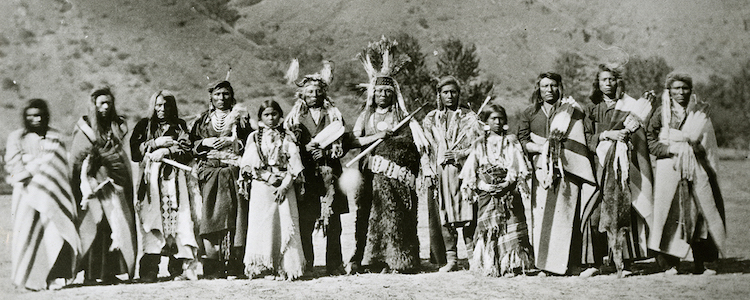
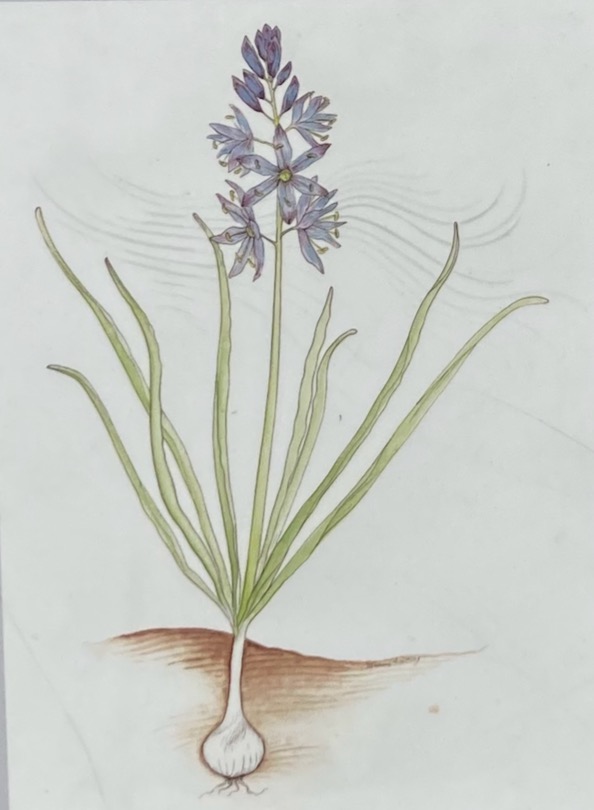
A man from the village soon came out cautiously and greeted Clark and his men, “and conducted us to a large spacious lodge.” Through sign language he told Clark that the lodge belonged to a great chief who three days earlier had set out with “all the warriors of the nation” in a southeast direction and would be back in 15 to 18 days. The remaining men and women seemed afraid, but gave Clark and his men a small piece of buffalo meat, some dried salmon, berries and roots, including something Clark describes as “round and much like an onion, which they call quamash (or as we call it today, camas).” “Of this they make bread and soup. The bread or cake is called Pas-she-co sweet. They also gave us the bread made of this root, all of which we ate heartily.”
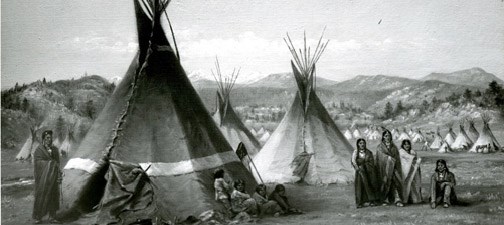
Clark gave his benefactors “a few small articles as presents,” and then proceeded on with a chief to his village two miles farther on the same plain, “where we were treated kindly in their way and continued with them all night.” For Clark and his hunters, the worst was over.
Clark noted that the two villages they had encountered consisted of about 30 double lodges, but that they were at that time inhabited by only a few men and a number of women and children. They called themselves the Cho pun-ish or Pierced Noses. Their dialect appeared very different from the Flathead Indians (part of the Salish-speaking tribes that formed the easternmost of the Plateau Indians), “although originally the same people. They were darker than the Flatheads I have seen. Their dress is similar, with more beads — white and blue primarily — brass and copper in different forms, shells, and wear their hair in the same way.” The Pierced Nose people were, of course, the Nez Perce. They called themselves the Nimiipuu — The People
Clark described the Nez Perce men as “large” and “portly,” the women “small” and “handsome featured.” He observed large quantities of the quamash gathered and in piles about the place. He further described the plant in greater detail: “Those roots grow much like an onion in marshy places. The seeds are in triangular shells on the stalk.” He went into even greater detail in describing the process for “sweating” them, which involved digging a large hole three feet deep and adding layers of wood and small stones before setting it on fire to heat the stones, and then laying on grass and mud to extinguish the fire and placing the Pas-shi-co root on it.
The salmon and Pas-shi-co were welcome, but Clark found himself very unwell from having eaten “too freely.” The hunters were again sent out, but were able to kill nothing despite seeing some signs of deer.
Lewis and the rest of the Corps had in the meantime found the horse meat that Clark had saved for them. One of the packhorses was missing, and Lewis sent LePage, who was responsible for it, back to look for it. LePage was unsuccessful, so Lewis sent another two men. The horse was important since it was carrying not only their diminishing stock of trade goods but all of Lewis’s winter clothing as well. In spite of this, Lewis took the time to note several new birds, including the Steller’s jay and three new species of pheasant or grouse. He was now two days behind Clark.
Saturday — September 21, 1805
(From the journal of William Clark)
“I am very sick today and puke, which relieves me.” — Captain William Clark
However the rest of the day may have gone for Capt. Clark on Saturday, September 21 — the seventh day of the Corps’ Bitteroot Mountains ordeal — the first sentence in his journal entry was just three little words: “A fine morning.” Being a fine morning, Clark sent out a group to find deer. He remained behind to speak further with the Nez Perce chief, thanks to whose hospitality he and his men had been restored. The chief provided Clark with information about the land and river ahead of them and even “drew me a kind of chart of the river, and informed me that a greater chief than himself was fishing at the river half a days march from his village, called the Twisted Hair.”
The chief went on to tell Clark something especially intriguing about the land before them — that after passing several forks, the river would pass through the mountains, “at which place was a great fall of the water passing through the rocks. At those falls, white people lived, from whom they procured the white beads and brass, etc., which the women wore.”
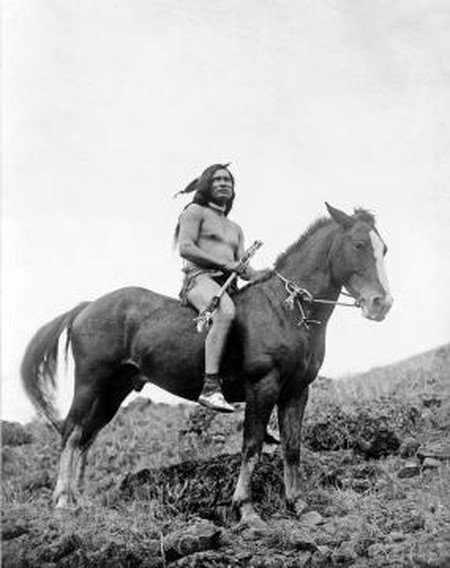
A chief from another band visited with Clark as well. The two smoked a pipe, but all Clark had to offer in return was his handkerchief (clean, one would hope) and a “silver cord” (military braid, perhaps?). The hunters returned empty handed, and in order to sustain his team, Clark “purchased as much provisions as I could with what few things I chanced to have in my pockets, such as salmon, bread, roots and berries, and sent one man, R Fields, with an Indian to meet Capt. Lewis, and at four o’clock p.m. set out to the river.”
Along their way, Clark’s group encountered a man en route to the same destination, and Clark immediately “hired” him as a guide. His compensation was the “neck handkerchief of one of the men.” Half past 11:00 at night the group arrived at a camp just below that of the Twisted Hair. Here they found “five squaws and three children.” Clark’s hired guide called to the chief, who was encamped on a small island in the river.
Clark’s immediate impression of the Twisted Hair was a positive one: “I found him a cheerful man with an apparent sincerity.” The two leaders smoked together until one in the morning. Twisted Hair received a medal.
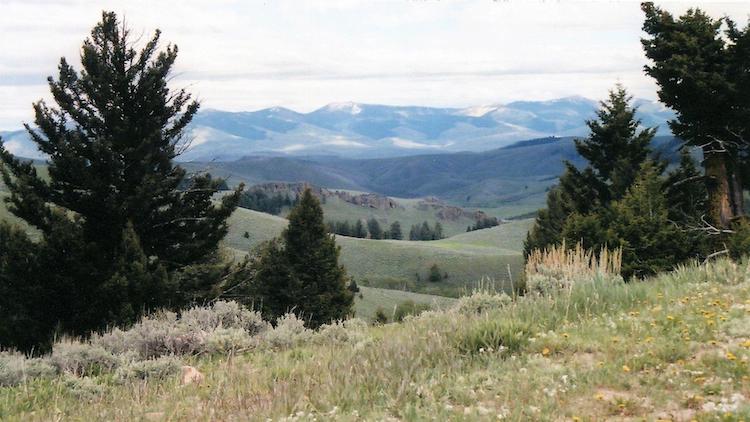
Clark also spoke favorably about the land where he and his band now found themselves. His description conjures images of the countryside I’ve experienced throughout Eastern Washington, Eastern Oregon, and Idaho. Big Sky Country. “The country from the mountains to the hills is a level, rich, beautiful pine country badly watered, thinly timbered and covered with grass. The weather very warm after descending into the low country. The river hills are very high and steep, small bottoms to this little river, which is Flathead” (today known as the Clearwater River). Clark described this section of the river as “160 yards wide and shoaly.” He also recognized it as the river by which his desperate party had killed the first colt they ate as they crossed the mountains.
Meanwhile in Capt. Lewis’ party, things were not going well. On the morning of September 21, he was having trouble collecting his horses. Once the party was finally able to get going, their progress was slow, and they stumbled weak with hunger through fallen timbers. The following day, Sunday, September 22, Lewis lost his composure when one of his men failed to hobble his horses. They wouldn’t be able to get started until 11 am. The momentum changed quickly, however, when Reuben Fields showed up with the provisions that Clark had traded for with the Nez Perce. One can’t help but wonder if Fields had ever had a warmer welcome in his life.
At 5:00 that day, Lewis and the remainder of the Corps of Discovery walked into the Nez Perce settlement where Capt. Clark had preceded them. The event prompted an atypical emotive flourish from Clark that would rival the occasional flights of poetry from his closest friend and fellow explorer.
“The pleasure I now felt in having triumphed over the Rocky Mountains and descending once more to a level and fertile country where there was every rational hope of finding a comfortable subsistence for myself and party can be more readily conceived than expressed, nor was the flattering prospect of the final success of the expedition less pleasing.”
This was the last journal entry Clark would make until November 29 — during which time he would discover how hollow his previous observation would ring just two months later. He might then have looked back fondly on the fire and horseflesh that he and his men had shared at Colt Killed Creek.
What the Corps of Discovery would face over a period of thirty days at the mouth of the Columbia River would be far more brutal than the seven days they spent crossing the Bitterroot Mountains. Ironically, the nearest to disaster that the Corps of Discovery would come would be at the point of realizing of their mission’s objective: the Pacific Ocean. But that’s the subject of another story.