Tales From the Magic Skagit: “You Don’t Need a Weatherman to Know Which Way the Wind Blows”

But a fish vane? Well, that’s a different matter entirely.
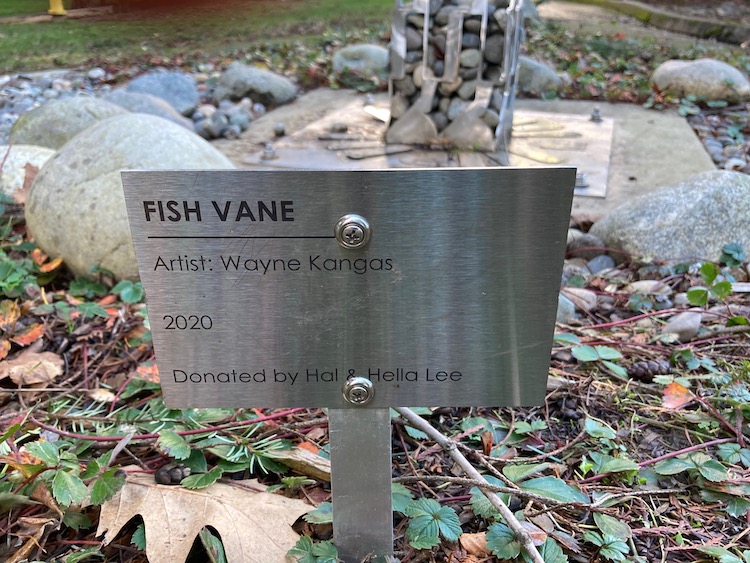
Time is a slippery beast in the Age of Pandemic. For as long as I’ve lived in Mount Vernon my daily walks have invariably taken me through Hillcrest Park, but I’m not entirely sure when it was that I first noticed the “Fish Vane” at the park’s north entrance. I think it was sometime in 2020, which was when I first shared photos of it on the Meyer Sign Facebook page.
As with any pieces of public art, I’m always curious about the creators and their inspirations, but I don’t recall seeing anything at the time that identified the Fish Vane’s sculptor. The metal plaque that you can now find at the sculpture’s base, however, credits its creator as Wayne Kangas, a 73 year old Bellingham artist whose works range from stained glass to photography. Wayne took up working with metal about seven years ago, according to a recent online article in the Everett Herald.
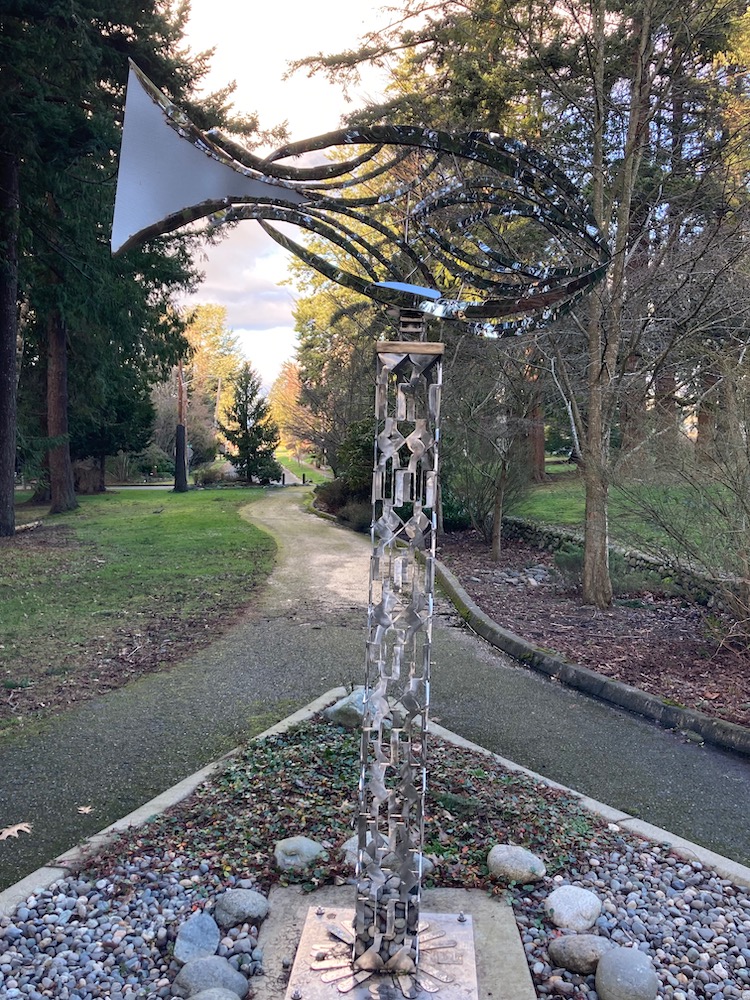
The Fish Vane sculpture is made from hundreds of mirrored metal pieces that were leftover from the process of cutting out letters for the name of espresso machines. Kangas cut those letters into the shapes needed to make a fish. “It’s got a mirror finish to it, so when the sun comes out, it throws these beams of sunlight everywhere,” Kangas said. “It changes colors.”
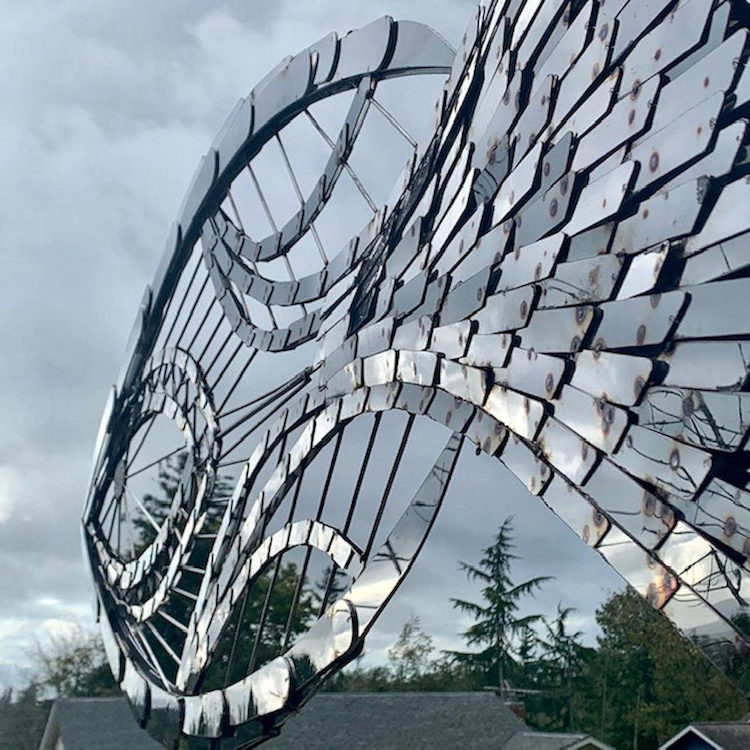
It took Kangas about 40 hours to make the fish-shaped weather vane. The sculpture was designed to be equally balanced on both sides so it pivots with the wind, giving it the kinetic quality that creates its reflective magic. Kangas likes to work with recycled materials because of the challenge to make art out of odd-shaped scraps, and he’s made other weather vanes, including one shaped like a rocket, but the artist notes that it’s the fish designs that have been the most popular. He recently installed “Weather Vane II” behind the Firehouse Art Gallery at 179 Second Street in Langley. The work was commissioned by the Langley Arts Fund in partnership with the Whidbey Island Arts Council and the Langley Arts Commission.
“We really liked the kinetic nature of the piece — the fact that it moves in the wind,” said Dan Wodjenski of the Langley Arts Fund. “When it’s sunny and it’s moving, it casts light around the area and that becomes an extension of the piece itself.” More of Kangas’ work can also be found in Matzke Fine Art Gallery and Sculpture Park on Camano Island, including statues and hanging wall art.

Although it was the fact that the sculpture functions as a weather vane that attracted the Langley Arts Fund, I’ve noticed that its Hillcrest Park progenitor seems a bit more static. Truth is, I’ve never seen it pointing in any direction other than east — which leads me to believe that the balancing mechanism of the 9-foot tall sculpture may be off kilter.
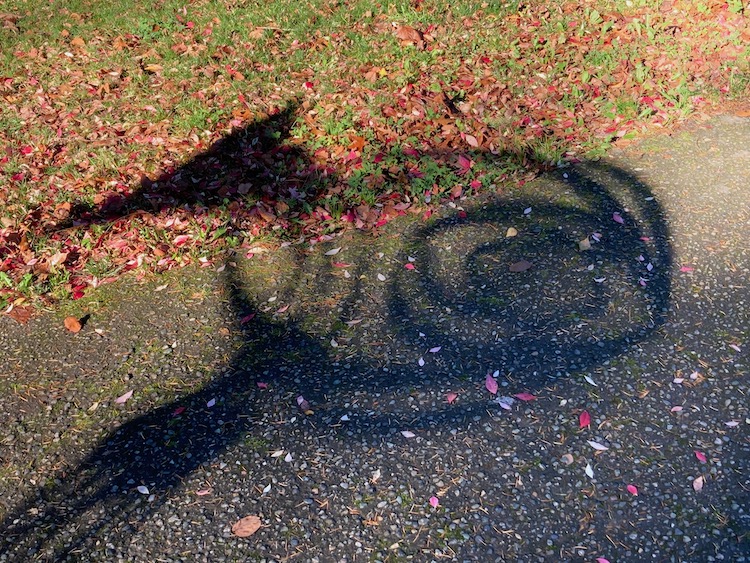
As an experiment, I gave the tail a push to the west last week (no offense, Mr. Kangas!), and within seconds it had swung itself back to its starting position. The light show it gave off in the process, however, was delightful, and I found myself wishing that it had a solar powered motor that would keep it slowly revolving throughout the changing light of day. Besides, we of the Magic Skagit are the heirs of a people — native and immigrant alike — who have turned our gaze westward. And while our salmon may travel east to spawn, the ocean is home. To quote the psychedelic poet, Jim Morrison, “The West is the best…get here, and we’ll do the rest.” You don’t need a weather vane to know that.