Tales from the Magic Skagit: A “Simple Conversation” with Jay Bowen (Part 2)
“I don’t want our culture to be recognized only as a novelty or an anomaly, but as a true contributor to society and the world. We are not just in the past — we are in the present.”
– Jay Bowen
In the “made for TV” version of the life of artist Jay Bowen, Episode Two would have him shaking the dust of the Skagit Valley off his boots and striking out in Santa Fe, New Mexico as an aspiring young artist with a story to tell. His talents would be immediately recognized by his mentors and peers, and he would return home years later as the prodigal native son.
But as most of us have come to realize, life seldom follows a Hollywood script. And in Jay’s case, what transpired over the coming years — spanning his arrival at the Institute of American Indian Art (IAIA) through his “death” decades later — was a new set of challenges. In the crucible of life, however, what we can best hope for is not the end of travail, but the distillation of our sense of purpose, without which life can seem cruelly random. In the real world version of Jay Bowen’s life, that sense of purpose is what has prevailed, and it is what continues to animate his art. It can best be described as a mission of healing.
We continue now with Part 2 of “A Simple Conversation.”
Art, Death, and Resurrection
“The first of the newcomers to the Skagit Valley that my great, great grandfather tried to communicate with were the wrong people to have been sent. If they had sent scientists, physicians, philosophers, the great thinkers, our world today would be a very, very different world. Today, what has happened is that the right people have been assembled. All these great thinkers, great ambitions, great goals have waited since my great, great grandfather greeted the first of those he called ‘the new people.’”
At the time I attended IAIA, we were trying to get recognized as a legitimate college. I was an ambassador to Rhode Island School of Design (RISDE), who helped us get the recognition — although I can honestly say that since then I’ve had greater recognition for having gone to IAIA than to RISDE. Our school has had an enormous impact for its size. This small body of students spawned an art movement, despite the fact that my graduating class only had 10 people in it.
We had some great teachers. Professor Daley taught art history, which was an all-year lecture course. He taught it with such enthusiasm and such knowledge that you couldn’t help but fall in love with what he was sharing. One day he took this Renaissance painting of a bucolic scene of a castle, with a saint or two hanging out and hills in the background. It was boringly classic, but there was this little bird in the painting as well. “I’m going to teach you about the geometry of this painting — why it is nothing more than a math equation,” he told us. He broke the thing down into geometry and then eliminated a little bird that was in it — and the whole picture fell apart. I remember the class gasping. I try to bring that same dynamic to every painting I do.
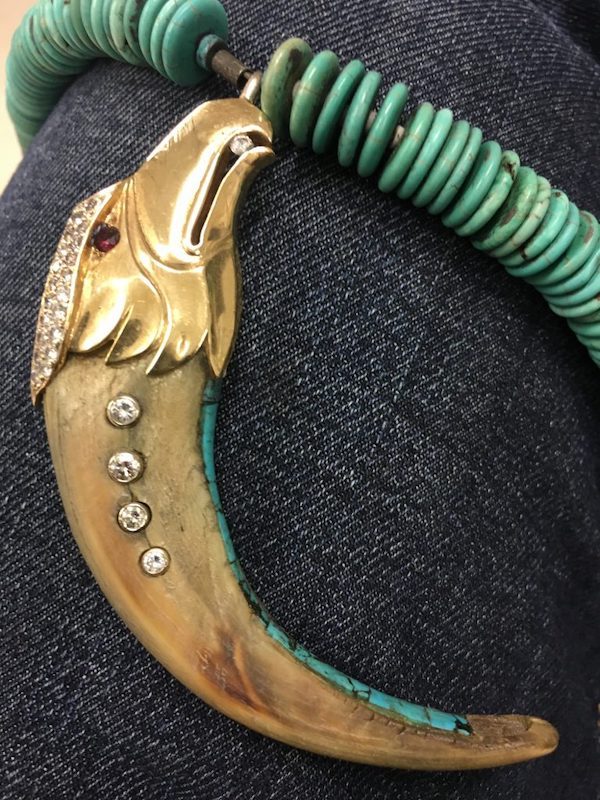
I concentrated on jewelry making as part of the sculpture department at IAIA, along with print making, photography, glass blowing — my teacher was Dale Chihuly — but it was jewelry that ultimately enabled me to make a living as an artist. I look at jewelry as “wearable sculpture.” I studied under Alan House, who was the head of the sculpture department and went on to become an internationally acclaimed sculptor. One day he picked up a ring I was working on and told me, “If you take this piece and make it 12 feet tall it should still balance and still work. It was like God had spoken to me, and ever since I’ve imagined every piece I’ve ever made as though it was 12 feet tall.
Even in New Mexico I felt that I was ostracized for my work. I was getting backlash from a lot of people because it was so “non-traditional.” I actually describe my work as extremely traditional — it’s my tradition, and I had my freedom and the authority from my great, great, grandfather to say what I wanted to say. We were given a language that is not a dead language and it is very dynamic. You can stretch it and pull it a long ways. There are certain rules you can’t break, but otherwise you can stretch it and pull it any which way you want to. That is what my work is about: using that language for healing.
I got married to a gal from Oklahoma City after college. We had gone to college together and I moved back there and tried to make a life. I started my jewelry career in Oklahoma — jewelry is big there, and I could advance my skills in the trade. I did a lot of oil pastels on the side — it was art that wasn’t connected with ‘making a living,’ but it was something sacred in reserve. I continued with my jewelry making back in the Skagit Valley and finally retired from Charles Fine Jewelry in Burlington after a fishing accident in the Cascades that tore me up pretty bad and ended my jewelry career — which meant that I would have to rely on my painting to survive as an artist.
My great, great grandfather was my biggest inspiration, along with multiple minor spirit helpers. They can be called down to help you accomplish something. My great, great grandfather had five major spirit helpers — the only one in the history of the tribe to have had that many. He was a very powerful man for all the good reasons. He was a healer — the one I told you the story about. Every painting that I do is all about healing. I employ those gifts from my great, great grandfather, and when they go to a home the medicine starts working. If you run into people who have bought my work and you ask them what happens the day after the painting comes into their home, their lives are never the same.
I needed to sell one painting a week to make up for the loss of my jewelry income. You can find my work at the Form Gallery in La Conner, but I mainly sell what I post online. I posted some pictures just the other day, and by the next day two of my paintings were sold. The paint wasn’t even quite dry. The week before I completed a large piece and I hadn’t even finished my cup of coffee before someone offered to buy it. It’s not “normal” work. It isn’t intended to give warm fuzzies — it’s intended to tell stories that touch people. I give you the story when I sell you the painting, and I don’t do two of anything.

People ask me, “How could you sell that piece? Don’t you just love it?” I love every piece. Every one is my favorite, but it is medicine — and having all this medicine in your cabinet and not sharing it with anyone isn’t good. So when I let it go, it starts working. That sculpture downtown (Valley of Our Spirits) works every day. That’s medicine. I’d have to have a 15,000 square foot house to accommodate everything if I kept it. A friend of mine had suffered from depression for years, and then he hung one of my paintings in his home and has been free of depression since. His energy and happiness went up, even in winter. My great, great grandfather would say, “Good work!”
About six years ago I died. I went into cardiac arrest and was in a coma for five days at Skagit Valley Hospital. I spent those five days in heaven. I was greeted by my son and my great, great grandfather. We had so much fun, and I got to have great conversations with God. It was a good five days witnessing souls journeying to and from Earth. The experience of heaven is pure joy. There are crystal layers that go off into infinity in all directions…and you realize that this is God. God said, “Watch,” and I saw two lights — two souls depart for Earth. I saw them return again. God said the first one had lived 10 seconds and the second one had lived 100 years. Time has no use in heaven, so I got to watch 100 years go by.

Everyone goes to heaven, but only if they want to. You can keep getting back in line for the same ride. The reason Earth was created is that God wanted to go to Earth. The first thing you do is choose a mother. Your soul looks down on earth and chooses a mother. As soon as a child leaves the womb, its soul can go inhabit the body. There is no soul in a fetus — it comes from God, who tells us, “I’ve created the Earth for you to enjoy. You’ll be given at least one gift, if not more, with which to help others. Don’t hurt anyone, and I’ll see you when you get back. I’ll send spirit helpers and angels to assist you.” God doesn’t intervene with humanity, angels do.
The girl I was dating at the time was sitting over in the corner of my room and she saw my body lying in bed, but at the end of the bed there was me, my great, great grandfather and my son. We all three appeared in the room. I wanted to go back with them, but my great, great grandfather and my son wanted me to return here. Then they disappeared and I fell back into my body. As soon as I did I felt a more tremendous pain than I ever have in my life. I thought I was screaming bloody murder — even my hair hurt. I had to learn how to walk again, how to move again. I lost probably 60 to 70 percent of my vocabulary and I still have short term memory issues. It took me years to rehabilitate.
I got tired of hearing people say, “God has a plan for you.“ I tell them, “I talked to God, and there is no effing plan!” So what do I with the fact that God sent me back? I need to try to improve the world — which is why I practice native medicine. I’ve sent patients back to doctors who were fixed. I never had a doctor consult me, but it proves that my great, great grandfather was a great man who had a lot to offer the world, not just a bunch of hearsay. I’m meeting next week with a doctor in Seattle who does a lot of research into native medicine. We’ll spend the day talking and formatting ways that you can integrate it into western medical curricula.
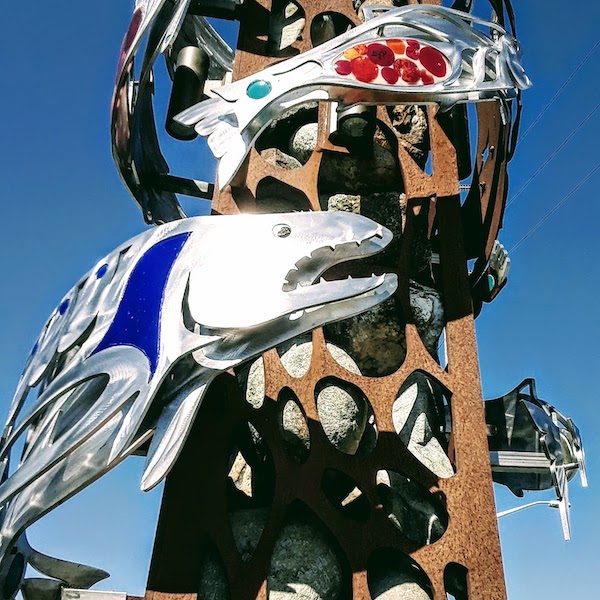
When “Valley of Our Spirits” was dedicated in Mount Vernon, the city wasn’t initially going to do a ceremony, but I felt we needed one. We had a native singer, and the front row of chairs was reserved for tribal elders. In my speech I called for an end to the “Indian Wars.” You could hear the politicians gasp, but all the grandmas nodded. They knew exactly what I was saying, and I wanted to be the first to say it. I’m this one voice trying my hardest to get this message out.
What is the most impactful way to assert native culture today? That question is what brings us to the conversation we’re having, but I think one way is simply to recognize the names and places in the Skagit Valley associated with native events. Where was this long house? Where was this village? Where was this burial site? Skagit City was originally a major burial site, and they buried the people in the trees. We should recognize the names of the rivers — starting with the basic fact that the Skagit River and Skagit Valley were named after my people.
Today there are a couple of thousand enrolled Skagit tribal members. We are now witnessing the developing identity of the first generation born outside of the boarding schools. Sadly, we still deal with a lot of people who are dying of alcohol and drug abuse. It is a slow form of suicide. But there is also a big effort to hold onto our culture. A lot of young native kids are getting into education — my granddaughter has a full ride scholarship to Gonzaga, and my great niece is going to WSU. It’s very common to hear the kids talk about their post-graduate degrees. The new superintendent at La Conner School District is part Sioux, and the curriculum includes teaching inclusive history. As long as the new people recognize that the link between the past and the future is in telling the representative stories of our native people, we all have a chance. All of our stories need to be told.
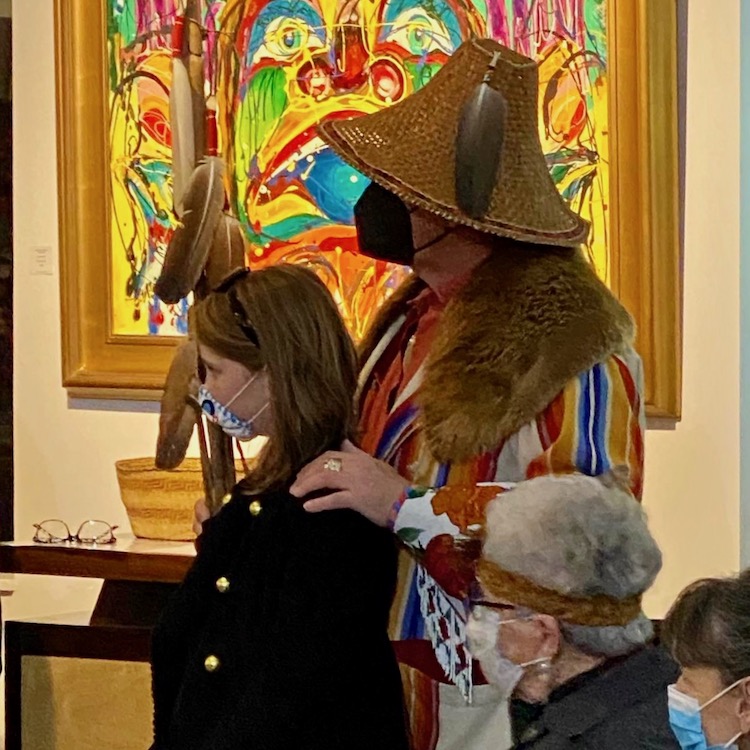
This ends our two part series based on my August 2021 interview with Jay Bowen — but it’s not the end of the conversation. Not by a long shot. Meyer Sign has offered to work with Jay on a project to create signage around sites in the Skagit Valley associated with tribal history and culture, and in so doing there will be many more stories to tell.
Which brings me back to the first story Jay told me. The one about his great, great grandfather and that first meeting with the “new people” and the staff that defied their attempts to lift it from the ground when Jay’s ancestor was able to easily do so. I find that in returning to that apocryphal tale I’m reminded of the Arthurian legend of my Anglo Saxon forbearers. How was it that a mere boy could pull a sword from an anvil when the strongest of men failed? I think it has to do with ones definition of strength.
Perhaps the greatest strength resides not in physical dominance but in relationship, in a purity of heart and the humility of accepting that our identity is not in standing apart from the world but in being a part of the world and in the power of healing. That wisdom is not unique to Jay’s tribal culture. It exists to some degree in the human experience universally, but it is a wisdom we are apt to forget — at our peril. I believe, as Jay says, that when we tell all of our stories we will recognize the link between the past and the future — and through the power of that link we’ll gently take up the staff of Jay’s great, great grandfather. I’d like to think that we’re the “right people” for that task if we’re willing to take it up.