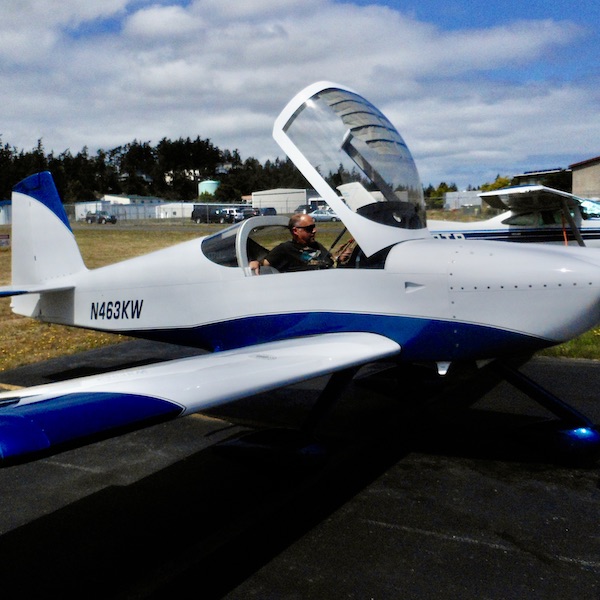
This Is The Plane That Ken Built, Ya’ll
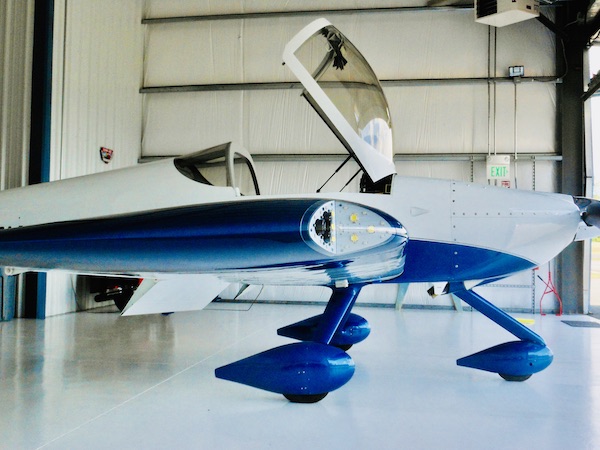
Ken Hitt built his very own airplane from a kit.
Let me just pause…and then repeat that first sentence for further effect.
Ken Hitt built his very own airplane from a kit.
By himself.
Growing up, I don’t ever remember encountering a kid who didn’t want to fly. After all, who wouldn’t want to soar above the clouds and chase the horizon with no posted speed limit or traffic signs? I don’t, however, ever remember encountering a kid who said, “I’m going to learn to fly” — and then did precisely that. I certainly could never have imagined anyone saying, “And after I learn to fly, I’m going to build my own airplane.”
At the age of 24 (which from my current vantage point makes you still a kid), Ken Hitt decided to get his pilot’s license — and about a week later, September 26, 1987, he began taking flying lessons at Harvey Airfield in Snohomish. Just a little over 8 months later, June 1, 1988 to be exact, Ken had his pilot’s license.
As a guy who would probably rather buck hay than plant his butt at a classroom desk, the “book learning” aspect of learning to fly was more challenging for Ken than the physical skills involved in operating an aircraft — and vehicles, engines, and their operation and maintenance were already familiar subjects for the person who would subsequently own a commercial sign company. In addition, of course, there were hours and hours of studying avionic communications, aeronautical principles, meteorology, and navigation.
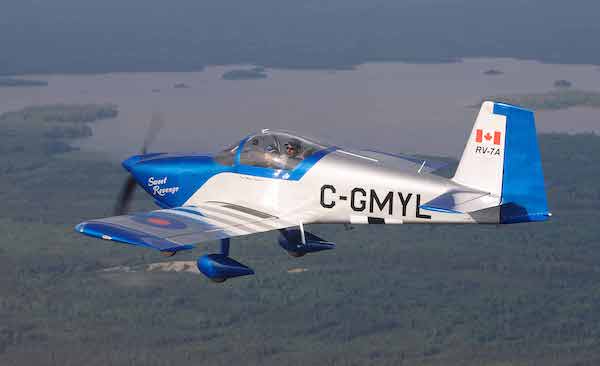
Ken bought his most recent plane from a well known kit aircraft manufacturer in Oregon that was founded back in the early 1970s by a skinny young engineer named Richard VanGrunsven (you gotta love the Dutch). The company, Vans Aircraft, has its plant in the little town of Aurora and produces eight different kit plane models. Ken chose its most popular design, the RV-7A, which the company’s website describes as “one serious flying machine.” They ain’t whistlin’ Dixie about that — as Ken will be the first to testify.
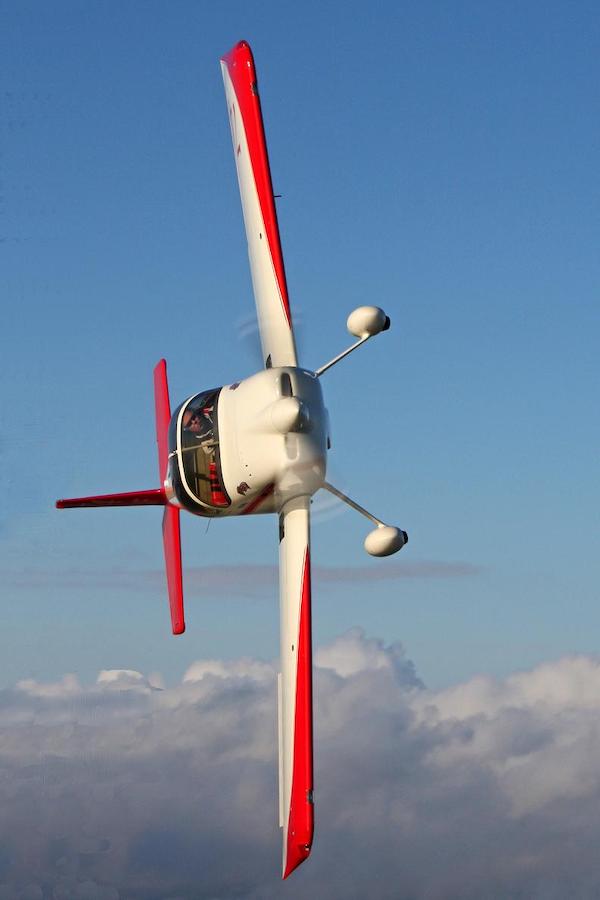
It took Ken 20 months, 10 days and change to build his plane, which he completed this past May. It flies under the call sign “3 Kilo Whiskey” — which strikes me as a good name for a Scottish punk band. RV aircraft come in four “sub-kits,” which have to be built in a specific order: the empennage kit (that’s airplane for “tail section”), the wing kit, the fuselage kit, and the finishing kit (which includes landing gear, plexiglas canopy, brake lines and hardware). Ken drove to Aurora to pick up most of the kits himself using Meyer Sign’s flatbed truck.
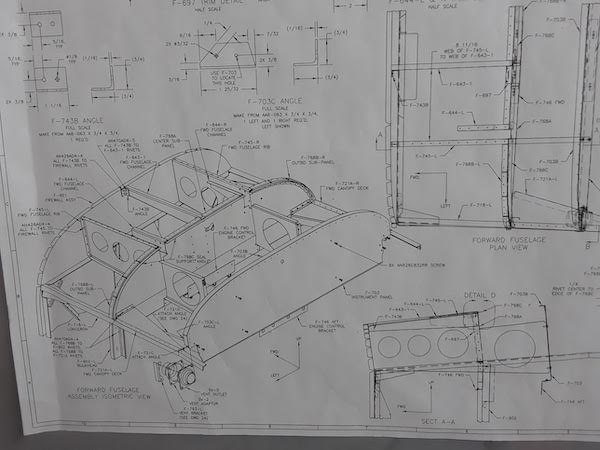
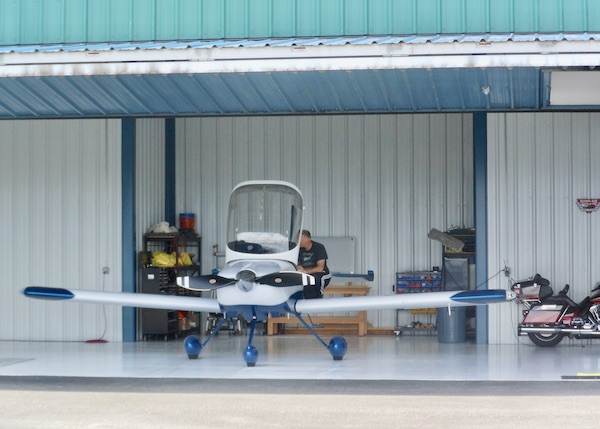
You might imagine that just having the assembly space to build something like this, never mind the skills, would be an issue. Fortunately, when Ken had his current Mount Vernon home constructed, which I like to refer to as “Man Cave Mahal,” he devoted most of its square footage to a massive garage. Whereas your typical house consists of a residential floor plan with attached garage, Chateau Hitt is more like a garage (which Ken calls “The Factory”) with an attached residence. I remember being over at Ken’s place for Super Bowl during the painting phase of his plane’s construction, with a large section of the garage converted into a commercial spray painting tent with a footprint that would have exceeded the two car garage of my home.
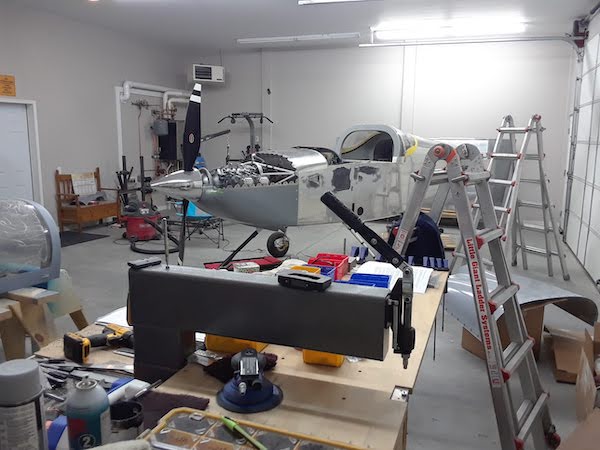
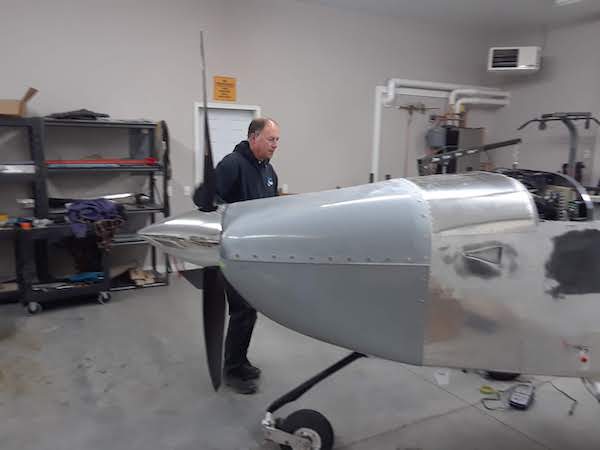
It might seem that the primary motivation for building a kit plane versus simply purchasing a completed aircraft would be economically driven, but for Ken, who had previously owned a plane, the motivation was the sheer satisfaction of the building process. When you think on it, building a plane component by component gives you a much more intimate knowledge of the contraption that you are literally trusting your life to every time you lift off the runway. Few of us can claim to know our own automobiles that well.
Ken chose the RV-7A for its performance and versatility. As the Vans Aircraft website describes it, “The RV-7/7A is able to maintain cruise speeds near or even above 200 mph depending on the engine installed. That speed, combined with the endurance and the range made possible by its 42-gallon fuel capacity, means that you can traverse half the American continent in a day — or even further if the winds are right.”
Ken’s plane is powered by what he describes as a “slightly modified” Lycoming IO-360 engine, capable of producing 190 horse power. It has a wing span of 25 feet, a length of 20 feet, 4 inches, and a height of 7 feet, 10 inches. At a gross weight of 1,800 pounds it can comfortably cruise at 195 mph with a ceiling of over 21,000 feet and a climbing rate of more than 1,800 feet per minute. That’s the power piece of the package. The versatility piece has to do with the RV-7A’s ability to leave the ground quickly and take off/land on virtually any airstrip, including grass or dirt.

When you have the ability to cruise airborne on autopilot at a relaxing 160 or so miles per hour, you are not only achieving better fuel efficiency than many of the compact cars you are flying above, but with the RV-7A’s fuel capacity you also have some destination options. Believe me, this really changes ones take on the time/space continuum — which means that on a slow day at the shop, Ken can opt for lunch at his favorite taco place in Meridian, Idaho. A few weeks ago, he took his mom on a short trip to Great Falls, Montana to visit his uncle. Our recent photo excursion over the Cascade Range took us most of one morning, including a stop for pie and coffee at a cafe in Port Townsend. These experiences give you a new appreciation for the old expression, “the sky is the limit.”
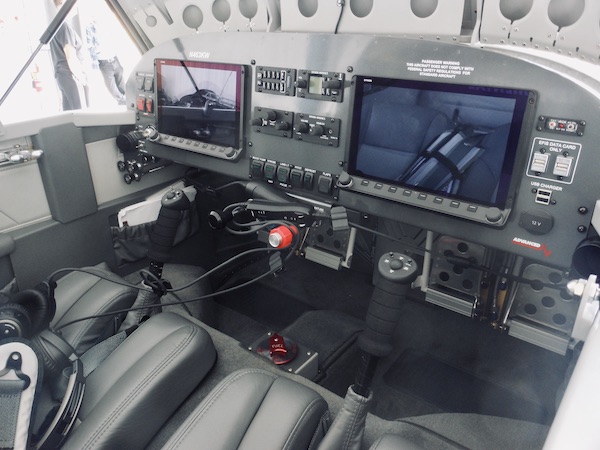

Ken counts flying among the great joys of his life. “It’s the absolute freedom of it,” he says. On the “joy scale” of 1 to 5, flying gets a 4. I might have thought that would put it on a par with motorcycles, but I found out that motorcycle riding currently rates a 2. “It’s more dangerous than flying. Motorists are too distracted these days,” Ken says. At least in a plane — thanks to the marvels of technology — you can see where anyone else is in the sky at a radius wide enough to comfortably respond. And you can witness creation in a way that brings you a renewed sense of its miraculousness. I think that’s another reason why Ken Hitt likes to fly. It’s certainly why I enjoy flying with him.
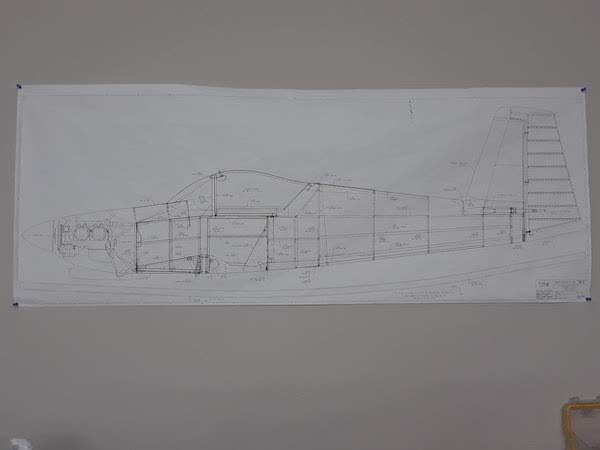
By way of closing, I should mention that I’ve tried to put a bug in Ken’s ear that his plane needs a name. If you’re going to be in as intimate a relationship as a pilots are with their aircraft, it seems like that relationship should be on a first name basis. I’ve even been bold enough to suggest a name: Sign of Freedom. It seems appropriate on a couple of levels.
But what I’d really like to know is what our Meyer Sign followers have to say on the subject — so I’ll put the question to you like this: If you were fortunate enough to be Ken Hitt, what would you name the plane you built with your own two hands? I can’t wait to read your suggestions!