A Corona Moment with Chief of Police Chris Cammock
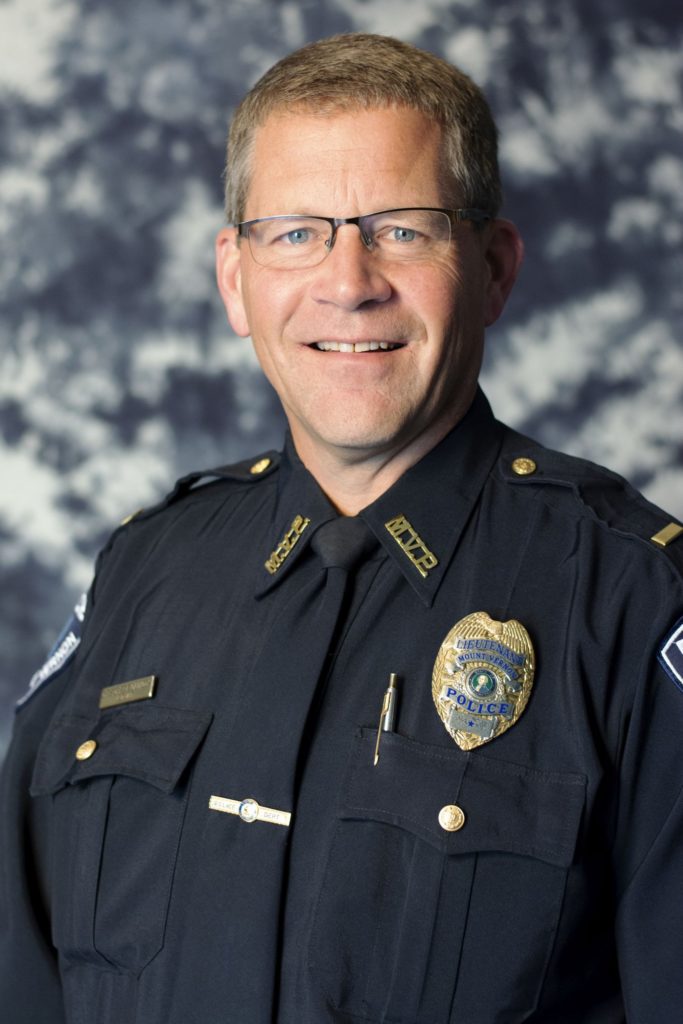
From the time I started this series of discussions with folks in our community about how the current pandemic has changed their lives, Chris Cammock was at the top of my list of interview subjects. After all, with all the attention being paid (rightfully so) to “essential workers” and “first responders,” it seemed fitting that the perspective of the head law enforcement officer for the City of Mount Vernon would be just as relevant as those of healthcare workers, grocery store employees, and anyone else for whom suiting up and going to work isn’t an option, regardless of the risk that doing so might entail.
In between the time I first reached out to Chief Cammock and our interview date was on the calendar, something besides a pandemic (and just as profound) captured the attention of our country. The death of George Floyd and the wave of demonstrations this tragedy incited has affected police departments in cities all over America (and the world) as they attempt a difficult balance between acknowledging public outrage over incidents of alleged police misconduct and the never ending mission of law enforcement to “serve and protect” communities from violence and disorder affecting both lives and property.
During my half-hour phone discussion with Chief Cammock, we focused mainly on how the coronavirus has affected the MVPD — but it was impossible to ignore the 800-pound gorilla in the room, and shying away from engagement is not a part of Chris Cammock’s DNA, nor that of the law enforcement organization he leads.
At a time of intense national scrutiny of the relationship between law enforcement organizations and the communities they serve, the following anecdote will tell you a lot about the Mount Vernon Police Department’s relationship with its citizenry.
George Floyd
On Sunday, May 31, a local resident sent out a private notification via social media to a group of acquaintances about organizing a demonstration in front of the Mount Vernon Court House. The intent was to give voice to the injustices laid bare by George Floyd’s death at the hands (or more accurately, the knee) of police in Minneapolis. The clearly communicated intent was to gather some 25 friends together to peacefully exercise their first amendment rights. Somehow, however, the notification went public — which was the point at which the Mount Vernon Police Department got involved.
As Chief Cammock recalls, “We saw the post at the same time the public did, and Sgt. Brandon Young reached out to the organizer, who at that point was starting to feel a bit overwhelmed and was appreciative that we’d offer our assistance as an organization skilled in crowd control. We know from experience that as these things develop they can take on a life and energy of their own, and about 15 minutes into the gathering the demonstrators decided that they wanted to get more visibility, so they went out to Riverside and College Way. The demonstration unfolded spontaneously and organically, and the fortunate thing is that through our interaction we made adjustments and gave suggestions for being safe, and all along the route things were well behaved and respectful. The original intent was to be peaceful and lawful, and the sentiment that was communicated was, ‘let’s not be like Seattle — let’s be civil, even though we’re angry.’ That kind of peer influence explains how a small group of police could cooperate with and help a much larger group of angry citizens — and it’s another example of the value that social media can play. We’ve seen plenty of examples of how that has gone in the opposite direction.”
On the afternoon of the Mount Vernon demonstration, Chief Cammock took to his department’s Facebook page to provide some perspective on the events that had sparked it, concluding with the statement, “The Mount Vernon Police Department is staffed by men and women, from diverse backgrounds, who are highly dedicated and committed to the professional delivery of service. We strive to be an organization that creates opportunities to learn from and share with the citizens we serve. People rightfully have questions about police actions, want to be informed, listened too and we welcome that opportunity.”
Expressions of support for Chief Cammock’s Facebook sentiments included those of a local pastor who had attended the Sunday march: “As a graduate of the Citizens Academy I know all of this is true and as I walked the streets with the peaceful protestors today I knew the MVPD officers were there with and for us!”
Discussions about policing at both a local and national level are clearly evident on the MVPD Facebook page, and they bring into focus the underlying premise about what policing is. As one who has attended the Mount Vernon Police Department’s Citizens Academy and lived under numerous police jurisdictions during my life, I mentioned to Chief Cammock that it seems as though we’ve seen a more militarized culture develop in law enforcement over the years, with the accompanying sense that police suit up to go into a battle zone rather than into a community. It’s a perception that the Chief clearly understands, along with the balancing act that it implies.
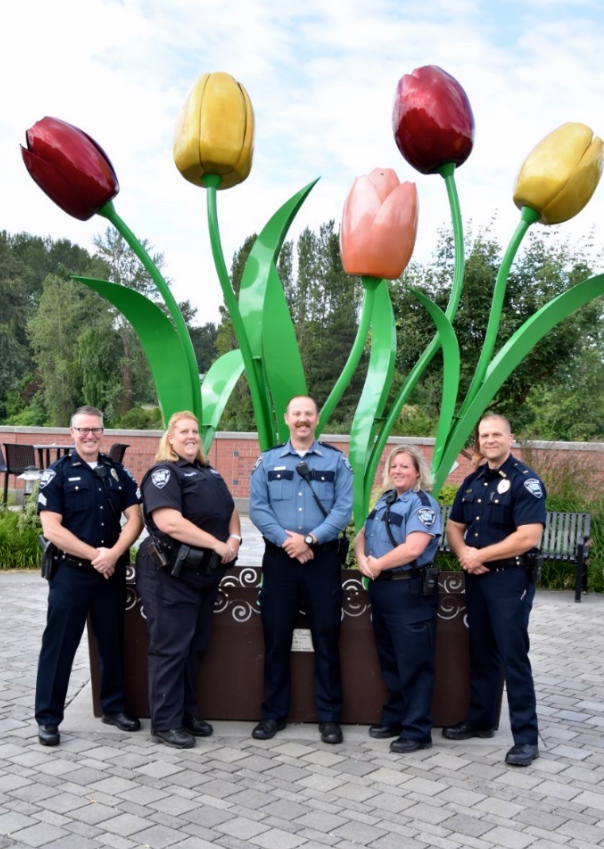
“We are still considered a paramilitary organization with similar structures and trappings, and there are times when there are human adversaries just like in the military. The public expects us to resolve these situations, so there are a lot of times we have to put that hat on. It can be difficult to maintain that balance. As Citizens Academy makes clear, we may be a community of 35,000, but we still have the same kinds of issues that face much larger ones.”
Policing in the Time of Pandemic
Which brings us to the issue of the century — one that is facing every police department in the world. As first responders, how does law enforcement cope with a novel coronavirus pandemic?
Intriguingly, Chief Cammock has the perfect law enforcement analogy for dealing with a non-human adversary. You take it in phases.
“In our industry, what we typically respond to as a crisis is human generated, and there are four phases to how an encounter goes. When you overlay this with a pandemic or other medical crisis, you still have those underlying phases to deal with — but on a more protracted basis. A robber comes into a bank yelling “hands up.” He’s in a takeover phase. There’s a lot of chaos. Maybe a round gets fired. There’s screaming and yelling, and then the police are called and the bank is surrounded. He (the robber) realizes he’s in a spot he doesn’t want to be in, with a lot of uncertainty as to the outcome. Then time goes by, things calm down, and you move into the next phase, which is a degree of stabilization.”
“During that phase as police you are trying to negotiate a resolution, and at some point you move into the realization phase. The bad guy realizes the situation they’re in, and they are going to do one of a couple of things. Either they’re going to fight it out, try to flee, or say ‘forget it’ and either give up or do harm to themselves. But to some degree a resolution follows that realization phase.”
“So if you overlay this with what has been going on with COVID, when it first hit the nursing home in Kirkland — and then all of a sudden it was in Skagit County — and there were all those emotions and then the incident with the Skagit Valley Chorale members, and we didn’t know how to act. And even now if anyone coughs or sneezes around you, you wonder if they have something radioactive in their pocket. We’ve become hyper vigilant about things we weren’t before. But as more information became available we started to stabilize and realize — but the time has been excruciatingly long. In the case of a law enforcement incident, we might go a few hours or a few days — Waco was unique in that it went on for months — but ours are typically short lived, and those are the cycles we’re used to operating in. This is more like years. The resolution phase is when there is a cure.”
When asked about how the pandemic has affected the daily operations of the MVPD, Chief Cammock credits an ounce of prevention for having prevented a possible pound of cure.
“Early on as a county, we came together as law enforcement agencies and developed a staffing plan in case any of our agencies became heavily infected. My biggest concern was the sheriff’s office, because it supports all of our jurisdictions and includes the jail — so for them to go down with 50% of their staff wiped out would be a huge deal. We took care of each other — and the best part about a plan is hoping you’ll never have to use it.”
Which is not to say the MVPD hasn’t been affected. “We had one staff member who got the virus, although not through work. It was early on during the ‘unknown phase,’ and they had returned from a trip. What was weird about it was that they didn’t have the symptoms that were recognized — a completely different set of symptoms. They were at work for a few days and not feeling well, and over a weekend developed a completely different set of symptoms and then went in and got tested the following week. Both the doctor and the patient were surprised they had tested positively for COVID. In retrospect, we took more precautions than we might have today. We ended up quarantining the staff who worked around this person as well as other support personnel who might have had contact. We drew a circle as best we could around where we thought it (the infection) would be, then waited and watched. And we were fortunate that this was all the further it got.”
“Longer term, we’re having to adjust to this emotionally, psychologically, equipment wise, and adjust what our place and role in it is — balancing the emotions of our staff in the office regarding their personal safety and what they’re taking home with them. I remember early on when Skagit Valley College closed and someone in our staff asked me if we would close as well. I said no. What symbol would that be for the public? We’ve never technically been closed, but we’ve limited access and done things in measured and proportional responses to the crisis.”
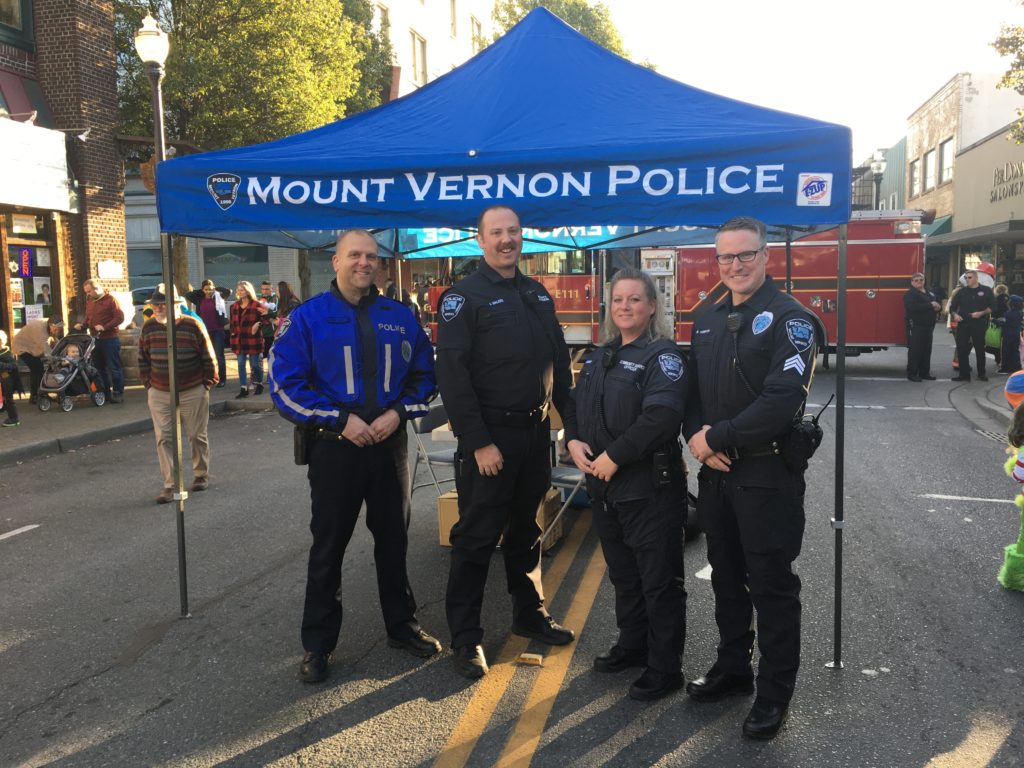
The pandemic hasn’t lessened the role of policing in our community, but Chief Cammock does note that it has affected the nature of that involvement. “The county had funds available to voucher more than 40 chronically homeless people, so vagrancy went down among our call categories, although we’ve seen an increase in domestic violence and we continue to be concerned about the potential for child abuse. The next impact we expect to see will be due to the fact that with the courts closed prosecutors have been stacking cases waiting for re-opening, which will create a tidal wave on our clerical side.”
There are some positive impacts as well, the Chief notes — some of which may continue beyond pandemic resolution. “For awhile, we weren’t able to do two-person patrols. We had folks in field training, so we put the trainee in one car and had the trainer in another car and used Zoom to connect them. One of our night time details planned a drug raid and put the group on Zoom so they could video conference before they did it. It turned out really well.”
Essential Workers
With all the focus on “essential workers” and “first responders,” I wondered aloud if Chief Cammock felt that the MVPD and law enforcement in general receive the credit they deserve during the pandemic. The Chief really didn’t see that as an issue.
“Sure, police are first responders too, as much as EMTs. What’s different about this is that typically community crises have a police-front focus, but this is a medical crisis rather than a human adversary one. So for us one of the things that is great is the spotlight that has shone on the medical community and EMTs, in contrast to 9/11 when you saw firefighters and police officers as the heroes.”
“I thought this really shone a light on a group of committed professionals who don’t often get the recognition that is so well deserved. In past crises we are often the ones calling in fire and paramedics, whereas now there are a lot of cases in which they are the ones calling us in to stabilize things — so we appreciate them getting that notoriety, and we feel a bit less comfortable with sharing that limelight.”
Chief Cammock and I finished up our conversation with a return to the subject we had started it with: the aftermath of the George Floyd killing and the role of law enforcement in our communities. I asked the Chief what he felt was the most hopeful outcome in the current environment, and his answer displayed mixed but hopeful sentiments.
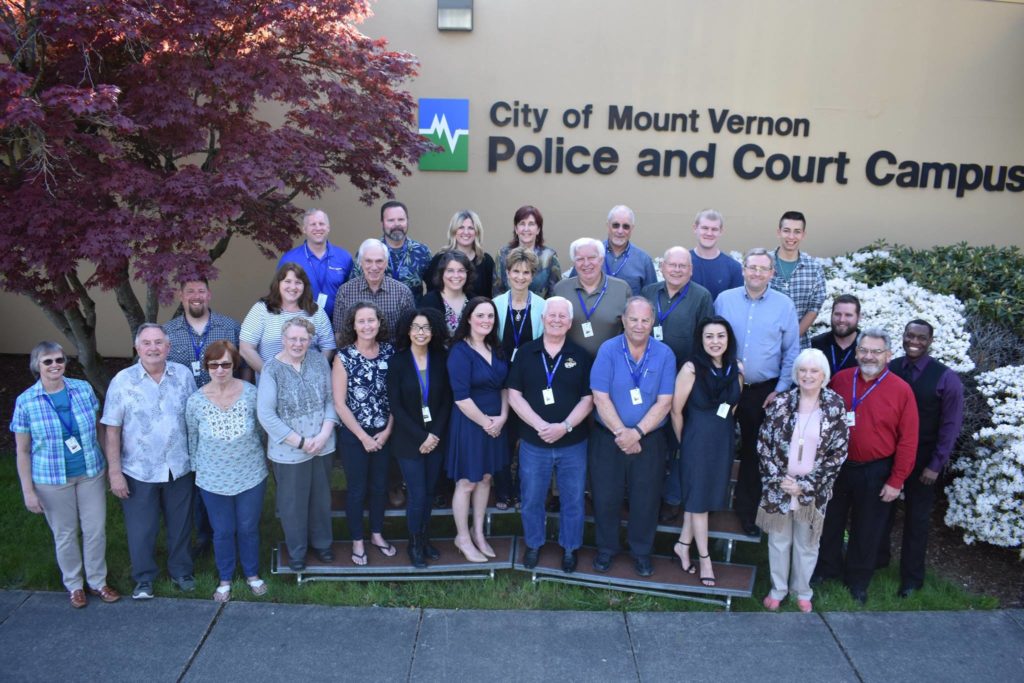
“I struggle in these situations because on one hand these events feel as though we’ve stepped back a decade, but I also think that because of the attention that this has drawn from around the country — and even the world — this has the potential to move us exponentially forward as a community. In the days to come as we will hear the conversations that go on, and maybe some individuals who are a circle ring or two out from the most emotional hub of the situation may get some takeaways and change their attitudes about police — and on the police side we really need to be seeing, hearing, and understanding our community.”
“As law enforcement professionals, our role in general is to look for facts and draw inferences from them. That’s how we approach our investigations of people in the community, and we have to take that same approach when it comes to the focus on law enforcement. More facts will emerge, and I want our community to know that I recognize where they’re coming from. How I’ve resolved it for myself is to participate with my community in letting them know that we acknowledge that we are part of the same pain that they are feeling…which is why I attended each of the funerals in uniform for the victims of the Cascade Mall shooting.”
An Organization is an Organism
This is not an easy time to be in law enforcement, but I’m reminded of why community outreach efforts by our police are so critical in creating a bank of trust that may need to be drawn upon when situations fray the ties that bind policing and community. It’s a relationship that is always on Chief Cammock’s mind.
“An organization is an organism…a living, breathing body. You want diversity in your police…you want that strength. Police departments need to be accountable to their community, but that accountability should never become so extreme that professionals feel there is no allowance for failure in some ares. The expectation of flawlessness and super human ability is more than we can meet — but I want to remind our community that if you ever feel disenfranchised from us, look at all the times and places we’ve tried to be a part of you.”
A good reminder of those times and places is the Mount Vernon Police Department Facebook page. If you want to better understand Chief Cammock’s world, and share yours in the process, it’s a darn good place to start. In the meantime, let’s do our law enforcement officials a favor and be good to each other. What do you say?