Citizens Academy: The Ties that Bind
In the previous installment of our Citizens Academy series, we talked about the challenge of responding to the law enforcement needs of our community as cost-effectively as possible, while making sure that our neighborhoods not only ARE safe, but FEEL safe. It’s a balancing act between reality, perception, and resources — and it’s a highly fluid dynamic. What makes that dynamic work is the concept and practice of crime prevention, and the role it plays in removing “opportunity” from the crime equation (crime = motive, opportunity, method).
Staffing the number of uniformed police required to adequately address the multitude of crime prevention strategies that we enumerated in our last episode would exceed the budget realities facing our police department. The key to bridging that gap is community involvement, which brings us to the all important subject of volunteerism.
COPP (Citizens on Proactive Patrol)
Not long ago the MVPD responded to a call involving an individual who was arrested at a residence not his own. He had been acting in an erratic and threatening manner, and his resistance to the officers who were attempting to arrest him resulted in the use of a taser — twice. It would be safe to say that for most of us, being based once would be sufficient to ensure our compliance with the police.
Having taken the individual into custody, the arresting officers were faced with another dilemma: recovering the four metal barbs that were left behind by the tasers. They were able to locate three of them, but the one remaining posed a danger to anyone walking on the grass where the altercation occurred. Within an hour, a group of citizen volunteers with metal detectors were on the scene, and the missing barb was recovered. Citizens On Proactive Patrol (COPP) to the rescue.
In this particular case, community volunteers not only performed an important safety function, but they also made it possible for officers on duty to respond to other needs rather than spending time combing through a lawn in search of what was almost literally a “needle in a haystack.”
The origins of COPP go back to the very first Citizens Academy class more than 25 years ago, and the desire that graduates from the initial classes had to play a useful role in neighborhood policing. Since the first Citizens Academy in 1995, 655 graduates have completed the 12-week program, and out of that number more than 160 have gone on to become the eyes and ears of the MVPP as part of an even larger pool of volunteers that augment the commissioned and non-commissioned staff of the department.
The mission statement of COPP, as articulated by MVPD, is about as concise a description of the program and its benefits as you’ll encounter:
Citizens on Proactive Patrol is an extension of the activity and philosophy of the Department’s community policing efforts. These citizens are trained volunteers organized to increase the safety and reduce the fear in the community. They drive the city streets to provide a presence and report incidents and problems, with their main focus on quality of life issues. In essence, COPP is a roving crime watch system working in cooperation with the police.
Some things to take note of in the above description are, once again, the concepts of increasing safety and reducing fear, and the role those objectives play in the quality of life of our neighborhoods. Stated more colloquially, Lt. Greg Booth (who heads the Crime Prevention team) states, “COPP is a critical component of our (crime prevention) program, along with the rest of our volunteer pool. They are quality people that bring creativity and energy to our program.”
Given the obvious benefits that COPP provides, it might seem surprising that its inception was not without some internal discussion at the time of its formation in 1996. “There were long debates about the program initially,” says Lt. Booth, “and it was far more limited and structured in the beginning. Now what they do is more far reaching, but their impact on non-emergency situations means that our officers are better able to focus on criminal incidents.”
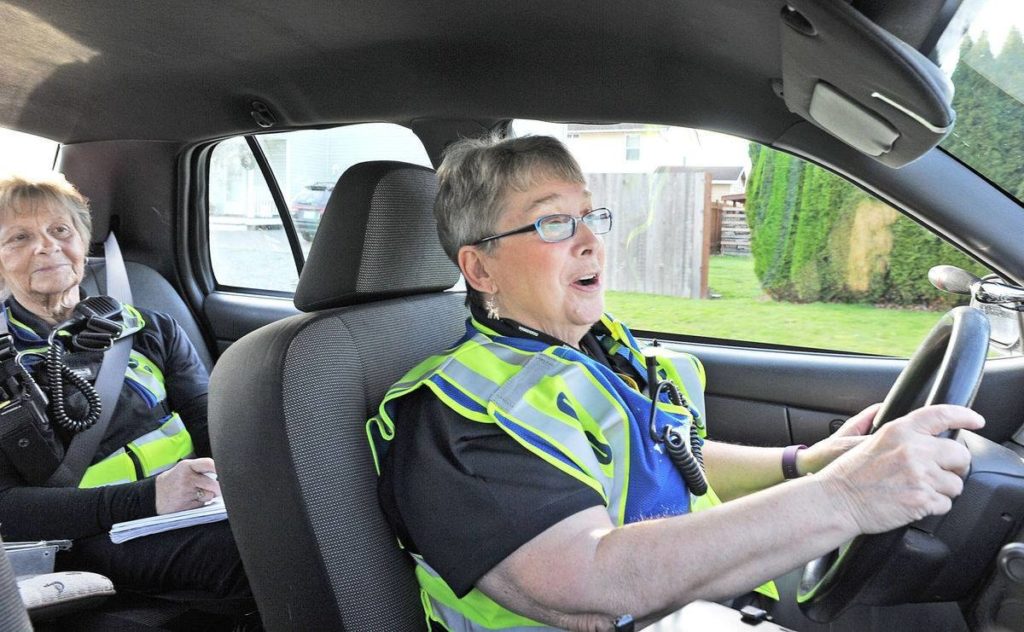
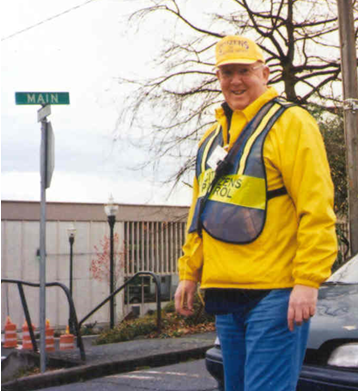
Among theses non-emergency functions are traffic control, foot patrol, found bikes, found dogs (MVPD has a new kennel facility for our four-legged residents in distress), special events, and neighborhood canvassing. From a single patrol car and logo’d reflective vests, COPP’s resources now include two SUVs, tablet computers, smart phones, and its very own policies and procedures manual and advisory board. The group has further evolved into specialty units, including weekend kennel assistance, community outreach, and interfacing with neighborhood watch associations. And of course, there’s the metal detector unit. “Many lives have been touched by COPP,” says Lt. Booth.
If COPP sounds like your cup of tea, the requirements for volunteering are the completion of a Citizens Academy course, meeting the basic physical ability requirements, passing the application process, and receiving additional training.
Click here to see a King 5 news story about the COPP program.
The Gift of Volunteerism
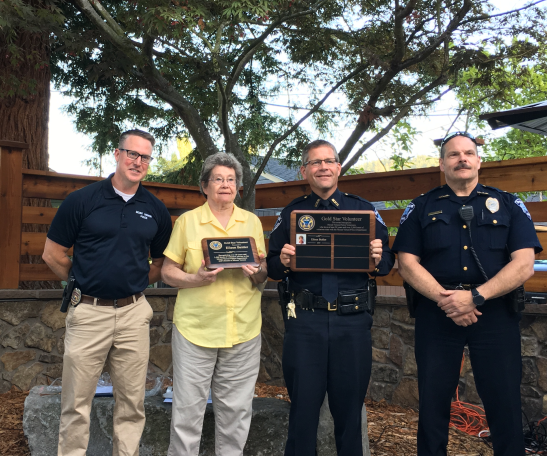
As important as the role played by COPP is, the program is in fact a sub-set of a larger volunteer pool within MVPD that performs a multitude of services at a tremendous cost savings to the department. These include vacation house checks, records filing, statistics, and evidence management. In a quarter century of service to the department and the community, MVPD’s more than 30 volunteers have contributed in excess of 79,000 hours of time, representing millions of dollars. It can be said, without a hint of hyperbole, that volunteers are the ties that bind our police and community — and in so doing, they define the very concept of “neighborhood policing.”
See you in cop class!