The Big Switch
Once upon a time, telling someone you hoped they lived as long as a light bulb would have qualified as a curse…albeit an oddly poetic one. Nowadays, the expression could be seen as a blessing!
And then you notice the end cap of LED bulbs on prominent display. Standard A-shape, omnidirectional, using at least 84 percent less energy than incandescent versions, and with an unbelievable 10 year warranty! And all this, my friends, for less than ten bucks! The manufacturer estimates that that the cost of energy consumed by these bulbs will run you a miserly $1.14/year, based on three hours of use per day. And the life expectancy of this technological wonder? Just shy of 23 years! This is when it occurs to you that you probably haven’t seen a home technology shift this profound since the vacuum tube gave way to solid state.
Ken Hitt, Meyer Sign & Advertising’s general manager, has been watching the advent of LED technology in the commercial signage market for several years — long enough to know that the impact of LED on residential lighting is following the same curve as the commercial sector for the same reasons. To gain some insight into “the big switch” from older lighting technologies — most notably neon — to the wonderful new world of LED, I asked him to share his own epiphanies on the subject.
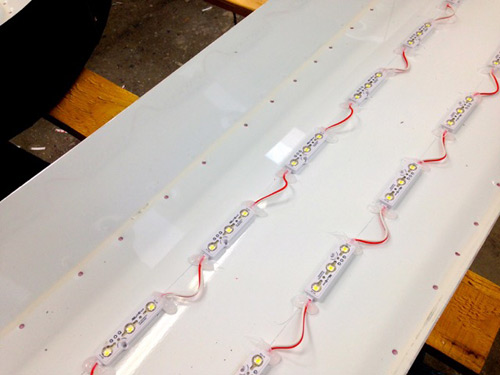
LED lighting units take up far less space and consumer far less power when replacing neon in signs.
(Me) How does LED compare with neon?
(Ken) “To begin with, there’s ease of installation. LED is a lot easier and a lot faster to install. With neon, you have a technology that uses very high voltage — which means you have to be much more careful with it. If something goes wrong with the wiring, it can be destructive. Also, when you install with neon you invariably have some damage due to mishandling. It’s much more fragile than LED — especially if you have to travel some distance — and that adds to the cost.”
(Me) How has the cost differential changed over the last three years?
(Ken) “Three or four years ago, the initial cost and installation of LED was about the same or perhaps a little more than neon — until you factored in service and breakage. Since then, however, the number of suppliers has really pushed LED prices down quickly.”
(Ken) “It’s a no brainer, really. As soon as you tell customers that maintenance is virtually nil, and that power consumption is considerably less, the sale is done — especially if that customer has been around long enough to understand the cost of service over time. It really boils down to a total cost of ownership issue.”
(Me) How has LED technology changed?
(Ken) “The most significant technology change has been with the color white. In the past it was hard for producers to get a good white LED. For one thing, white produces a lot of heat, so they used to have big aluminum heat sinks with these lights to offset that. Another disadvantage was that the light itself wasn’t really white. If you held it up against something that waswhite, the LED color looked more yellowish or greenish. In addition, the beam spread was narrow. Now there are better spectrums of white, the beam spread has improved, and the size of the bulbs has come way down. This is important because we use a lot of white in our signage designs.”
(Me) How do these improvements in LED technology affect design options?

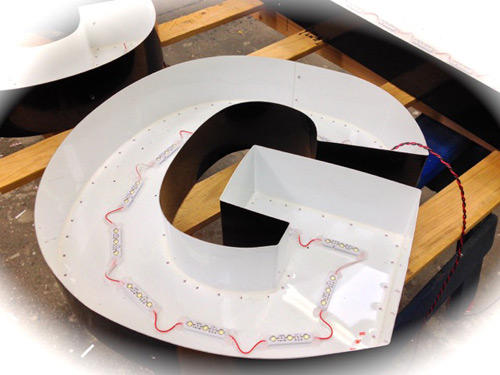
These channel letters reveal just why LED is a lot easier to work with than neon tubes.
(Ken) “Sure, although most of our neon business is now in service rather than new signage.”
(Me) What is the most important thing that business owners should consider when thinking about LED signage?
(Ken) “While the most obvious benefit to LED would be that power consumption is considerably lower, the biggest factor is really maintenance. With LED signs, maintenance is virtually non-existent. By contrast, maintenance is really expensive for neon. You can’t ‘repair’ a damaged neon tube, you can only replace it — and that cost adds up, along with energy consumption, when compared to LED. From the standpoint of total cost of ownership, I just wouldn’t consider using anything else.”

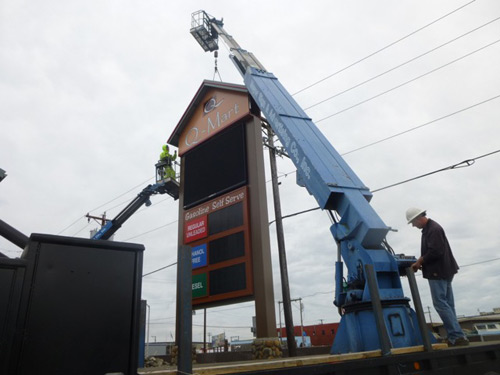
Installing a new sign. Take note of the red border along the peak of the sign’s top. That is actually LED.
Compared to neon, LED is easier to install, far less expensive to maintain, and costs less to operate. So what’s not to like ?
