“A part of the 1962 World’s Fair is still with me. . .”
John Meyer, the founder of Meyer Sign & Advertising, must have had a knack for marketing. If not, he certainly had an instinct for pitching a story — as is evident in the opening line of the March 1987 letter toThe Seattle Times relating his personal association with the Seattle World’s Fair, on the occasion of its 25th anniversary.
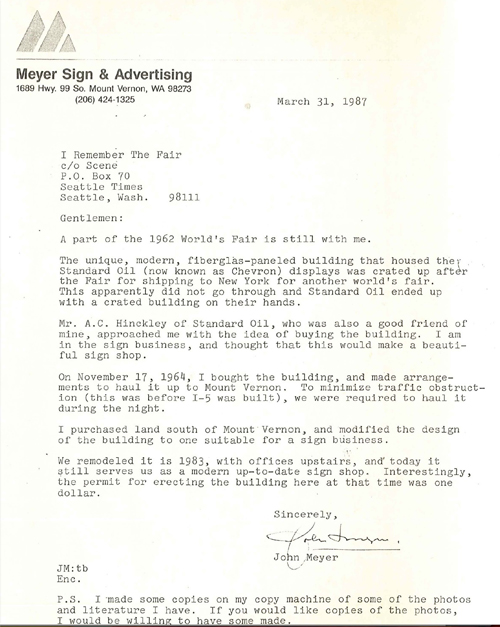
If John’s story failed to translate into print, it’s not that it didn’t deserve to. It may just be that it lacked sufficient “provenance” — a concept familiar to fans of Public Television’s Antiques Roadshow. If that was, in fact, the case, then think of this blog as an exercise in setting the record straight — or at least more complete. At it’s heart, however, it’s less a story about a physical connection between a Mount Vernon sign company and an event that made Seattle synonymous with the 21st Century than it is about a relationship between two businessmen — and how we used to think about “doing business” half a century ago.
Clients and Friends
John Meyer and A.C. (Arnold) Hinckley’s relationship began the way many client/vendor relationships do: with a sales call. Tonnie Boer, John’s daughter and the wife of current owner Martin Boer (John sold the business to his daughter and her husband decades ago) remembers Hinckley’s response to her father’s cold call as, “Who the heck is John Meyer?” To which her father gamely replied, “Who the heck is Arnold Hinckley? I just want to meet with you.”
“Hinckley got a kick out of that,” Tonnie recalls, “and agreed to a meeting.”
Martin Boer suggests another reason that his father-in-law might have broken through Hinckley’s seeming reserve. “John had that ability to engage people, and they were quickly taken with him.”
Given Hinckley’s role as a regional operations manager in Standard Oil’s marketing department, John was fortunate to win his business, but in the process he also won his trust and friendship. Martin remembers traveling to Seattle with heavy equipment provided by Meyer to install a beam in the home Hinckley was building.
“John and Arnold had a unique relationship that pre-dated my joining the company, and we did a lot of work for Standard Oil,” says Martin. “We were involved in the image changeover to Chevron, and that generated a lot of sign installation and service work, which continued even after the World’s Fair.”
Chevron at the Fair
Otherwise known as Century 21, the Seattle World’s Fair of 1962 was all about a bright and shining future still nearly four decades hence — but that didn’t deter the event’s organizers from recruiting countries and corporations alike who saw the marketing potential in offering up glimpses of what that future held in store
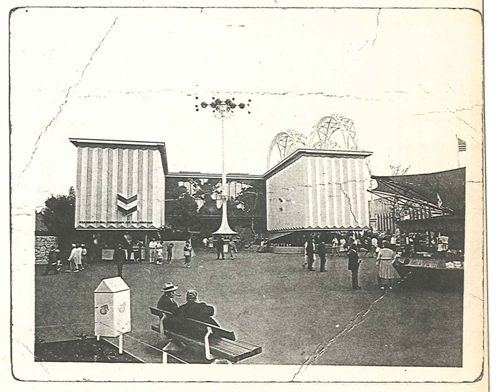
— a future in which they, of course, figured prominently. One such exhibitor was Standard Oil, who predictably dedicated their pavilion to better living through petrochemicals.
While history suggests that the Chevron exhibit didn’t generate the buzz that accompanied Boeing’s “Spacearium” (750 visitors at a time could take an imaginary 10-minute journey through the cosmos) or the State of Washington’s “World of Tomorrow” (including a vision of the “House of Tomorrow” some five months before the first Jetsons episode), it nevertheless pulled off a marketing coup by producing the official Century

21 fair guide. It should come as no surprise, therefore, that featured on the brochure, in front of both the Space Needle and the monorail, was Standard Oil’s Chevron exhibit. Whether or not Arnold Hinckley had anything to do with this feat, it was brilliant — and it ultimately ensured that Chevron outdid its corporate peers in “impressions,” if not actual headcount.
The Seattle World’s Fair ended on October 21, 1962. President Kennedy had originally planned to attend the closing ceremonies, but his aides had to excuse his absence two days earlier due to a severe head cold known today as “The Cuban Missile Crisis.” Had the outcome of that event turned out differently, the 21st Century might well have ended before it began.
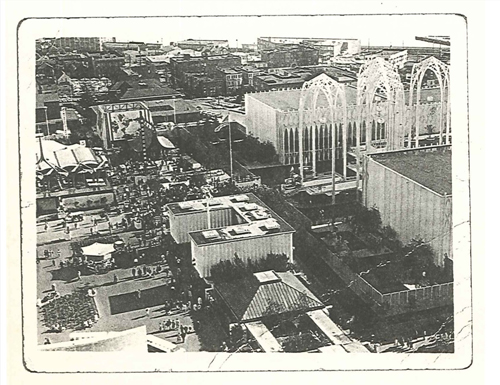
The end of the fair did, however, require Standard Oil to fold its tent and quit the Emerald City. While they crated up their exhibit with the intention of sending it to another event back east (presumably the 1964 World’s Fair in New York), transportation logistics scuttled those plans, and the oil company was left with an un-utilized asset that was taking up Seattle real estate.
No one at Meyer Sign & Advertising can say how it exactly happened, but it seems reasonable to conjecture that Standard Oil made the fate of their World’s Fair building a question to be resolved on a regional level — which would therefore have made it the purview of one A.C. Hinckley. That being the case, it would seem only natural that Arnold Hinckley would get in touch with his pal and sign shop owner John Meyer to see if he would be interested in a great deal on a unique building. After all, what are friends for?
Just how the deal went down with the sale of the Chevron World’s Fair building to Meyer Sign & Advertising is lost in the mists of time, but a letter from Standard Oil acknowledging the transaction (note the old school letterhead) is dated November 17, 1964 — which means that the building had been gathering dust at a
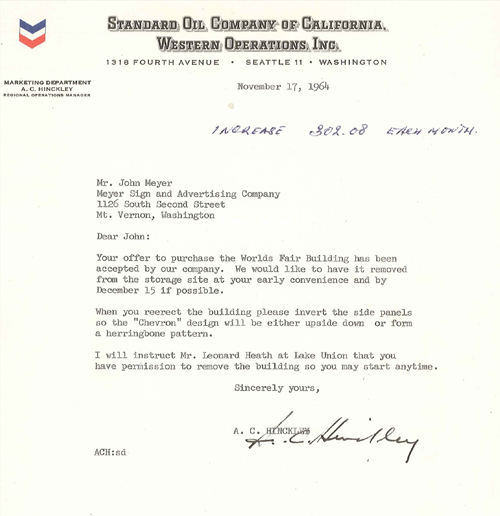
North Lake location in Seattle for two years. The subsequent bill of sale, pictured below, is a model of legal brevity that makes you wonder how many square feet of office space the Standard Oil legal department took up at corporate headquarters. If this was a typical legal document, a broom closet might have sufficed.
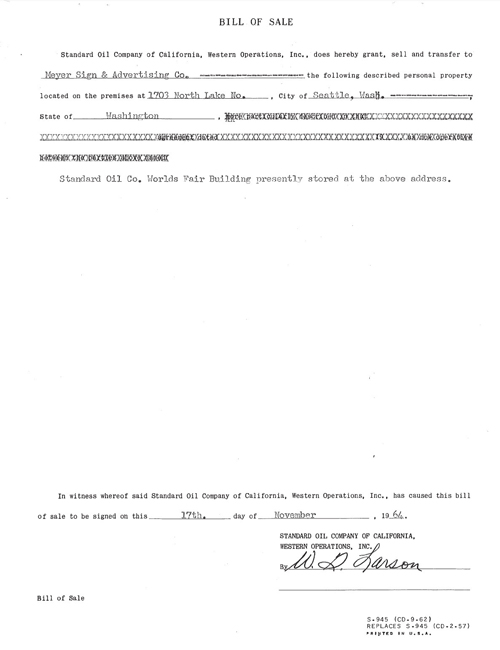
We could tell you what Meyer Sign & Advertising paid Standard Oil for a dismantled World’s Fair exhibit, lock, stock, and flagpole, but then we’d have to kill you. Suffice it to say that the price was considerably less than that of the laptop computer with which this story was composed.
This is the House that John Built
At the time John Meyer was concluding his transaction with his friend Arnold Hinckley, his sign company was located in downtown Mount Vernon (some 60 miles north of Seattle, in what is known as the Skagit Valley), across from a former Greyhound bus depot. To pave the way for a business expansion, John purchased an acre of land at what is his company’s current site off Old Highway 99, and got a building permit from the city of Mount Vernon. Proponents of “small government” should take note that the cost of the permit was one dollar. That’s right…one dollar.
Once dismantled, the shell of the Chevron building was made up of 20×20 squares. “We had to make a few trips at night to get all eight squares,” Martin remembers. “We had a wide load, so we moved them at night to lessen our impact on traffic.” The sole instructions Standard Oil provided for reassembling the building were as brief as the bill of sale: hang the panels upside down so the pattern is not obviously a chevron– compelling evidence that the concept of “brand management” pre-dates the late 20th Century.
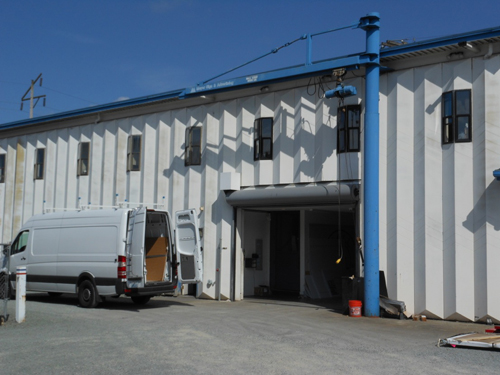
With a bit of engineering consulting, John determined the foundation needs of his new shop, and put it together piece-by-piece. As Martin recollects, “It was just a shell in the beginning — we drove trucks through the center. Over time, we added a floor for office operations and further extended the fabrication area, so it’s gone through quite a transformation — but it’s held up. We’re due to repaint and refurbish it.”
An Interesting Story
As we come to the end of this narrative, we go back to its beginning and revisit the question of John Meyer’s marketing savvy. As a good salesman, you might think that his motivation to buy a building from the 1962 World’s Fair, rather than build from scratch, would come from recognizing its intrinsic PR value. Martin, to the contrary, believes the reason was simpler than that: his father-in-law wanted to expand, and he knew a good deal when he saw one. And, of course, there was the added bonus of helping out a friend.
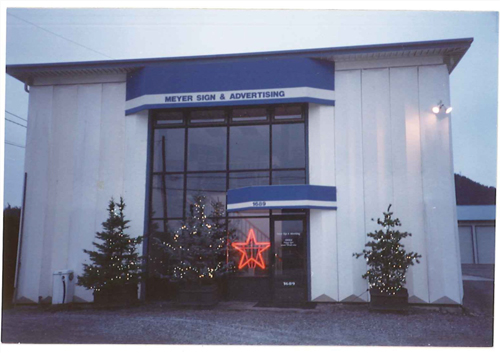
Although John refrained from promoting his company’s Skagit Valley link to the Seattle World’s Fair (his 1987 letter to The Seattle Times notwithstanding), Martin admits that John, “liked that it made an interesting story.” So John, we hope we did the tale justice; and if any of A.C. Hinckley’s descendants happen to be reading this, we hope you’ll share your side of the story as well. Like John Meyer and Arnold Hinckley, it’s truly one of a kind.